Wednesday, July 4, 2012

Some photos from Owi to the Philippines (83)

    Here are a few photographs from Gene's collection.

On Owi:

Lt. Joseph Davis getting his mail from Sgt. Ahern on Owi,
Dutch New Guinea

A hut on Owi, Dutch New Guinea, at sunset

Officers' tents on Owi, Dutch New Guinea

In the Philippines:

Ruined bakery in San Fabian, the Philippines (note Gene accidentally
reversed the negative)

Turnips for sale at the market in Guimba, the Philippines

Gene's washstand (a device to hold his helmet) in Baguio, the Philippines

Cub ambulance service airplane in Baguio, the Philippines: "Goldberg's Angel of Mercy sponsored by the students of Goldberg Elementary School, Detroit, Michigan"

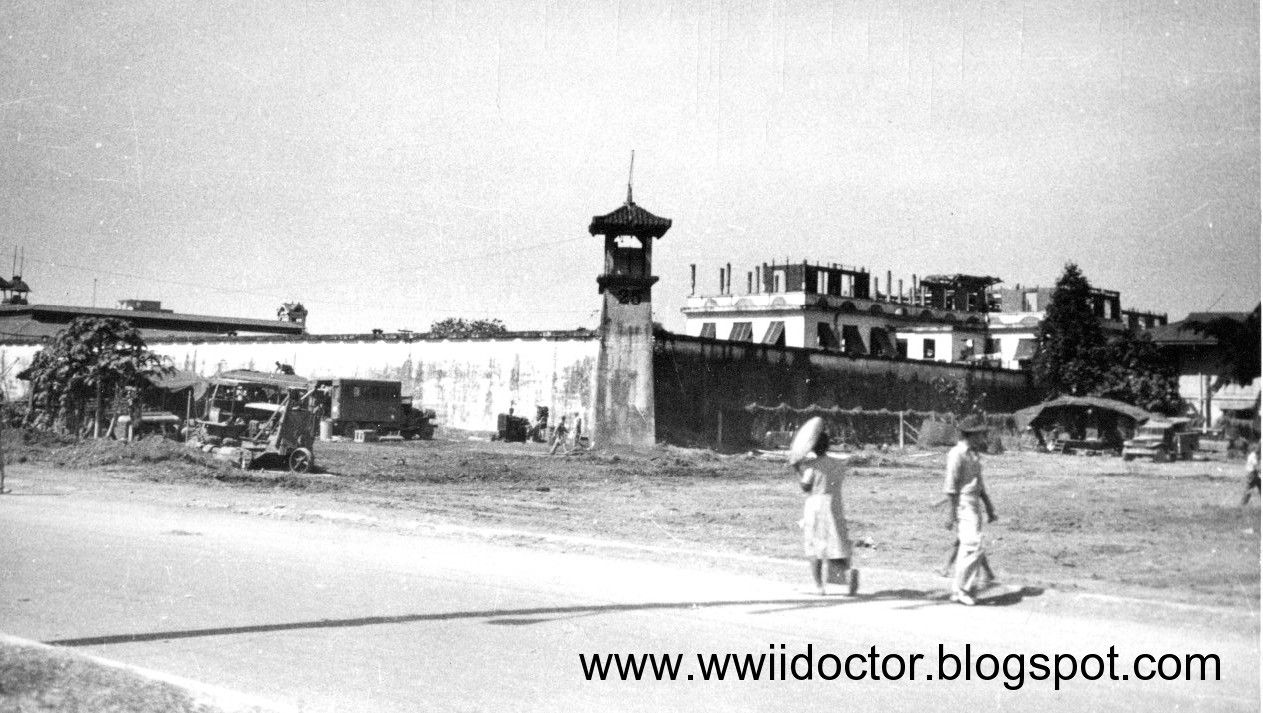
Bilibid Prison in Manila, the Philippines

A line of Igorot girls looking for lice in Caba, the Philippines

Granary in Caba, the Philippines

A view of Mount St. Tomas from Caba in the Philippines

Some photos from DTC to Biak (82)

     I'm going to be on vacation for a couple of weeks, so here are some photos that didn't fit in elsewhere.  I hope you enjoy them!


From the Desert Training Center:


Near Freda looking toward the Chuckwalla Mountains
Members of the 92nd Evacuation Hospital lining up for innoculations

In Australia:

Australian soldiers riding bicycles near Rockhampton


Rockhampton train
Australian men working in the train yard in Rockhampton

In Hollandia:
Piece of a  wrecked canoe near Hollandia Gene sent through the
 mail to Beth

Carvings on the other side of the piece of wrecked canoe

Some of the enlisted men of the 92nd Evac (they look like characters in the musical,
South Pacific, don't they?)

Japanese supplies


On Biak:


Looking from the beach road on Biak up to the the Japanese
bunkers dug into the cliff


Japanese bunker on Biak
Major surgery tents on Biak
Minor surgery tents on Biak
Ward tents on Biak


Capt. Hiram Armstrong's fox hole on Biak


Monday, July 2, 2012

First Impressions (cont.) (81)


     Gene's letter to Beth continues with his impressions of Japan.  He had treated Japanese soldiers and picked up many items of clothing, photos, post cards, etc. they had left behind.  He had also read all the information provided by the army about Japan, but that wasn't the same as experiencing the country first hand.  As long as he couldn't go directly home to his beloved wife,  Beth, he wanted to see the situation for himself and take photos of ordinary things.
Smiling family (the man is tipping his hat) in Wakayama with cars parked in the background on the left side of the street

15 Oct. '45 [continued]
    
     We went on down the street, on which the car tracks ran. They drive on the left side. There were a fair number of civilian cars and trucks - some charcoal burners and 3-wheeled motor cycle affairs. At intervals we would look at stationery shops, radio shops, etc. All of them were more like junk shops than anything else.
     In some of the home shops we stopped in I looked at their living establishments. The first room off the street-level shop room was raised about 2 feet and covered with straw mats. They stepped out of their clogs when entering it. They sat on flat cushions or pads. There was always a large urn (about 2 feet high and 2 feet in diam.) full of sand in which charcoal was placed. If there was a table, it was low. They sat cross legged. Eating, of course, was accomplished with chop sticks. Understand all these were poor people's homes. Out in front might be a couple of dozen pieces of kindling wood drying, or some chicken manure carefully gathered together on a piece of paper, or some sawdust!
     When you'd go in a place they might have on display a bowl or some wooden buttons or fancy hair pins! Kimono prices were something - 2 or 300 yen [$13 to $20] for punk-looking stuff. We passed a few shrines - torii gate, stone lantern pedestal, upright stone tablets. I saw one temple that was off limits but got some good pictures - the horrible looking figures you see in museums, a curved roof affair and black with age. The walls were open around the gates so I wasn't trespassing (t'ain't healthy!)

On the back of this photo Gene wrote: "Stone lanterns.  Steps beyone the Torii lead up to a hill-top shrine.  Woman behind the post of the torii is stretching & drying an obi (sash worn about the kimono) after washing it."
     The further south we went, the better the shops became.  Several times men would stop us and ask if we wanted to look at things.  So several times we sent down devious narrow streets and alleys to go to more private homes to look at more kimonos!  Most of the nice appearing places were surrounded by stone or stone and 'dobe [mud] walls.  Most of the homes had heavy tiled roofs - rather ornate - the tile being almost black in color.  There were pine trees (small versions of our Ponderosa pines) and ones that may have been cypress, all about - none very large.  There were small hills along some of the streets and not much of the area was thickly built.  The houses were mostly of unpainted, weathered wood.  They had garden beds stuck everywhere.
     Finally we began to find lacquer work in the stores.  We took a narrow side street and it turned out to be a short cut to where we wanted to go.  I had 2 packs of cigarettes and he finally traded for 2 lacquer rice bowls and covers that aren't very fancy.  The guy wanted 45 yen [$3] each for them to start with.  Of course we aren't supposed to barter but it is practically impossible to get a thing otherwise.
     Down at the end of the street, we were directed to the pier - where we arrived about 1 P.M. and our boat didn't leave until 5:30.  We just happened to talk to the mess officer of the base [the officer who procured food and oversaw its preparation] and he said to go to the officers' quarters and go to the mess.  We looked in where the field grade officers [senior to company officers but junior to general officers, i.e. major, lieutenant colonel, and colonel] stay.  You have to take off your shoes to go in!  They say the officers sleep on regular floor-level Jap beds and like it!  There is a rack for their shoes!
     We went into the mess and didn't have to go barefooted!  Along this water front is quite a resort spot, with fancy hotels built along the cliffs over the sea.  These places were supposed to be visited by members of the Royal Family at times.  The mess hall was a former private theater with beautiful screens and a marvelous stage curtain all hand embroidered and stitched.  These places had windows from the ceiling to the floor on the sea side.  We were served by Jap girls who knew a few words of English.  Then we sat a while.  I used the latrine.  What a spot!  There were conventional urinals, but the stool was a fine heavy porcelain oblong box set in the floor, complete with a curved shield at one end and self flushing.  A neat trick, that!
Toilet stool in the floor at a theater in Wakayama that had been converted to the mess hall

     Then we went along a wide curving walk, thru 2 short tunnels, with homes, hotels and shops along the way.  The whole place swarmed with sailors at that time of day.  At 3:30 we were back at the officers' club and had a few drinks, then came back at 5:30.  Yours truly feeling quite light hearted and gay [in other words, he'd had a couple of drinks!]
    The Major bought a pearl.  I'm not certain but what it is a fake.  He paid 3 packs of cigs for it and it is as large as a fair sized pea.  So ended the Odyssey.
     All my love, Eugene

Friday, June 29, 2012

First Impressions of Japan (80)

     Gene finally gets to go ashore.  He is interested in absolutely everything!

A Japanese women on the street in Wakayama
15 Oct. 1945
Beloved,
     In later years I want you to remind me that this birthday marked my Jap beachhead!  We left the ship about 8 on an LCVP [landing craft, vehicle, personnel].  We called at another ship and then went on up the inlet.  The map showed "an old fort" and "a fort" on each side of "the creek" (for size) but I couldn't make out a thing but a small hill.  The factories which we passed (which we'd seen from the ship) are really huge affairs - possible steel mills.  We went up this inlet about a mile and landed at a sort of dock.  I talked to the crew man and he said this wasn't the regular place to land, but some Lt. Col.s wanted off there.  I was the only one not getting off there so decided I could at least stick with the others!  Besides another Major had a map!  Well, these Col.s wanted to go to Osaka 20 odd miles north.  They got a truck to go to Headquarters first and we rode along.  We ended up in the so-called Kobe Headquarters in Wakayama, about 8 miles north of the place where the regular shore landings are made.  It was across the street from an old castle area, now a reservoir.  In places there was a moat about 30 feet wide and a stone wall 20 feet height around a small hillock.  We went into the Hq. and procured more maps and found out where we were and where we wanted to go.  It was plain sailing after that - one street to follow south.  The mess officer Lt. and the other Major and I teamed up.
     The people - what a sight!  Out of thousands of women, I saw maybe 5 that wore skirts!  90% wore a variety of pants and about 10% wore kimonos.  The pants are amazing.  Imagine a cloth of gray in a pattern of squares - a kimono top with full sleeves closed at the wrist with elastic, tucked inside pants which are fairly voluminous at the waist and a very baggy seat, tapering sharply to a jodhpur-like leg below the knee, closed with elastic about the ankle!  The feet encased in white cotton "shoes" with a separate toe and wearing a wooden clog with two cleats.  Some kimonos were worn by elderly men, but most men and boys wore a variety of army uniform.  Did I take pictures!  About 30 black and white.  Mostly of people, too.
Wakayama street cobbler wearing army-like clothing
     Bicycles were everywhere - men and women riding them.  Some kimonos were made of a heavy material like the material in men's suits.  Others were every conceivable figure and material, as were the pants affairs.  I saw several slack suits, dark material and of a state side style.  Some kimonos have a sort of bustle affair - like a flat, oblong sofa pillow, tied to the small of the back with a wide colorful sash!  Babies are carried in a sling on the mother's back and seem perfectly happy.  It is alarming to see the angles their heads take when they sleep!
     The street cars (off limits to troops - no room anyway!) are crowded something remarkable.  People hang on the front and rear cornices.  They have real-sized horses (Gene objected to the small ones the Filipinos had - B [Beth added]), a few hauling long carts.  Any time you go down side streets, and often on the main streets, there is a marked odor of feces!  The honey bucket carts (drawn by hand) are prevalent and unmistakable!  There were quite a few bombed and burned out places - all interspersed with gardens, and lots of wreckage already cleared.  We saw a few modern buildings.  Some people were quite pleasant.  Only a few looked sullen.  Many just looked straight ahead.  Most of the women and girls looked discretely down at the ground.  The youngsters, as anywhere, were quite boisterous.  We came past several batches just returning from school.  They came romping along and shouted "hello" and laughed and smiled.  A few of the shop keepers would bow to us.  In all, it was hardly a conqueror-vanquished relationship!
Wakayama children going home from school

     Well, the Major had some business to attend to, so I stood outside and took pictures of people.  Then we caught a ride about 2 miles on our way (a regular army bus line from HQ. to the billets) and then we started walking.  I certainly laughed at this Major.  He has been overseas just a few months.  He's about 45 - has sons 18 and 21.  Well, he had to look into every place even remotely resembling a shop to try to buy a kimono.  We went slowly, needless to say!
     I spent most of my time out on the street looking and taking pictures.  When you stopped to look, a small crowd would gather.  It you went into a shop (just hole-in-the-wall places) they closed the sliding door and offered you seats and then the parley began.  All these shops were very, very poor - a handful of goods only.  One could do well with our Jap phrase books (Gene wrote before he left the Philippines that he had looked thru the book and decided to learn just 2 phrases - "how much" and "that's too much"! - B).  The natives could turn to the appropriate pages as well as could we!  Prices, of course, were outrageous.  Everyone had rolls of yen notes and weren't interested in selling for money.  They wanted to trade for candy or cigarettes.  The standard exchange is 15 yen for a dollar.  Well, the kids on the street would cluster around offering 10 yen for a pack of cigarettes!  The usual price was 20 or 30 yen.
    
     Gene's letter is so long and enthusiastic (and with so many photos!) that I am going to break it off here and continue it in the next post.


Wednesday, June 27, 2012

Geisha (79)

     Japan had flirted with democracy since the mid 1800's, but the feudal system was difficult to change and the military forces often overpowered and overruled the civilian ones.  After the surrender of Japan in 1945, the Allied Powers decided the whole military structure of Japan would have to be abolished.  The United States and Great Britain were both democracies, and believed a self-governing, democratic Japan would be more likely to remain peaceful than a dictatorship.  General Douglas MacArthur was named Supreme Commander of the Occupation forces to oversee the changes necessary to bring Japan to democracy.  A new constitution was needed.  Civilians, who had been shocked and disillusioned by their military leaders, were open to learning about democracy if it meant better lives for themselves.  The education system was revised to teach and support the fundamentals of democracy.  The goal of military dominance was replaced with a goal of economic growth.
     In 1939 the total population of Japan was about 71 1/2 million people.  Around 4% of the population was killed in World War II (about 80% of the deaths were military, and the rest civilian).  Although the military was abolished, many of the social structures would remain.  One custom needed to be explained to the incoming soldiers: the geisha system.  The article that follows is what the Japanese authorities submitted to the U.S. army, and the army submitted to the men of the 92nd Evacuation Hospital.

REPORT OF PREFECTURE (Gene added "Nagoya" ) TO THE U.S. ARMY:
THE ORIGIN OF "GEISHA"
     In olden times there were some women who served as dancers or musicians in the grounds of Shinto Shrines.  In the course of time some of these women became dancers or singers in hotels and restaurants.  They entertained the men who came to enjoy their time.  Then some of them became "Geisha" and some unlicensed prostitutes.
Gene's photo of a Japanese entertainer playing
the shamisen
     "Geisha" were invited by hotels and higher-class restaurants and they entertained men as singers and dancers with the accompaniment of "Shamisen" (a kind of musical instrument).  Before the China Incident  [Japan claimed it was involving (conquering) other Asian countries for their own good to get rid of Western influence, and the objection of the Chinese was an "incident"] there were many "Geisha" but since the outbreak of the Great East Asia War the number has been decreasing [they were needed in the factories] and in March 1944 they were forbidden to do their business by orders of the Government.  Then some turned to be unlicensed prostitutes.
     In this prefecture the measures of licensed prostitutes were taken away and all the women who serve in hotels and restaurants have been treated as "Geisha".  The authorities are now preparing to give license to 3,000 as "Geisha" to entertain visitors to the city.

The outline of the regulation on "Geisha" as we said they served as singers of dancers in hotels and "Ryoriya" (restaurants) but some became prostitutes so generally now "Geisha" girls are thought of as street girls.
1)     1. They must have a license from the police station, and live in a certain limited places.
2)     2. Those who come to one of the following items can not become "Geisha"
             a)  Under fourteen years old.
             b)  Those who are suffering such diseases as leprosy, lung disease, veneral [sic] or other                 infections diseases.
             c)  Those who are regarded as bad for Society.
             d)  Those who are regarded as unfit from the authorities.
3)     They must obey the orders of the head of the police-station.
4)     They must take physical examination at on appointed time.
5)     They must keep the rules of the authorities on preventing the social evil disease.
6)     The customers of "Geisha".
They are not called their own names they have special names and those names are used.  The masters of hotels or Ryoriya (restaurants) called "Geisha" their daughters and they ("Geisha") - call the masters as "Father Ottssan" or Nissan (brother).  This shows their relation is intimate, for the masters have all responsibility about "Geisha".
Gene's photo of a young Japanese woman, possibly 
a geisha

The visitors call when they come the second time, the "Geisha" that he called first.  They often hear the lectures on social evil diseases and know how to prevent the diseases.  They are afraid to be stopped their business by orders of the authorities, so they keep the rules made by the local governments. 

          Rules made by the Prefecture to prevent social evil diseases.
               1.  She must not use the same cup of the visitor, don't kiss the man.
               2.  She must us sack. [condom?]
               3.  She must use preventative medicine.
               4.  She must wash her vessel after she used it.
               5.  If the visitor has some disease she may refuse.

Meirakuen (Formerly licensed quarter) about three years ago in the center of Nagoya that is on the grounds of Osu temple the lord at that time allowed to have a licensed quarter that was the origin of the licensed quarter.  But in 1921 the quarter moved to Nakamura.  There were about 138 houses, number of the licensed women were many, men went to enjoy their lives.  Since the China Incident the number has become less and less.  When the war began there were about two hundred licensed.

In September this year all licensed women were set free, so most of those women became "Geisha" so some of the "Geisha" in the Meirakuen can play and dance well, but some are not so well.

To entertain the Allied Occupation forces or citizens they are preparing to have 2,000 Geisha and about 100 restaurants in that quarter.

          Statistic:

Age     Number          Age     Number          Age     Number

17       3                     24      30                    31      0

18      4                      25      16                    32      4

19      1                      26      17                    33      1

20      16                    27      8                      34      0

21      11                    28      13                    35      1

22      38                    29      7                      36      0

23      45                    30      6                      37      0

                                                                    38      0

                                                                    39      1

             Total:             223 [I count only 222]

Education:
No schooling:                   6
1st year                             0
2nd year                           6
3rd year                            8
4th year                            4
Finished primary school  17
Kotoka [?]- 1st year          3
Kotoka finished                12
Finished higher girls
     School                         5
                 Total 223 [I counted only 61!]

41 Geisha cannot dance well
50     "       cannot play or sing well

     What followed was a long list of co-partnership descriptive.  I have copied only a few.  All peculiarities of English and lack of punctuation are theirs!

1. Position                                                 Yakkodori, Toyohawa, Toyokawa City.

2. Name of co-partnership:                                        "Enpukuso"
3. Name of it's representative:                   Kiichi Nomura
4. Number of shops:                                  20 shops
5. Number of girls:                                    65 girls
6. the fee of girl:                                        Short time (half an hour)        Y30.00 [about $2.00]
                                                                         One time (one hour)               Y40.00
                                                                                All night (11 p.m.-8a.m. next morning
                                                                                                                    Y150
Remarks:
          6 shops are in good condition, but 42 shops burnt down by
          Air raid on the 20th June, 1945, and now building up
          Those new houses in the same ground.
"Meirakuen" or "house of licensed prostitution" in Nagoya


Monday, June 25, 2012

Planned Invasion (78)

     Details of the planned invasion of Japan if the atomic bombs hadn't been used were revealed to the public via the Associated Press:
Map showing the island of Kyushu

TWO LANDINGS ON JAPAN WERE PLANNED: Initial Force Was to Go Ashore on Kyushu Nov. 1, With Second Disembarking in Tokyo's Dooryard About Four Months Later
     Washington, Oct. 10 - (A.P.) - The unneeded invasion plan for the Japanese homeland called for an all-American effort, with one force going ashore on [the island of] Kyushu about Nov. 1 and another landing in the dooryard of Tokyo about four months later.
     Details of the double-barreled strategy - code designated as "operation Olympic" and "operation Coronet" - were disclosed Wednesday in the biennial report of Gen. George C. Marshall.  He wrote that "these were our plans for final victory in World War II should Japan fight to a last ditch national suicide."
     The report taken together with available information on troop strength, indicated that the plan was to attack the homeland with numerically inferior forces.  This had been the plan for virtually all other operations in the Pacific, reliance being placed on superior firepower by land forces and support from naval gunfire and aviation. 
     Marshall said that the Japanese had husbanded an army of 2 million men to defend the homeland.  He did not give the American strength in manpower, but discussed it in terms of divisions.  On the basis of 15,000 men to an infantry or marine division, with smaller numbers for armored, air-borne and cavalry divisions, somewhat more than one-half million men were accounted for.  Units attached to divisions for special purposes and service [such as the 92nd Evacuation Hospital] and engineering forces would about equal the total of the divisional strength bringing the total forces used in the two operations above one million men.
     This force, of cource, would not have included the thousands of naval personnel manning the supporting fleets and transports nor the air forces participating in the operations.
     Marshall's accounting of the divisions to go ashore in Japan mentioned none other than American army and marine forces, indicating that although the British may have had plans for naval support of the invasion there were no arrangements for British or other Allied participation in the actual landing operations.  Marshall said that Gen. Douglas MacArthur, in co-operation with Adm. Chester Nimitz, was prepared to execute two plans for the invasion of Japan:
Modified scheme of maneuver map, Operation Olympic in Victory and Occupation: History of U.S. Marine Corps Operations in World War II by Frank Shaw
Shoulder insignia of Sixth Army
Shoulder insignia of First and
Eleventh Army Corp
      "The first, known as operation Olympic [Gene's underline and comment: (we were due to land at "H+4 of D day!) [4 hours after the first landing]] provided for a three-pronged assault on southern Kyoshu in the fall of 1945 (Marshall previously had mentioned Nov. 1 as the date) by the Sixth United States army, consisting of the First and Eleventh army corps and the Fifth marine amphibious corps.  Three groups were to land in the order named at Miyazaki, Ariaka Wan and on the beaches west of Kagoshima to isolate the southernmost Japanese and destroy the defending forces there.  Preceding the main assault were to be preliminary operations in Koshiki Retto and a diversionary feint off Shikoku by the Ninth corps.
     "The second phase of the Japanese operation, operation coronet, was to be carried out in the early spring of 1946 (An attached chart bore the notation "To follow Olympic at about four-month interval.")  The Eighth and Tenth armies, consisting of nine infantry divisions, two armored divisions and three marine divisions were to assault the Kanto or Tokyo plain of eastern Honshu.
     "These two veteran Pacific armies were to be followed ashore by the First army, which had spearheaded our victory in Europe and was now to be redeployed for the final battle of the Pacific.  In this attack the First army would have contained ten infantry divisions.  The three armies had the mission of destroying the Japanese army on the main home island and to occupy the Tokyo-Yokohoma area.
     "On Kyushu we would have held a one-corps reserve of three infantry divisions and one air-borne.  From here the plan was to fan out to the north and clean up the remainder of the Japanese islands.  Supporting the cleanup would ultimately have been an air garrison equivalent to fifty groups."
     Marshall said these were the plans for invasion "but we had other plans which we anticipated might bring a much speedier end to the war" - the atomic bomb.
     Said Marshall of this: "The results are well known."

    Next up will be the information about Japan and facts the army gave all of the occupation soldiers about the geisha.

Friday, June 22, 2012

Biding Time (77)

     Maj. Eugene Pfile liked to be busy and hated waiting around.  When he had time and weather cooperated, he took pictures of ordinary things. He bought leather and made various articles, such as fringed buckskin vests for himself and Beth in the desert, and a kangaroo purse for Beth and a camera case for himself in Australia.  In the Philippines, he got the necessary chemicals and developed his own photographs.  Lots of the men played cards or gambled, neither of which appealed to Gene, although he did enjoy an occasional game of chess.  The card players had plenty to do on the boat, but Gene didn't.  He read (fortunately the ship had a good selection of books available!), wrote letters, and bided his time until he could be out exploring.
USS James O'Hara, the ship that carried the 92nd Evac Hospital to Japan

6 Oct. '45
Beloved,
     What a merry-go-round!  First we were going to anchor at Wakayama at 6 P.M.  Then they decided to make it 6 A.M. tomorrow morning, so we turned around and went directly south for about 6 hours.  Now we are going north again.  But the worst part is, we may have to stay on board for 8 more days [it turned out to be more]!  Words fail me.  Why if that is true it will be downright criminal!
     Supposedly, the Navy doesn't have the harbor swept - held up by the weather.  I'll say no more for fear I'll scorch the paper.  The sea has been smooth today.  I've read and yawned and paced up and down.  Such a life.  We had a punk Dagwood picture this evening.
7 Oct. '45
     So this is Japan!  We are now well into the inland sea and are strung out single file, going along a wide buoyed lane.  We should be at Wakayama in an hour.  Golly but these are a rugged, rocky set of islands!  They looked just like New Guinea from a distance.  Closer up you can see the bare rock hill tops.  There are lots and lots of small to tiny islands of rock.  The high ranges are hidden in clouds.  It is overcast with a downright chilly wind.  Are the aspens turned already?  I suppose they are.
8 Oct. '45
     That was a good picture show but it had a sad ending.  It was "The Woman of the Town" - a story of Bat Masterson and Dodge City.  The heroine was killed in a gun fight.
     We are quite comfortably situated, thank you!  On this darn boat!  The only time I'd want to be a sailor would be for shore duty!  But it is better sitting here than in Lingayen Gulf.
     It was cloudy and rainy all day.  The water is quiet as a mill pond.  There are shore parties of the crew going ashore every day for a few hours.  We [the 92nd Evac] have to stay put.  We will see enough later, I suppose.  They claim we will pull right up to the dock at Nagoya.
   Here is a good one.  Last evening in a bull session about vacation spots, resorts, etc., I said that was the thing I liked about Colorado - that if I took an afternoon off, in just an hour I could be out in the wilds.  With one breath, [Maj.] Joe D. [Davis] and [Warrant Officer Jim] Colvin (Californians, Beth adds) said, "What takes you so long in that place - you can just walk out, can't you?"
     I kept busy all day.  The work details were all changed to even up the work.  It should go smoother this time for I'm keeping all the officers.  The men have done a very good job.  Decks are swept 4 times a day.  Everything in the whole ship is swept and mopped once a day.
     We saw several small Jap fishing boats today with 2-3 men in them.  The boats are peculiarly shaped - sharp prow, heavy wood, and powered by a one cylinder engine.  I've been reading some of Ibsen's plays.  I enjoyed "The Doll House", thought "The Master Builder" a bit odd, and "Peer Gynt" absolutely crazy!
Oct.9, '45
     You should see me - all tonsorialled fresh!  We really are fortunate on this ship.  They allow us lots of privileges.  One of the soldiers has the use of the ship's officers' barber shop in the evenings to cut hair for the officers.  We moved anchorage this noon getting ready for another typhoon.  It is supposed to be passing about 100 miles from here.  I'll be glad to get ashore.  The typhoon season for these latitudes is supposed to be over, darn it!  This will further delay our landing, I supposed.  They say we will land at Nagoya on the 15th, but I'll bet we are delayed.
     It has been chilly and rainy all day.  When we moved this noon we saw 2 baby carriers [small aircraft carriers], 2 cruisers, a battleship and all kinds of destroyers.  We moved about 2 miles.  My new police detail is doing O.K.  I may have [Warrant Officer Jim] Colvin stay behind to police the boat.  I'm anxious to go ashore.
Oct. 10, '45
     Last evening I thought that by this morning I could tell you what it was like to be in a typhoon.  Thank goodness I can't though!  It passed about 100 miles from us.  We had a high wind all night with velocities up to 50 miles an hour, I guess, and the ship rolled and pitched a bit.  But the report is that at Buckner Bay in Okinawa the velocity was 131 miles an hour and that a number of ships were lost, probably landing craft.  So it goes.  We are lucky but I suppose it will further delay our landing.  We have been here 5 days now and it hasn't been all clear any of that time.  It hasn't even been clear enough for me to take pictures of the shore line!
     I read a few more of Ibsen's plays and now am reading "Oliver Wiswell" by Kenneth Roberts.  It is most interesting in that it presents the Tory colonists' side of the [American] Revolution whereby Benedict Arnold is a fine fellow and Ben Franklin is a skunk and a roué!!
     The police detail is running smoothly.  Golly but I'm tired of this boat!
Oct. 11 '45
     We were lucky in this typhoon.  It passed 100 miles from here at 0300.  I guess we had more wind than I thought.  There's an anemometer in the ship's --- [Beth couldn't read his handwriting when she was transcribing his letters] and it showed up about 90 miles an hour.  One of the ship's officers told me we dragged our anchor 3 times during the night, with the engines at full speed (ordinary cruising) ahead (77 revolutions a minute, maximum is 95).  It is remarkable that the ship didn't pitch worse.  The storms usually curve SE to NW, then back out to sea.  If this one had done that it would have hit us squarely.  I want to get off this thing before another comes along!  We are still slated to leave here the 15th and to land the same day.
     Now I have one of Frank Dobies books, "The Longhorn" [Gene's mother was very fond of westerns].  I've just started it.  This evening we had a show "Tornado"  It was a "drammer" [drama] of a southern Illinois coal mining town in which the tornado played a very small part!
     This is the darnedest life.  I usually get up[ between 6 and 6:30 - shower and shave and take a look at the weather.  Breakfast is at 7.  Then I read and loaf around till 9, when I start to think of the police detail - take a look around some of the decks.  Inspection is at 10 which lasts about half an hour.  I usually go thru the forward half of the boat (which contains most of our troops) with the Navy Lt. and one of the ship's doctors (there are 2).  On the rounds they go thru the kitchen and bake shops so I have a look to see what we will have for dinner.  Then I read till time for dinner at 12.  Then I read till I start to get sleepy (usually by 1 or 2!).  Then bunk fatigue until about 4.  Sometimes I don't even get sleepy!  Then more loafing and reading until supper about 5:30 and then more of the same.  I've played a little chess.  I figure that by the time I land, I'll have spent 2 1/2 months on board a ship since I got on at Frisco [it ended up being 101 days - more than 3 months!]
12 Oct. '45
     They turned the heat on us today - literally!  Yep, it was getting kinda chilly in our rooms!  There was quite a strong wind and it was cold.  But it did smell so good and fresh.  I'm certainly glad to be out of the tropics.  The latest word is that we will be delayed 3 days longer and won't land till the 18th.  Of course that gives time enough for another typhoon which would delay it longer.  There was an announcement in the Osaka paper that we landed on the 9th.
     They are holding Jap language classes on board!  I attended one and decided I didn't care for the stuff - I don't expect to stay that long!
13 Oct. '45
     I just now came down from the boat deck where I went to look at the moon.  It is about half full and fairly high in the west.  It is beautiful across the water, with all the lights of the boats - red, white and green.  There is scarcely a cloud in the sky.  The air is quite chilly but there is no wind.
The Nagoya harbor from the deck of the USS James O'Hara

     Today I was looking at the shore thru the glasses [binoculars] for quite a while.  It was beautifully clear and sunny all day.  It was chilly this morning and chilly in the shade all day.  I do like it that way for a change.  There is one low range of hills quite close to us that could be anywhere in the mountains of Colorado - scattered timber (pines, I suppose) and brush and bare and rocky spots.  The brush is turning various shades of brown.  Huge steel towers of the electric line stretch over the hills in 2 different directions.  NE of the area is a range of mountains that seems quite heavily timbered.  The blue haze is all about them.  For long distances up some of the hills are patches of terraces - all quite dark green.  We can't see a thing of the town.  There are about 25 or 30 huge, tall cement smoke stacks scattered in among the factory buildings.
     Today was another lazy, useless day.  There is a rumor around tonight that we may not land till the 24th.  Honestly, it is criminal that the Army doesn't work things out better.  If they wait long enough we will have another storm.
14 Oct. '45
     Tomorrow evening I expect to have something interesting to write for a change!  The C.O. of troops is allowing the Mess Officer and me to go ashore as a sort of reward for our efforts.  We expect to leave about 7:30 and to arrive about 8, and return about 11:30.  It should be interesting.  I hope the sun is out.  Today was another fine day.  It looks as though we won't land for another 10 days, darn it.
     All my love, Eugene