Showing posts with label 92nd Evac Hospital. Show all posts

Monday, August 20, 2012

Lists and Final Thoughts (97)

     Gene was a list-keeper.  I am including some of the lists he kept in his diaries, and will end this blog with a few final thoughts, although I plan to post occasional articles from magazines or newspapers that Gene or Beth saved, and more of Gene's photos.


DATES

3 July '42 - Reported to Fitzsimmons, Denver
25 June '43 - Left Camp Stoneman APO 4580
27 June '43 - Left Frisco
13 July '43 - Arrived Brisbane, Camp Ascot APO 4580
22 July '43 - Left Brisbane
23 July '43 - Arrived Rockhampton APO 926
23 March '44 - Left Rockhampton
24 March '44 - Left Gladstone
1 April '44 - Landed at Finschhaven APO 322
19 April '44 - Left Finschhaven
23 April '44 - Landed Hollandia APO 41
27 May '44 - Left Hollandia
28 May '44 - Landed Biak APO 920
12 June '44 - Moved to Owi
24 Dec. '44 - Left Owi & Biak
13 Jan. '45 - Arrived Lingayen Gulf, Luzon
17 Jan. '45 - Landed at San Fabian APO 70
21 Jan. '45 - Moved to Malisiqui
28 Jan. '45 - Moved to Guimba, Nueva Ecija
12 March '45 Moved to Agoo, La Union
3 May '45 - Moved to Baguio, Mountain
1 July '45 - Moved to Caba, La Union
5 Aug. '45 - [Gene to] 120th Gen. Hosp. Manila APO 1011
23 Aug. '45 - back to unit at Caba
25 Sept. '45 - On board APA 90 - the O'Hara
27 Oct. '45 - Landed on Japan at Nagoya APO 713
16 Dec. '45 - [Gene] went to Repl Depot at Okazaki
23 Dec. '45 - Sailed on Adm Rodman
3 Jan. '46 - Landed at San Pedro

ADMISSIONS

Desert, USA - 8 months                                              10,310
Rockhampton, Qsld., Aust. - 7 months                         7,466
Hollandia, Netherlands E.I. - 2 weeks                             760
Biak and Owi, N.E.I. - 6 months                                  11,963
Guimba, Luzon, PI - 6 weeks                                        2,520
Agoo, LaUnion Prov., Luzon - 6 weeks                         3,990
Baguio, Mtn. Prov., Luzon - 2 months                           3,048
Caba, LaUnion Prov., Luzon - 1 1/2 months                 1,800
                                                                                    41,857

BIAK AND OWI, CASES HANDLED [by Gene]:
MORTAR, ARTILLERY, GRENADE, RIFLE, MACHINE GUN)

Head - 60
Ocular [eye] - 19
Face - 41
Chest wall - 37
Chest (intrathoracic) [chest cavity]- 18
Abdominal wall - 17
Abdominal cavity - 22
Shoulder - 60
Arm - 45
Hand - 42
Buttocks - 36
Thigh - 67
Leg - 120
Foot - 29
Neck 31
Back - 36
Scrotum - 6
Misc. - 39
Total - 646

OFFICERS 3 JULY '45 - CABA, LA UNION, LUZON

Niemeyer, Williamson, Varley, Huey, Armstrong, Adams, Latum, Klockman, Coshak, Gentry Donovan, Swartz, Davis, Yount, Mancuso, Herrill, Jensen, Benesette, Vinicor, Dreiling, Nigg, Mihalick, Nethery, Burroughs, Colvin, Bernard, Free, Gray [and Pfile]; attached from general hospital - Connolley and Soll; had returned home in April - Neeb, in June - Ivers
[later] home on leave  in Aug. - Donovan, Dreiling, Adams, Burroughs, Mihalick

OFFICERS [in the desert?]

Lt. Col. Mathewes (Stanley W.) - Regular Army
Lt. Col. J. Sims Norman - Pueblo
Lt. Col. James F. Mason
Maj. Robert Sterling - Pueblo
Maj. Omer Rathman _ Billlings, Mont.
Maj. Paul M. Ireland - Pueblo
Maj. Merrill W. Michaels - Pueblo
Maj. Albert M. Tipple - Pueblo
Maj. Edwin W. Varley, Jr. - Pueblo
Capt. Hiram E. Armstrong - Pueblo
Capt.Edward A. Hagmann - Billings, Mont.
Capt.Conrad A. Lochmer - Oregon
Capt.Arthur H. Meade
Capt.Ernest A. Born - Prescott, Ariz.
Capt.Leland M. Evans - Sierra Madrea (Pasadena), Calif.
Capt.John Mihalick - Colo. Springs
Capt.Irwin I. Schatz - Pueblo
Capt.Richard H. McIlroy - Pueblo
Capt.Ward C. Fenton - Lamar
Capt.George C. Christie Canyon [sic] City
Capt. Harold J. Beck - Pueblo
Capt. Francis S. Adams - Pueblo
Capt. Arnold C. Niemeyer - Pueblo
Capt. Alton S. Hansen - LaJunta
Capt. John F. Terstegge - San Francisco
[Capt. Eugene F. Pfile - Trinidad]
Lt.William N. Baker - Pueblo
Lt. Monte N. Black - Seattle
Lt. Harold F. Harper - Ft. Riley, Kans.
Lt. Fergus R. Pingrey - Durango
Lt. James D. Salmon - Chicago
Lt. Joseph H. Davis - San Francisco
Lt. Edward S. Powers - Los Angeles, Cal.
Lt. Harley S. Fremming - San Francisco, Cal.
Lt. Walter S. Johnston - Pueblo
Lt. Carl W. Swartz, Jr. - Pueblo
Lt. Louis A. Motchan - Hollywood, Cal.
Lt. Raymond A. Nethery = Pueblo
Lt. A.L. Swanson - Pueblo
Lt. John Dykstra
2nd Lt. MAC Tatun
2nd Lt. MAC Klockner
2nd Lt. MAC Farmer
Lt. Gatauer [?Glautauer] MC - Swiss??
Lt. Lessner D.C. - Brooklyn
Lt. Mancuso MC - New Orleans

Gene on the beach at Owi

     Doctors are supposed to heal, and the doctors of the 92nd evacuation Hospital worked long and hard to fulfill that obligation.  Ed Gray, a supply officer with the 92nd Evac., recalled a scene at the 50th reunion: "In the tent, Black Jack was wrapping the broken body in plaster.  He was wearing a surgical hat and mask, dog tags, jock strap and GI boots.  Sweat was running down his back and around the sores from skin disease and jungle rot.  Brown streaks ran down his legs as it washed the residue of diarrhea from his backside.  The lights flickered and he swore at me and I resolved that we would never have lousy equipment again." 
     They worked hard and saved many whose descendents are alive today because of their dedication.  But they could not save all.
     Father Kilian Dreiling was the chaplain for the 92nd Evacuation Hospital for much of their time in combat.  Joseph S. Smith, son of  an enlisted man with the 92nd Evac., wrote a book about Fr. Dreiling (2004), Our Padre: the Inspiring Life and Stories of Fr. Kilian Dreiling, C.PP.S WWII Army Chaplain.  One job of Fr. Dreiling was to comfort the soldiers the doctors were trying to save.  Another was to prepare the dead, those they were unable to save, for burial.  In a sermon later in his life, he related "...the gory task became a holy task. ... Often the blood of my comrades  reached all the way to my shoulders.  As I carefully washed the sacrificial blood into the ocean, a tremendous flood of sadness and compassion  encompassed my entire body ... The blood now mingled with the eternal ocean, became the ultimate and total sacrifice my dead soldier would, and did, give me and his country.  It signified his life, the whole of it, offered in conjunction with the terrible sorrow of his mother, relatives and friends, it identified totally and completely with our Lord's saying 'Greater love than this no man hath than to lay down his life for his friends.'  It beautifully summed up : compassion, love and sacrifice."
     I dedicate this blog to the Greatest Generation.  May we learn from their lessons and sacrifices.  May we try to do what is right and good.  May God bless us all!
Sunset on Owi

Friday, August 17, 2012

Final Days, then Home! (96)

     Gene had spent several days waiting in Denver before his orders came through to go to California for training, and he spent several weeks in Nagoya, Japan waiting to go home.
Japanese paper money in 1945

December 3, 1945  Mailed sword, 48¢.  Obtained new large Jap binoculars.  Heard that points will drop to 77 by end of week.

December 4, 1945  Discriminated against!  [A man with] 75 ASR [Adjusted Service Rating, or "points"]  goes [leaves] the 7th, except for MC's and DC's [medical corps and dental corps]!  [ASR score was the number of points needed for discharge; they were granted as follows: one point for each month in service, an additional point for each month overseas, five points for each combat award and 12 points for each dependent child under 18; Gene must have had about 75 points.]  Cool and rainy this evening.
...

December 6, 1945  Went to Inuyama to a #1 Geisha house for sukiyaki dinner ¥ 70 ($4.66). [Capt.?] Max [Vinicor] went to Kyoto to find why and wherefore.

December 7, 1945  Bought a red vase with green chrysanthemums for ¥500 or $33 1/3.  No news except that we should get the bronze stars soon and be able to leave.

December 8, 1945  Still no word.  Inspection of hosp - quasi official, by me, the "Old Man" [i.e. Gene is the commanding officer].

December  9, 1945  Went to Inuyama to take 2 rolls of color pictures.  Clear day.  Revert to I Corps, removed from the 25th Div.
View from the balcony of the Inuyama Castle

An orchard on the road between Nagoya and Inuyama

December 10, 1945  No word on the bronze star.  I'm going to Kyoto to see!

December 11, 1945  Went to Kyoto by train.  No luck in hurrying it up!  It will take a week.  Stayed at the 135 Med Bn (Col. Draper).
...

December 13, 1945  In command a month today.  But the message came thru to send out the 75 pt. MC's!  Oh happy day - the 17th!

December 14, 1945  Getting a verbal release from I Corps was like pulling teeth.  Later - they called and said they had to write my orders!

December 15, 1945  I sent [Capt.? Maj.? John] Yount to get my orders.  He returned from Osaka with the orders, about 7 P.M.  Was I relieved!
...

December 17, 1945  Some doctors with 77 points have been here 12 days!  More discrimination against doctors.
...

December 19, 1945  Snowed about 6" last night.  Max got our stars, so now I have 80 points.  Hope it will help me get home.
...

December 21, 1945  Thrills!  I'm on orders with a group of 100 to Ft. Logan [in Denver]!  Saw it this A.M. after a brisk walk with Max on the frozen ground.  Should be the Admiral Rodman [ship].

December 22, 1945  Up at 0400 (called an hour early by mistake!)  Stood in the cold an hour.  On train by 0800, on boat by 1030.

December 23, 1945  Sailed at 0730.  I'm Senior Med. Off. [officer] with 10 docs and 6 dentists to do the work.  What a job organizing things!  A little seasick!
...

WESTERN UNION
VH2 INTL=F OKAZAKI VIA MACKAYRADIO
EFM MRS E F PFILE=                                                       1945 DEC 26 AM 8 12
          800 PARK ST TRINIDAD COLO=
EXPECT TO BE HOME SOON DONT WRITE FURTHER.  WILL CONTACT YOU ON ARRIVAL
LOVE AND KISSES=
          EUGENE

WESTERN UNION
VH69 10=CAMPANZA CALIF 3 400P
MRS E F PFILE=                                                                1946 JAN 3 PM 6 26
          800 PARK ST TRINIDAD COLO=
ARRIVED LA GOOD TRIP WILL PHONE YOU IF POSSIBLE LOVE=
          EUGENE

January 3, 1946  Passed Catalina Island. Docked at San Pedro at 1023. 5543 nautical miles - 12 days. Went to Camp Anza, Riverside, by bus. Called Beth. Happy Day!

January 4, 1946  Left Camp Anza at 1730 by Union Pacific [Railway] for Salt Lake City.  Day coaches!
...

January 8, 1946  Thru processing at Ft. Logan at 1330.

     There and back again.   Gene was home, one thousand two hundred eighty-five days after he left!  He was relieved from active duty on April 6, 1946, and remained a reserve officer until April 1, 1953.  My final post will be lists of various sorts that Gene kept: number of admissions, types of injuries he treated in Biak and Owi, etc.  I appreciate any comments you might have.

Wednesday, August 15, 2012

Maj. E. F. Pfile, C.O. (95)

     This is Gene's last letter home that was saved, although he has two more months of diary entries.

2 Nov. '45
Beloved,
     Well what do you know - I'm writing by the light of a gasoline lantern!  It seems that a pole fell across our light line this evening.  Things are starting to level off.  The 229th General Hospital is moving in.  They are setting up their iron beds with mattresses.  The nurses arrived about noon so the halls echo and re-echo to the sound of female laughter (also yap-yap).  This morning some of their officers went to work on the wards and took over the OR [operating room].  I haven't touched a patient since I arrived and probably won't.  As the general hospital sets up, we pack up.  It will end by us moving bag and baggage to the barracks area, setting up our mess and all there.  Of course that probably won't happen for another 2 weeks and by then they may have other plans for us.  Otherwise there is no telling how long we may sit there.  Oh me, why don't they just let us go home!
     I've seen some Jap lanterns in use.  Jap cops use them at night, even riding along on a bicycle!  Can you imagine that?
     All my love, Eugene

November 3, 1945  [Maj. ? Herb] Nigg went to Kyoto [to return home].  I tried to carry on.  Maj. Gen. Mellins (25th Div.) came to see our place.

November 4, 1945  Nigg will be stuck for a while.  The score has gone into reverse for lack of boats - 96 [points] for 0[fficers] and 80 for EM [enlisted men].

November 5, 1945  Gen. Krueger was around at mess time yesterday.  Things were quite a mess!  It's a wonder we weren't really laid out cold!

November 6, 1945  Exam. [examination]  Team for Reg. A [Regular Army?] officers [career officers?] here from Kyoto.

November 7, 1945 More O and EM will get to leave soon.  The 229th Gen. Hosp. will take over the books at 2400.

November 8, 1945  Blue vase ¥450 [$30], green ¥200 [$13], red ¥100 [$7.50], small ones ¥20 [$1.50] each, clips ¥10 [$.75] each

November 9, 1945  Down to 46° F in my room last night!

November 10, 1945  Wool underwear issued today.  Nigg to leave the 13th.

November 11, 1945  Armistice Day - imagine!  Really came a free one [soon to be changed to "Veterans' Day", this was the first time it could be celebrated in a world free of major conflict in six years].

November 12, 1945  I took command officially this morning.  A skeleton crew.  We have a Jap wood stove.

Probably from the Trinidad Chronicle-News:

MAJOR E.F. PFILE NOW AT NAGOYA, JAPAN, IN COMMAND OF HOSPITAL
     Now stationed at Nagoya, Japan, as commanding officer of the 92nd evacuation hospital is Major E. F. Pfile of Trinidad whose wife, Beth, resides at 800 Park street.
     Major Pfile, who was a practicing physician and surgeon in Trinidad for some time prior to his entry into the army medical corps 41 months ago, has been overseas 29 months.
     He has seen service in the campaigns of Hollandia, Dutch East Indies, New Guinea and the Philippines prior to his landing in Japan more than a month ago.

November 13, 1945  Nigg went to the depot today.  Jensen says I should get the five points for they said it was going thru.

November 14, 1945  Enlarged and printed pictures last night.  We have coal for out stove this evening.  The room temp. is 70° - the warmest it's been so far.

November 15, 1945  Rumor that we may open up.  We received woolens - 2 shirts, 2 pants and Eisenhower jacket.

November 16, 1945  More major crimes by soldiers exists here than I had any idea - armed robbery and burglary, etc.

November 17, 1945  They claim a new drop in critical score will come out Dec. 1st [i.e. fewer points will be needed to go home].

November 18, 1945  Dinner with Maj. Cooney at the Kanka Hotel, very good.  Walked home.  Gorgeous moon.
...

November 22, 1945  Thanksgiving - Base had turkey.  We had good steak.  Turkey later.  I'm catching flu or something.
...

November 26, 1945  Feel better today.  Opened the hospital - no patients admitted all day.  264th Med. Bn. Co. A may be taken away from us.
...

November 28, 1945  Cold much better except for cough.  Took a few color pictures.  10 patients.
Woman carrying a bundle up a hill in Nagoya

School children in front of the corner tower in the wall of the castle in Nagoya

Garden behind a shrine in Nagoya

November 29, 1945  [Second] Thanksgiving.  Turkey today.  Officers serve the men.

November 30, 1945  Rain again.  Chilly.  5 yards of brown silk jersey cloth at 30 yen ($2.00) a yard.  I saw the factory.  Real silk, too!


December 1, 1945  Heard this eve that I'm eligible!  Points drop to 79 for MC's [medical corps] immediately!  Mailed clothes and silk.  $1.09

Wednesday, August 8, 2012

Home, Boys, Home, with a Sigh from Gene! (92)

     Gene and Maj. (?) Nigg went from Kyoto to Osaka before returning to Nagoya.

October 29, 1945  Went to I Corp Surg. at Osaka.  Left for home at 1, arrived at 7 P.M. in dark.
Osaka
Map modified from zonu.com showing Nagoya, Gifu, Kyoto and Osaka

29 Oct. '45
Beloved,
     Well, we got back and that's about all.  Oh what a tiresome ride!  But to go in order.  We had breakfast at 7:30 and went down to the offices at 8 and talked for about an hour.  There at 6th Army they say everyone eligible is to be sent home.  It is pitiful how messed up and ignorant of conditions Headquarters is at present.  They had been told this building [in Nagoya] was not suitable for a general hospital!  We put them straight in that and a few other things.  But they said we were under I Corps at Osaka, so we went down there (about 20 miles - mostly cement roads) and arrived at 10:30.  There we got the old run around and double talk.  The Surgeon there says we are attached to the 25th Division so we'd have to see them!  But it looks like Nigg can send the eligible ones out.  To do the work here [Nagoya] they will send in officers from a general hospital on account of the old 92nd is going on and on!  They may close others, but ours - never! [The higher-ups changed their minds -again- and the 92nd Evacuation Hospital was inactivated February 28, 1946.] Isn't that a crack [up]?  What do they need with an evacuation hospital?  Oh well, it will work out and I'm not bothering my head about it.  When my time comes, I'll get out, or else!
One of the many bridges in Osaka
     Well, we went over to the officers' hotel to eat and they wouldn't let us in because we weren't in khaki uniforms with ties!  So we went over to the casual officers' place.  It was the best deal for casual officers I've seen - Jap waitresses, white table cloths, silver, etc.  Good food, too!
     Then I went out and took a roll of Kodachrome.  It was chilly on the way back but we had blankets.  We went for 50 miles again without seeing a GI vehicle, though we passed some Jap trucks and hordes of people.  It was not quite dark when we finished the poor road and the gas was getting low.  After another 15 miles we turned into the road where we could expect to meet some GI cars.  We went a mile and ran out of gas.  We opened up some rations, I put on my wool undershirt and while I was doing that a jeep came by, stopped and we got gas!  We gave them some C rations and came on home.  We drove around Nagoya a while [getting lost, not sight seeing!], coming back to the edge of town once, and finally found our way to the hospital.  Nothing had happened here.  Everyone dropped around to the room to see what we had found out.

     Their trip and Maj. (?) Nigg got things moving.  The next entry in Gene's letter home shows the result.

30 Oct. '45
     Yea verily, this is a glum evening.  Practically all the gang left this evening.  [Maj. Arnold]Neimeyer and [?] Jensen volunteered to stay a few days.  Otherwise, [Capt.? John] Yount and [Capt.? Max] Vinicor and I are alone.  But I'm mighty glad the others got away and as it now appears, safely.  You see, the 25th Div.  and the Nagoya base are trying to set up their organization and there are so few medical officers immediately available - i.e. on the face of it.  Actually, there are 2 general hospitals sitting in the bay with a low priority for unloading.  All that is necessary is for the Div. Surgeon to whistle for 'em and they could be here.  So the soldiers won't be neglected.  Well, the 25th Div. general says he has permission from the 6th Army to hold all officers and men for a while, but he sent no direct order to us, so Nigg went ahead on 6th Army orders and sent everybody out.  Then Nigg and I went to see the Surgeon and said they were gone.  He fumed a bit but then said that what was done was done, and then started to do the sensible thing - plan to get the general hospital in soon.  Apparently this outfit will move in and take over and we will store out stuff and be attached to them.  That will suit me fine.  If Nigg gets away as he should I'll be CO of a paper work hospital - do the administrative work with the help of the non-coms (who know the ropes) and that is all!  So it should work out O.K.  But it makes me sad to see the old gang go.
     All my love, Eugene

Wednesday, August 1, 2012

Setting up the Hospital in Nagoya (89)

     After all of the idleness on the ship, Maj. Pfile is delighted to take some photos, then get to work setting up the hospital.
A field near Nagoya with the air base in the background

27 Oct. '45
Beloved,
     Oh me!  Oh my!  Have I ever been flying around and getting little done.  This morning at 8 [supply and transportation officer Ed] Gray was on hand with our trucks and most of our EM's [enlisted men] came up to our building.  Then they sent back weapons carriers [jeep-like trucks] for the officers.  We left about 10 but first yours truly (and I do mean yours, Sugar!) took a roll of color pictures.  As it turned out, it was well I did, for I had no time later.  The sky was cloudless but there was quite a haze in the distance.  This is all perfectly flat around here, with mountains far off.  We certainly saw a burned out city!  We passed huge factories that were mere skeletons and miles and miles of some factory areas that were burned to the ground, with machinery all warped and rusted.  It certainly is freakish how here and there a home or building would be entirely unscathed.  They certainly have lots of cops here on the street corners directing traffic.  They wear blue uniforms with black roll leggings, white gloves and SWORDS!  Can you feature that?  Most are short swords, perhaps 18" overall, but some are long.  They appear to be on the cavalry saber style and not Samurai.  Here and there are shrines and small nooks with shrines in them.  Very few of the tall factory chimneys were knocked flat, and there weren't many bomb craters.  Rusted iron is everywhere.  They have plenty of scrap now!
A tower of the castle in Nagoya; the enlisted mens' barracks
were located on the grounds of the castle
     What a building we have!  It is 5 stories, completely modern and quite new.  One set of elevators is running, complete with floor indicator showing the floor it is at, in lights.  The outside looks rather crummy - dark and in places the smooth brick facing is knocked off.  But the inside!  The front has a marquis [marquee?] in fancy bricks, with part of the roof in glass bricks.  The floors in all halls are of this smooth stone and there are slabs of it in the walls.  There are mail chutes, light colored metal trims.  Most of the metal banisters have been replaced by wood.  The floors in the rooms are of wood (in squares) laid in cement.  The windows are large and the frames are metal.  The toilets are large - urinals and the porcelain "hole in the floor" stools, but with movable wooden seats over them.  I'm certain they were made at the [U.S.] army's orders.  The wash rooms are separate with lots of basins and large mirrors, both are rather low and you have to stoop to use them.  Showers have been added, again at army orders.  This is the pay-off - hot and cold water! and it is steaming hot.  The place must have been built with the idea of a hospital or barracks in mind, for on each floor is a large pantry with gas stoves, sinks, dining room and dumb waiters to a large kitchen in the basement!  The stoves are out, however.  There is a large built-in refrigerator.  We live on the 2nd floor.  The men have to live in some Jap cavalry barracks about a quarter of a mile away, situated in what was once a castle grounds.  There is a moat and walls and the whole area seems quite large.  They won't have such nice quarters.  The 25th Med. Bn. [medical battalion] and the 32nd Field Hosp. (a long time in Italy - a lot of their docs have been overseas 3 years) are all here but not setting up.  We have a few patients already.  The men are all hard at work plumbing and wiring.  We have lights in most of the building.
     Back to my day - we arrived a little after 11 and looked around.  There is one small building next to us and a large [one] set about 1/2 mile away, but otherwise the area is burned out.  We ate our rations about 12 and went to work.  One of the Lt.s [lieutenants] helped me part of the time.  We went to work on the inventory - gave the kitchen a quick once over, and a few other items.  A lot of it we don't need to check such as knives and forks for they are expendable.  Most of the time I spent on surgery, but it was easy.  They [whoever packed] had a complete list of their instruments, and a list of what was in each of their 100 boxes, so we went thru the lists and named off the non-expendables.  So many things are expendable - syringes, needles, supplies.  It would be something terrible to do the millions of individual items.  Sterritt [?] is doing the wards as they set up.  X-ray, dental, lab, ENT will do their own, so while it will tie me up for a few days, it won't e so bad.  Right now I'm waiting to check the receiving office.  A street car and a suburban electric go by here and the suburban's horn sounds natural.  The high point men are all hoping to leave.  I'm sure a General Hospital will take over, for this is an ideal set up for them.  I suppose they will take me over, too!  Oh, well, what's the difference for a couple of months!

Wednesday, July 4, 2012

Some photos from Owi to the Philippines (83)

    Here are a few photographs from Gene's collection.

On Owi:

Lt. Joseph Davis getting his mail from Sgt. Ahern on Owi,
Dutch New Guinea

A hut on Owi, Dutch New Guinea, at sunset

Officers' tents on Owi, Dutch New Guinea

In the Philippines:

Ruined bakery in San Fabian, the Philippines (note Gene accidentally
reversed the negative)

Turnips for sale at the market in Guimba, the Philippines

Gene's washstand (a device to hold his helmet) in Baguio, the Philippines

Cub ambulance service airplane in Baguio, the Philippines: "Goldberg's Angel of Mercy sponsored by the students of Goldberg Elementary School, Detroit, Michigan"

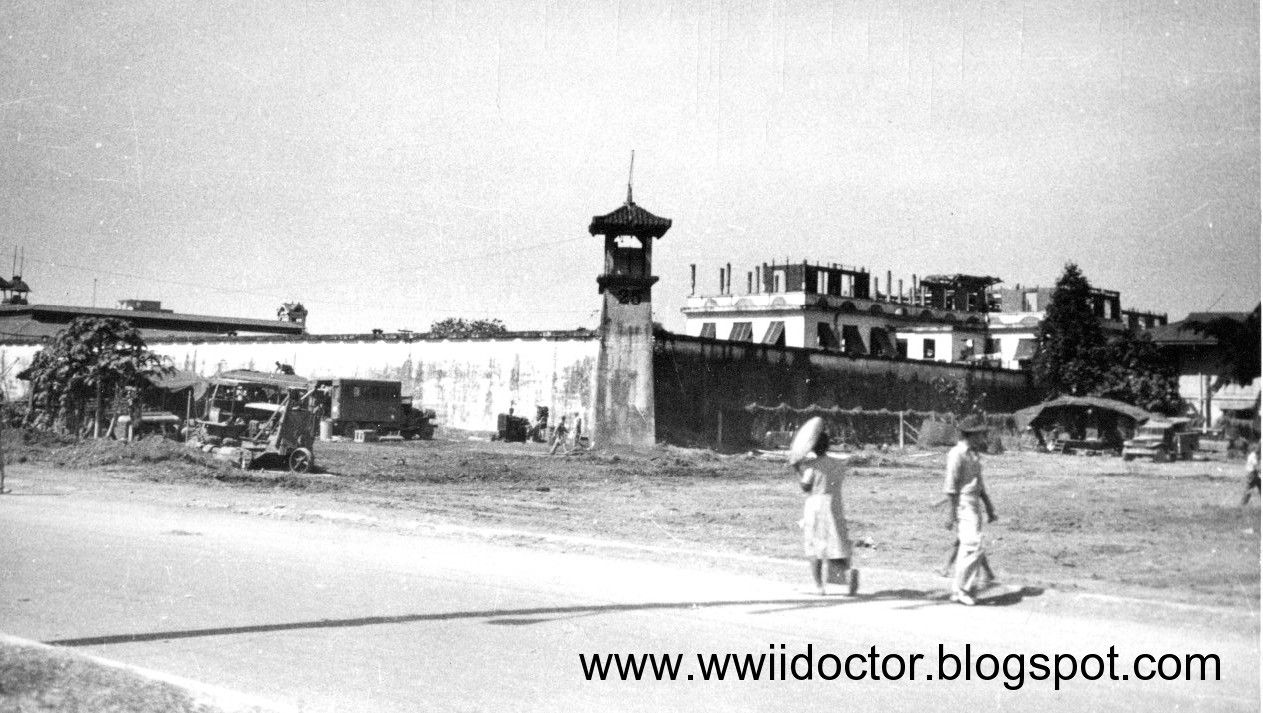
Bilibid Prison in Manila, the Philippines

A line of Igorot girls looking for lice in Caba, the Philippines

Granary in Caba, the Philippines

A view of Mount St. Tomas from Caba in the Philippines

Some photos from DTC to Biak (82)

     I'm going to be on vacation for a couple of weeks, so here are some photos that didn't fit in elsewhere.  I hope you enjoy them!


From the Desert Training Center:


Near Freda looking toward the Chuckwalla Mountains
Members of the 92nd Evacuation Hospital lining up for innoculations

In Australia:

Australian soldiers riding bicycles near Rockhampton


Rockhampton train
Australian men working in the train yard in Rockhampton

In Hollandia:
Piece of a  wrecked canoe near Hollandia Gene sent through the
 mail to Beth

Carvings on the other side of the piece of wrecked canoe

Some of the enlisted men of the 92nd Evac (they look like characters in the musical,
South Pacific, don't they?)

Japanese supplies


On Biak:


Looking from the beach road on Biak up to the the Japanese
bunkers dug into the cliff


Japanese bunker on Biak
Major surgery tents on Biak
Minor surgery tents on Biak
Ward tents on Biak


Capt. Hiram Armstrong's fox hole on Biak


Monday, June 25, 2012

Planned Invasion (78)

     Details of the planned invasion of Japan if the atomic bombs hadn't been used were revealed to the public via the Associated Press:
Map showing the island of Kyushu

TWO LANDINGS ON JAPAN WERE PLANNED: Initial Force Was to Go Ashore on Kyushu Nov. 1, With Second Disembarking in Tokyo's Dooryard About Four Months Later
     Washington, Oct. 10 - (A.P.) - The unneeded invasion plan for the Japanese homeland called for an all-American effort, with one force going ashore on [the island of] Kyushu about Nov. 1 and another landing in the dooryard of Tokyo about four months later.
     Details of the double-barreled strategy - code designated as "operation Olympic" and "operation Coronet" - were disclosed Wednesday in the biennial report of Gen. George C. Marshall.  He wrote that "these were our plans for final victory in World War II should Japan fight to a last ditch national suicide."
     The report taken together with available information on troop strength, indicated that the plan was to attack the homeland with numerically inferior forces.  This had been the plan for virtually all other operations in the Pacific, reliance being placed on superior firepower by land forces and support from naval gunfire and aviation. 
     Marshall said that the Japanese had husbanded an army of 2 million men to defend the homeland.  He did not give the American strength in manpower, but discussed it in terms of divisions.  On the basis of 15,000 men to an infantry or marine division, with smaller numbers for armored, air-borne and cavalry divisions, somewhat more than one-half million men were accounted for.  Units attached to divisions for special purposes and service [such as the 92nd Evacuation Hospital] and engineering forces would about equal the total of the divisional strength bringing the total forces used in the two operations above one million men.
     This force, of cource, would not have included the thousands of naval personnel manning the supporting fleets and transports nor the air forces participating in the operations.
     Marshall's accounting of the divisions to go ashore in Japan mentioned none other than American army and marine forces, indicating that although the British may have had plans for naval support of the invasion there were no arrangements for British or other Allied participation in the actual landing operations.  Marshall said that Gen. Douglas MacArthur, in co-operation with Adm. Chester Nimitz, was prepared to execute two plans for the invasion of Japan:
Modified scheme of maneuver map, Operation Olympic in Victory and Occupation: History of U.S. Marine Corps Operations in World War II by Frank Shaw
Shoulder insignia of Sixth Army
Shoulder insignia of First and
Eleventh Army Corp
      "The first, known as operation Olympic [Gene's underline and comment: (we were due to land at "H+4 of D day!) [4 hours after the first landing]] provided for a three-pronged assault on southern Kyoshu in the fall of 1945 (Marshall previously had mentioned Nov. 1 as the date) by the Sixth United States army, consisting of the First and Eleventh army corps and the Fifth marine amphibious corps.  Three groups were to land in the order named at Miyazaki, Ariaka Wan and on the beaches west of Kagoshima to isolate the southernmost Japanese and destroy the defending forces there.  Preceding the main assault were to be preliminary operations in Koshiki Retto and a diversionary feint off Shikoku by the Ninth corps.
     "The second phase of the Japanese operation, operation coronet, was to be carried out in the early spring of 1946 (An attached chart bore the notation "To follow Olympic at about four-month interval.")  The Eighth and Tenth armies, consisting of nine infantry divisions, two armored divisions and three marine divisions were to assault the Kanto or Tokyo plain of eastern Honshu.
     "These two veteran Pacific armies were to be followed ashore by the First army, which had spearheaded our victory in Europe and was now to be redeployed for the final battle of the Pacific.  In this attack the First army would have contained ten infantry divisions.  The three armies had the mission of destroying the Japanese army on the main home island and to occupy the Tokyo-Yokohoma area.
     "On Kyushu we would have held a one-corps reserve of three infantry divisions and one air-borne.  From here the plan was to fan out to the north and clean up the remainder of the Japanese islands.  Supporting the cleanup would ultimately have been an air garrison equivalent to fifty groups."
     Marshall said these were the plans for invasion "but we had other plans which we anticipated might bring a much speedier end to the war" - the atomic bomb.
     Said Marshall of this: "The results are well known."

    Next up will be the information about Japan and facts the army gave all of the occupation soldiers about the geisha.