Showing posts with label 1945 photos. Show all posts

Friday, August 17, 2012

Final Days, then Home! (96)

     Gene had spent several days waiting in Denver before his orders came through to go to California for training, and he spent several weeks in Nagoya, Japan waiting to go home.
Japanese paper money in 1945

December 3, 1945  Mailed sword, 48¢.  Obtained new large Jap binoculars.  Heard that points will drop to 77 by end of week.

December 4, 1945  Discriminated against!  [A man with] 75 ASR [Adjusted Service Rating, or "points"]  goes [leaves] the 7th, except for MC's and DC's [medical corps and dental corps]!  [ASR score was the number of points needed for discharge; they were granted as follows: one point for each month in service, an additional point for each month overseas, five points for each combat award and 12 points for each dependent child under 18; Gene must have had about 75 points.]  Cool and rainy this evening.
...

December 6, 1945  Went to Inuyama to a #1 Geisha house for sukiyaki dinner ¥ 70 ($4.66). [Capt.?] Max [Vinicor] went to Kyoto to find why and wherefore.

December 7, 1945  Bought a red vase with green chrysanthemums for ¥500 or $33 1/3.  No news except that we should get the bronze stars soon and be able to leave.

December 8, 1945  Still no word.  Inspection of hosp - quasi official, by me, the "Old Man" [i.e. Gene is the commanding officer].

December  9, 1945  Went to Inuyama to take 2 rolls of color pictures.  Clear day.  Revert to I Corps, removed from the 25th Div.
View from the balcony of the Inuyama Castle

An orchard on the road between Nagoya and Inuyama

December 10, 1945  No word on the bronze star.  I'm going to Kyoto to see!

December 11, 1945  Went to Kyoto by train.  No luck in hurrying it up!  It will take a week.  Stayed at the 135 Med Bn (Col. Draper).
...

December 13, 1945  In command a month today.  But the message came thru to send out the 75 pt. MC's!  Oh happy day - the 17th!

December 14, 1945  Getting a verbal release from I Corps was like pulling teeth.  Later - they called and said they had to write my orders!

December 15, 1945  I sent [Capt.? Maj.? John] Yount to get my orders.  He returned from Osaka with the orders, about 7 P.M.  Was I relieved!
...

December 17, 1945  Some doctors with 77 points have been here 12 days!  More discrimination against doctors.
...

December 19, 1945  Snowed about 6" last night.  Max got our stars, so now I have 80 points.  Hope it will help me get home.
...

December 21, 1945  Thrills!  I'm on orders with a group of 100 to Ft. Logan [in Denver]!  Saw it this A.M. after a brisk walk with Max on the frozen ground.  Should be the Admiral Rodman [ship].

December 22, 1945  Up at 0400 (called an hour early by mistake!)  Stood in the cold an hour.  On train by 0800, on boat by 1030.

December 23, 1945  Sailed at 0730.  I'm Senior Med. Off. [officer] with 10 docs and 6 dentists to do the work.  What a job organizing things!  A little seasick!
...

WESTERN UNION
VH2 INTL=F OKAZAKI VIA MACKAYRADIO
EFM MRS E F PFILE=                                                       1945 DEC 26 AM 8 12
          800 PARK ST TRINIDAD COLO=
EXPECT TO BE HOME SOON DONT WRITE FURTHER.  WILL CONTACT YOU ON ARRIVAL
LOVE AND KISSES=
          EUGENE

WESTERN UNION
VH69 10=CAMPANZA CALIF 3 400P
MRS E F PFILE=                                                                1946 JAN 3 PM 6 26
          800 PARK ST TRINIDAD COLO=
ARRIVED LA GOOD TRIP WILL PHONE YOU IF POSSIBLE LOVE=
          EUGENE

January 3, 1946  Passed Catalina Island. Docked at San Pedro at 1023. 5543 nautical miles - 12 days. Went to Camp Anza, Riverside, by bus. Called Beth. Happy Day!

January 4, 1946  Left Camp Anza at 1730 by Union Pacific [Railway] for Salt Lake City.  Day coaches!
...

January 8, 1946  Thru processing at Ft. Logan at 1330.

     There and back again.   Gene was home, one thousand two hundred eighty-five days after he left!  He was relieved from active duty on April 6, 1946, and remained a reserve officer until April 1, 1953.  My final post will be lists of various sorts that Gene kept: number of admissions, types of injuries he treated in Biak and Owi, etc.  I appreciate any comments you might have.

Wednesday, August 15, 2012

Maj. E. F. Pfile, C.O. (95)

     This is Gene's last letter home that was saved, although he has two more months of diary entries.

2 Nov. '45
Beloved,
     Well what do you know - I'm writing by the light of a gasoline lantern!  It seems that a pole fell across our light line this evening.  Things are starting to level off.  The 229th General Hospital is moving in.  They are setting up their iron beds with mattresses.  The nurses arrived about noon so the halls echo and re-echo to the sound of female laughter (also yap-yap).  This morning some of their officers went to work on the wards and took over the OR [operating room].  I haven't touched a patient since I arrived and probably won't.  As the general hospital sets up, we pack up.  It will end by us moving bag and baggage to the barracks area, setting up our mess and all there.  Of course that probably won't happen for another 2 weeks and by then they may have other plans for us.  Otherwise there is no telling how long we may sit there.  Oh me, why don't they just let us go home!
     I've seen some Jap lanterns in use.  Jap cops use them at night, even riding along on a bicycle!  Can you imagine that?
     All my love, Eugene

November 3, 1945  [Maj. ? Herb] Nigg went to Kyoto [to return home].  I tried to carry on.  Maj. Gen. Mellins (25th Div.) came to see our place.

November 4, 1945  Nigg will be stuck for a while.  The score has gone into reverse for lack of boats - 96 [points] for 0[fficers] and 80 for EM [enlisted men].

November 5, 1945  Gen. Krueger was around at mess time yesterday.  Things were quite a mess!  It's a wonder we weren't really laid out cold!

November 6, 1945  Exam. [examination]  Team for Reg. A [Regular Army?] officers [career officers?] here from Kyoto.

November 7, 1945 More O and EM will get to leave soon.  The 229th Gen. Hosp. will take over the books at 2400.

November 8, 1945  Blue vase ¥450 [$30], green ¥200 [$13], red ¥100 [$7.50], small ones ¥20 [$1.50] each, clips ¥10 [$.75] each

November 9, 1945  Down to 46° F in my room last night!

November 10, 1945  Wool underwear issued today.  Nigg to leave the 13th.

November 11, 1945  Armistice Day - imagine!  Really came a free one [soon to be changed to "Veterans' Day", this was the first time it could be celebrated in a world free of major conflict in six years].

November 12, 1945  I took command officially this morning.  A skeleton crew.  We have a Jap wood stove.

Probably from the Trinidad Chronicle-News:

MAJOR E.F. PFILE NOW AT NAGOYA, JAPAN, IN COMMAND OF HOSPITAL
     Now stationed at Nagoya, Japan, as commanding officer of the 92nd evacuation hospital is Major E. F. Pfile of Trinidad whose wife, Beth, resides at 800 Park street.
     Major Pfile, who was a practicing physician and surgeon in Trinidad for some time prior to his entry into the army medical corps 41 months ago, has been overseas 29 months.
     He has seen service in the campaigns of Hollandia, Dutch East Indies, New Guinea and the Philippines prior to his landing in Japan more than a month ago.

November 13, 1945  Nigg went to the depot today.  Jensen says I should get the five points for they said it was going thru.

November 14, 1945  Enlarged and printed pictures last night.  We have coal for out stove this evening.  The room temp. is 70° - the warmest it's been so far.

November 15, 1945  Rumor that we may open up.  We received woolens - 2 shirts, 2 pants and Eisenhower jacket.

November 16, 1945  More major crimes by soldiers exists here than I had any idea - armed robbery and burglary, etc.

November 17, 1945  They claim a new drop in critical score will come out Dec. 1st [i.e. fewer points will be needed to go home].

November 18, 1945  Dinner with Maj. Cooney at the Kanka Hotel, very good.  Walked home.  Gorgeous moon.
...

November 22, 1945  Thanksgiving - Base had turkey.  We had good steak.  Turkey later.  I'm catching flu or something.
...

November 26, 1945  Feel better today.  Opened the hospital - no patients admitted all day.  264th Med. Bn. Co. A may be taken away from us.
...

November 28, 1945  Cold much better except for cough.  Took a few color pictures.  10 patients.
Woman carrying a bundle up a hill in Nagoya

School children in front of the corner tower in the wall of the castle in Nagoya

Garden behind a shrine in Nagoya

November 29, 1945  [Second] Thanksgiving.  Turkey today.  Officers serve the men.

November 30, 1945  Rain again.  Chilly.  5 yards of brown silk jersey cloth at 30 yen ($2.00) a yard.  I saw the factory.  Real silk, too!


December 1, 1945  Heard this eve that I'm eligible!  Points drop to 79 for MC's [medical corps] immediately!  Mailed clothes and silk.  $1.09

Monday, August 13, 2012

Gene Is Captivated by Cloisonné (94)

     Gene has discovered a new-found delight in the Japanese art form of cloisonné  .  He tried to document each step of the process with photographs.  His letter to Beth continues with much enthusiasm.

Japanese man making a copper form for a cloisonné vase

Japanese artist designing the pattern for a cloisonné vase

Elderly Japanese woman grinding clay for the enamel on a
cloisonné vase

Elderly Japanese men applying glaze to a  cloisonné vase

Elderly man hand polishing  a cloisonné vase

A finished cloisonné vase offered by the salesman/manager
1 Nov. '45 [continued]
     They take the copper bowl (which product we saw being made at a separate place - a small forge, etc.  hand forging a prepared billet of some kind) and lay out a design.  I didn't see the silver wire being soldered on, however.  Then they put on a layer of clay and bake it.  An old woman was grinding the clay in a large mortar.  It has a pale lavender color to it.  She was sitting tailor fashion, as were the other workers.  This prepared, colored clay powder is placed in a small container and they apply it with a stylus to the design, concentrating on what they are doing!  Then it is baked and some more is applied.  Then the polishing, which takes days.  They polish it a bit on a power lathe and then start in by hand.  We saw one of the lathe and one being worked by hand.  One vase that was finished was about 10" across, bowl shaped.  It had this over-all transparent, shiny red color, far prettier than ruby glass.  On it was a dense pattern of tiny pink and white apple blossoms.  It had a sterling silver band on the top and bottom edges.  They all have that.  Well, that vase was ¥1200 or $60.  They don't give them away!  On that basis the great big ones must be worth $3000!  They had some smaller, tall vases started (like the one I finally ordered) and also a cigarette box that was a dream but not for sale.  It seems that only the old men do the work [other than the preparation].  It is terrifically monotonous, no doubt.  The younger mean-manager said for us to come back in a month or 6 weeks and they'd have some for me to look at.
     So we asked for other places and our guide asked him where to go.  We went thru another series of alleys, passing a Brig. General an party on a similar mission!  At that place they had a similarly shaped vase in blue with a chrysanthemum design on one side and a sprig on the other, and with a marvelous blue background.  It is amazing.  I though all cloisonné looked like my Chinese opium pipe, but here is a large vase in solid color, with a design (elaborate enough in itself - all shades and colors) on only part of it.  Well, that was ¥2200!  So we went looking for smaller vases.
     In another house they invited us in to a sort of display room and they had about a dozen vases just waiting the silver bands!!  These were about 15" high and typical vase shape.  They were in medium dark blue and in light blue.  I chose the dark.  On one side is an apple bough with pink and white blossoms and some pointed leaves like bamboo.  I think it is elegant.  It should be done for me next week.  Price is ¥450 or $30.  And furthermore, if I'm around here a month or 6 weeks and they have some of those red vases for $40, I'm going to get one of those!!  They give you a wooden box for each vase.  I'll pack it carefully and send it.  Now if they don't save it for me, I'll scream!
Blue  cloisonné vase Gene selected for Beth
     I took pictures of the old men working, but they were time exposures so I don't promise on them.  Next time I go out, I may take a color picture of the vases.  A good many of the houses there were of adobe or bamboo framework with adobe plaster.
     This building does have its troubles.  This morning the water in the toilets was off and the stuff piled up.  It seems there is a motor pump to force the water, but after a while they got it fixed.  They the hot water went off, but they got that fixed.  Yesterday an elevator motor burned out, leaving just one elevator.  I'm glad I don't have the job of looking after the building!
     All my love, Eugene

Friday, August 10, 2012

A Little Luxury (93)

1 Nov. '45
Beloved,
     This is really supposed to be yesterday's letter, but somehow, last evening, I didn't get to write you.  Yesterday I did a lot of leg work in my capacity as expediter but actually didn't have much to do.  Nothing new has developed except that the 5th Army has been building a fire under the 25th Division to get their eligible men and officers out.  The General Hospital is still supposed to get in very soon - possibly today.  The other hospital may be de-activated and give unto the 92nd new life and then move 35 miles or so away from here.  That sounds like bushwa to me!  But I don't care what cooks, really.
Japanese Waitresses
     To come to last night, McGinnis invited [Maj. ? Herb] Nigg, [Maj.?] Arnie [Niemeyer], [?]Stevens and me to dinner.  He is at Nagoya base and their field grade officers [major, lieutenant colonel and colonel] live in the Kanko Hotel, a fancy modern one that was untouched [it was built in 1936 in the heart of Nagoya as a state guest house, and even today is a luxury hotel].  My gosh - how the other half of the world lives!  At the door a Jap bell hop in a white bell hop uniform met us.  Several Jap girls in kimonos bowed us down the hall to the elevator.  There was a red plush carpet, fair sized foyer, etc., etc., even to a chicken colonel [full colonel] in a dress uniform reading his paper!  The Jap elevator girl understands floor numbers at least.  The rooms have the original hotel furnishings.  What luxury!
     The base men, as usual, seem to be a hard drinking lot and I didn't attempt to keep up to them.  We had dinner at 6:15.  The dining tables had dark colored cloths with reticular fringes [like net?] - rather odd.  We had a large amount of silver - butter knife, fruit knife, dinner knife, fish fork, fork, soup spoon, another odd shaped spoon and I'm sure something else I can't remember.  We had a thick soup, hard rolls, a fish cake with sauce (quite good - it was very fine grained), then what I judged to be sukiyaki.  Anyway it was meat cubes and vegetables cooked in brown gravy!  Then an ice and real demitasse [espresso coffee].  The kimono gals served and very well.  How they manage their sleeves, I don't see.  We had much light and witty (?) palaver.  4 nurses came in with their escorts.  They wore dress wool blouses and dark wool pants.  I suggested a dark wool kimono should be added to their wardrobe here in Japan!
From a Nagoya newspaper showing a photo of Maj. (?) Herb Nigg, and a ward in the 92nd Evacuation Hospital in Nagoya
     Later - it is now 11:30 A.M. and I've been interrupted.  Glory be - the 229th Gen. Hospital is actually unloading today.  They'll gradually replace our stuff with their own.  It should work out O.K.  We'll have the personnel from both hospitals for a while including 9 Lt. Col.s and 15 or more majors.
     Well, let's see dinner was finished.  Then we went to the bar and began drinking in earnest.  And again, I didn't pace the leaders.  We saw a reunion (after a weeks absence).  Anyway, it was entertaining!  I saw something I want for you, only like nothing I ever saw before!  It is made 10 miles from here and takes months to make.  I hope to go out there this afternoon so perhaps I can tell you more later.  It is a vase of cloisonné.
     Well, the confusion increases!  About 25 or 30 officers from the 2 gen. hosp. moved in.  5 or 600 of their men and the rest of their officers are going into the barracks area in the old castle grounds.  But you can jolly well be I don't worry my head over it.  Nigg is still CO and I just expedite slightly!  That old castle area is something.  It has a moat about 30 feet deep and a wall of a total height of about 30 or 45 feet.
     But I've more interesting items to ramble on about.  I think I have a present for you.  Back to last night.  I left the dinner silverware alone but just couldn't resist a cocktail spoon that has the Jap trade mark hotel name and Nagoya on it! [It must not have made it home, because I have never seen it!]  We came home about 10:30 and Arnie and Nigg were all wound up and insisted on talking till after 11.
Maj. Eugene Pfile in Nagoya
     Now, ahem!  The vase - oh yes, the vase!  A captain and I drove out about 2 miles beyond city limits.  We passed the biggest torii I ever saw.  It must have been 40 feet high and big in proportion.  We came to Shippo (the village) and could see no vase shops so we stopped at a bicycle shop and pointed to their charcoal brazier pot.  They nodded and sent out a young fellow.  He came back with a thick English-Jap dictionary.  So I hunted up "vase" and "cloisonné".  He drew a map on the ground.
     Meanwhile Culver [the aforementioned captain] found a Jap who could speak a little English and we took him with us.  We went another quarter of a mile, turned down a lane for that far, then took a narrower branch, and then a still narrower one!  We wound around houses and finally parked the jeep and walked thru another yard and there we were.  It was just a home with several rooms set aside for this work.  Our man talked for us.  2 old men were working on a huge vase - all of 3 feet high, and another old man at its twin.  They had practically nothing made up, but oh Honey, what they had was simply indescribable.  Their special color is red.  In other places we found it was blue, etc.

To be continued

Wednesday, August 8, 2012

Home, Boys, Home, with a Sigh from Gene! (92)

     Gene and Maj. (?) Nigg went from Kyoto to Osaka before returning to Nagoya.

October 29, 1945  Went to I Corp Surg. at Osaka.  Left for home at 1, arrived at 7 P.M. in dark.
Osaka
Map modified from zonu.com showing Nagoya, Gifu, Kyoto and Osaka

29 Oct. '45
Beloved,
     Well, we got back and that's about all.  Oh what a tiresome ride!  But to go in order.  We had breakfast at 7:30 and went down to the offices at 8 and talked for about an hour.  There at 6th Army they say everyone eligible is to be sent home.  It is pitiful how messed up and ignorant of conditions Headquarters is at present.  They had been told this building [in Nagoya] was not suitable for a general hospital!  We put them straight in that and a few other things.  But they said we were under I Corps at Osaka, so we went down there (about 20 miles - mostly cement roads) and arrived at 10:30.  There we got the old run around and double talk.  The Surgeon there says we are attached to the 25th Division so we'd have to see them!  But it looks like Nigg can send the eligible ones out.  To do the work here [Nagoya] they will send in officers from a general hospital on account of the old 92nd is going on and on!  They may close others, but ours - never! [The higher-ups changed their minds -again- and the 92nd Evacuation Hospital was inactivated February 28, 1946.] Isn't that a crack [up]?  What do they need with an evacuation hospital?  Oh well, it will work out and I'm not bothering my head about it.  When my time comes, I'll get out, or else!
One of the many bridges in Osaka
     Well, we went over to the officers' hotel to eat and they wouldn't let us in because we weren't in khaki uniforms with ties!  So we went over to the casual officers' place.  It was the best deal for casual officers I've seen - Jap waitresses, white table cloths, silver, etc.  Good food, too!
     Then I went out and took a roll of Kodachrome.  It was chilly on the way back but we had blankets.  We went for 50 miles again without seeing a GI vehicle, though we passed some Jap trucks and hordes of people.  It was not quite dark when we finished the poor road and the gas was getting low.  After another 15 miles we turned into the road where we could expect to meet some GI cars.  We went a mile and ran out of gas.  We opened up some rations, I put on my wool undershirt and while I was doing that a jeep came by, stopped and we got gas!  We gave them some C rations and came on home.  We drove around Nagoya a while [getting lost, not sight seeing!], coming back to the edge of town once, and finally found our way to the hospital.  Nothing had happened here.  Everyone dropped around to the room to see what we had found out.

     Their trip and Maj. (?) Nigg got things moving.  The next entry in Gene's letter home shows the result.

30 Oct. '45
     Yea verily, this is a glum evening.  Practically all the gang left this evening.  [Maj. Arnold]Neimeyer and [?] Jensen volunteered to stay a few days.  Otherwise, [Capt.? John] Yount and [Capt.? Max] Vinicor and I are alone.  But I'm mighty glad the others got away and as it now appears, safely.  You see, the 25th Div.  and the Nagoya base are trying to set up their organization and there are so few medical officers immediately available - i.e. on the face of it.  Actually, there are 2 general hospitals sitting in the bay with a low priority for unloading.  All that is necessary is for the Div. Surgeon to whistle for 'em and they could be here.  So the soldiers won't be neglected.  Well, the 25th Div. general says he has permission from the 6th Army to hold all officers and men for a while, but he sent no direct order to us, so Nigg went ahead on 6th Army orders and sent everybody out.  Then Nigg and I went to see the Surgeon and said they were gone.  He fumed a bit but then said that what was done was done, and then started to do the sensible thing - plan to get the general hospital in soon.  Apparently this outfit will move in and take over and we will store out stuff and be attached to them.  That will suit me fine.  If Nigg gets away as he should I'll be CO of a paper work hospital - do the administrative work with the help of the non-coms (who know the ropes) and that is all!  So it should work out O.K.  But it makes me sad to see the old gang go.
     All my love, Eugene

Monday, August 6, 2012

Letter from Kyoto (cont.) (91)

     Gene continues his letter to Beth about the conditions in Kyoto.
Scene from downtown Kyoto

Kyoto
     After we came to Otsu, we came out on a good wide cement road that turned west up some nice hills, with an electric car line along it.  We made good time along it to Kyoto.  Kyoto wasn't touched (Phil Moore of the B-29's said MacArthur gave orders to leave it for his headquarters!)  About the only sizable town that wasn't.  It is quite a large town - nice buildings, department stores, office buildings, etc.  There certainly are a lot of people here and some army.
    We got to the Surgeon's office in time to talk to one man and to learn a few things.  We know the Col. at this building so it was suggested we throw ourselves on his hospitality.  They were eating when we came - a dandy dining room.  This outfit is the HQ for what was a medical regiment.  They have separate ambulance companies, clearing companies, etc.  There are only a dozen officers here.  The Col. (Draper) is the CO and the only medical officer - he has to hold sick call for his men!  We had a fair supper in a nice warm room.  It was chilly in the jeep!  Williamson [a doctor who joined the 92nd Evac. fairly late in the war] gave me a new pair of woolen gloves at Baguio that he'd brought from Alaska.  They were a comfort.
     At dinner I met a Rev. Burns, a priest who has been in Japan 16 years.  He was isolated but not interned.  He was going this evening to pay his respects to Miss ?, an 82 (?) year old lady whose birthday it was.  I read about her in the paper on the ship.  She came to Japan 50 or more years ago.  She is the only American the Japs didn't have under some kind of control during the war.  This priest is elderly, nice looking and very pleasant.  He told me about how apprehensive the Japs were before the occupation.  He said a policeman told his (the priest's) cook that we'd take a bunch of women, put needles thru their palms and sew them together in a long line, then take them to the ocean and tow them out with a boat until they drowned!  But since she [the cook] had been with him for 10 years, she didn't believe it.  She went to market the other day and on the streetcar overheard 2 Jap soldiers talking.  One said he had been gone for 4 years and the other, 5 years.  They told each other it had been mighty bad.  The one said "And for what?  Look how it is since the Americans came.  It would have been better to have given up long ago!"  Another conversation she overheard was between some women.  One said that the Americans put them to shame.  That the Jap people were once polite, but now the GI soldiers were teaching them politeness.  She said that on streetcars or trains a Yank (standing himself) would take a young Jap man by the shoulder and make him get up and give his seat to an old Jap man or woman.  Such reports are most gratifying, aren't they?  This priest, when war broke out, had just finished building a TB sanitarium for poor Jap people with money collected in the States.  An order of Jap Sisters were then permitted to take over and run it.
     Tomorrow we will see some men and then try to find a better road home!  Apparently our officers will be able to go.  The EM's [enlisted men] haven't been held up.  The 25th Div. seems to be holding its officers but we aren't under them now.  This Lt. Col. Bumgarten says the 92nd will not be de-activated - that it will be given men from general hospitals.  But the field hospitals well be merged and some de-activated.  So I don't know - maybe I'll be
CO and maybe not.  I hope not!

[Gene now adds some more information about Nagoya]
     Back to Nagoya - all our stuff was unloaded and brought up last night [the night before the trip to Kyoto].  I found my footlocker about 8:30, uncrated and opened it.  Everything was fine.  Gosh but I have a lot of stuff in it!  I declare I'm going to throw plenty away before I come home!  In our room we have a large cabinet with shelves and some drawers and sliding panel doors.  But hanging up things will be a problem.  We don't like to drive nails in the good plaster walls.
Building where the 92nd Evacuation Hospital was set up
in Nagoya
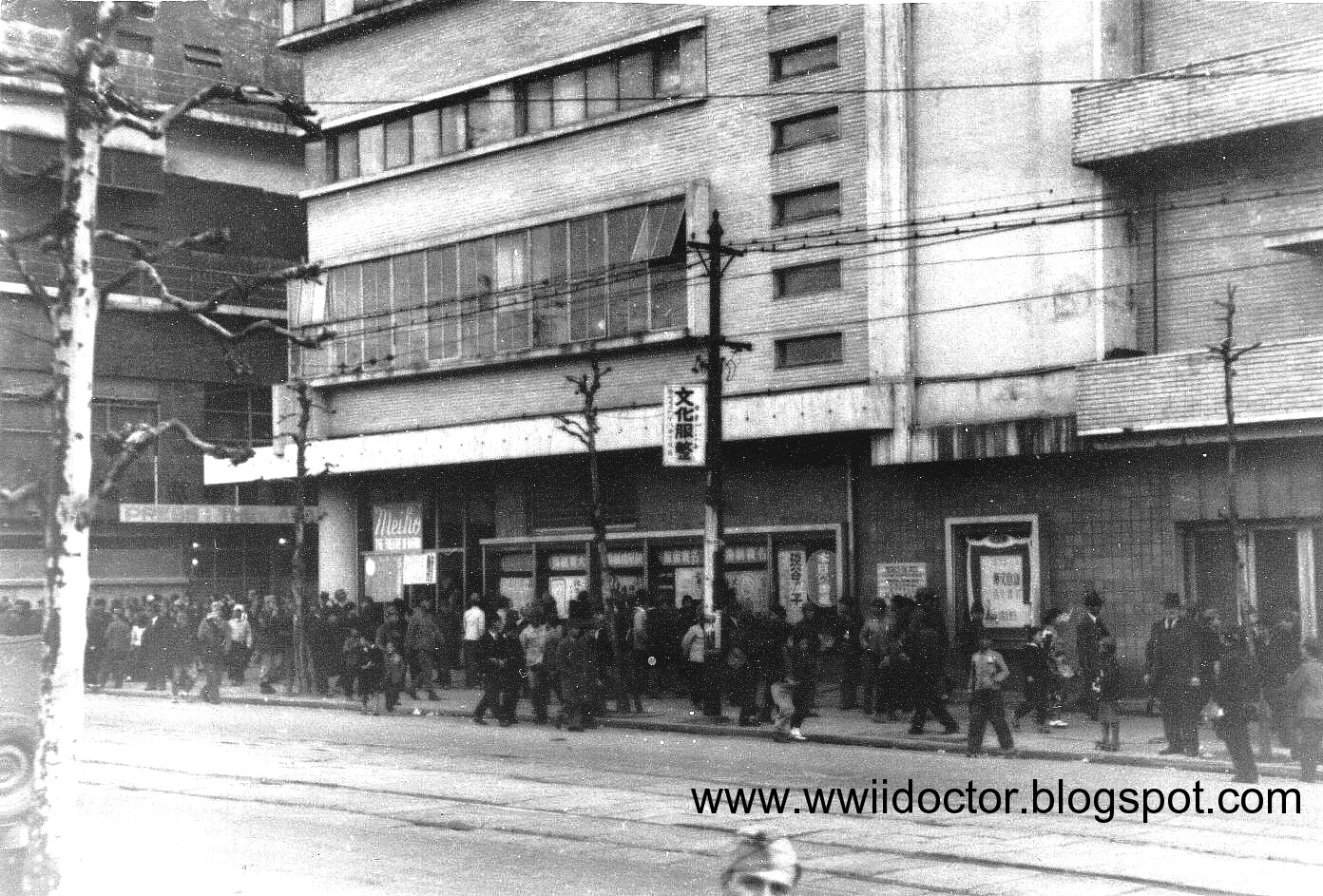
     I took more careful; note of the building.  It is a T shape, 5 stories in front and 6 along the [back] part, with a large auditorium on the 6th floor and a solarium on the roof.  The outside is of smooth white brick facing, but above the ground floor it has been painted over with black and dark red, which is wearing off and streaking.
     Last night I had a poncho and a double blanket under me and 2 over me (one doubled).  I had a pair of heavy socks and a cotton T shirt but about 4 A.M. I got chilly and stayed that way.  This morning I found my duffle bag and got out my air mattress and pajamas.  The room we have here for tonight [in Kyoto] has steam heat.  In our room this morning it was down to 60°.  In about 2 weeks we should have steam heat in our rooms so it will be comfortable.  They don't have hot water in this place so we are ahead of them on that score.
     One remarkable thing about the countryside here is that most of the houses out in the country have electric lights but they certainly don't seem to have any appliances!
    

Friday, August 3, 2012

On the Road to Kyoto (90)

     Gene is always ready to take advantage of spur-of-the-moment rides, as we see in this post.

October 28, 1945  [Herb] Nigg [an administrative officer ? who had joined the 92nd Evac in Owi] and I (and Lt. Griffith of the 32nd Field Hosp.) went to Kyoto by way of Gifu [about 125 miles].  Left 11 A.M. arrived 4:30 P.M.  What a road!  Stayed with 135 Med. Grp.
Modified map from hhh.gavilan.edu

28 Oct. '45
Beloved,
     I was in the billiard room but it was a bit chilly there so I'm now in the lounge and it is nice and cozy.  The radio is playing.  I'm in a nice easy chair with my feet on a carpet.  No, this isn't Nagoya, it's Kyoto!  This is a former University Club and is it a dilly!  The 135th Med. Group is stationed here and we are staying the night with them.  There are large ornamental light globes and wood paneled walls - a really snazzy place, steam heat and all!  It is a long story - also a long trip!  Nigg wanted to come over to see 6th Army to see what the score is and also to find out about himself and the other officers going home.  So, since I'm apt to be the next CO [he was the highest-ranking doctor of the three in the 92nd Evac. that would be left in Japan], I wanted to come too.  We heard it was a 3 1/2 hour trip over good roads.
     We left about 11 in a jeep with a driver.  Well, we arrived about 4:30 and what a road!  Sugar, you know our difficulties in touring the USA, getting on all the wrong roads [Gene and Beth enjoyed driving around the country seeing the sights].  Well, with signs in Japanese, a map with all the towns in Jap spelling, and their highway system here.  Oy, gevalt!  We took the wrong road out of town several miles and then got to the main road.  I guess it really wasn't so difficult.  We had the large scale Army maps and would point to it and show someone and by saying the name of the town we wanted and by sign language we'd get the general direction.  The highway was cement for a ways and in fair shape.  I can see what the air force meant when they said they were running out of targets.  Golly sakes but a lot of the industrial towns and villages are burned out!
     But to continue.  We headed for Gifu, NW of Nagoya.  We took a turn off the highway because the sign said to.  About 4 miles along on a narrow, twisting road thru an almost continuous village, I knew we were going the wrong direction and finally saw a sign for Gifu pointing the way we had come.  So we went back.  But we saw the sights - bamboo groves, rice fields and raw silk places with spindles of silk that had been dyed out in the sun. 
     At Gifu we drove into town before we knew that was it.  Then we asked for Ogosi and turned back SW.  We had good roads, more or less.  Then we continued on W toward the lake.  We saw quite a range of small mountains with what appeared to be a gap.  In that town we made a false turn and looped back.  There were signs in English spelling of the towns at important turns but their directions were not always clear.  In one town we went all around Robin Hood's barn, on the proper road, however.  It was a main road, but became dirt or gravel, about wide enough for 2 jeeps to pass.  We met a fair number of Jap trucks but no army vehicles of any kind!  But the road wasn't empty!  Oh no, it was simply a stream of people for quite some distance, even in the hills!  People walking, carrying huge loads on their backs, on bicycles with huge loads or pulling great long 2-wheeled carts piled high with boxes, or bundles of brush and branches of wood or lumber - just all sorts of things!
One cart of the many from the stream of people moving down the road
     But the road - words fail me for describing a main highway!  It was just one track.  Jeeps could pass in a pinch.  It ran thru villages where houses were built close to it, between walls, up hill and down, between rice paddies with densely forested (pine and cedar) steep hills beyond.  The railroad (double track) was always near so you can take pictures, but we were in a hurry.  Quite a few houses had steep thatched roofs - thatch about afoot thick, with green moss on the north side.
     There were dozens and dozens of shrines all along the road everywhere, usually in a nice grove of pine trees, one or more toriis ... 2 or even long rows of stone lanterns, sometimes stone lions or foxes, and then the shrine proper - small wooden ones or large tile-roofed ones.  I just wanted to take pictures of each one!  They are all so interesting and picturesque.
     In the higher valleys there was timbering going on, but not even the small branches are wasted.  What loads the people were pulling - men, women and children.  In several places there were bunches of small red chili peppers drying on straw mats.  There were miles and miles of houses with straw mats right on the road, with rice or beans drying.
     They don't pound the rice in mortars here.  They do thresh it out with flails or a sort of foot peddle machine with a rotating cylinder studded with wire loops.  Then it is winnowed in the wind or in front of a hand-turned fan.  Rice is cut close to the ground and tied in small bundles.  Some is put in very open shocks.  Some is hung over racks.  Vegetables are grown on all available ground.  There were plenty of the usual fecal odors!
Preparing the rice for threshing and winnowing
     The hills aren't terraced very high along there.  There were a number of nice clean mountain streams.  The people were dressed the same as elsewhere.  Many of the women wore small white cloth head shawls [see photo above].  Some of the men had bands of cloth around their heads fastened with an odd twist.  At most places the kids waved and hollered.  At intervals there were air-warning watch towers - usually 2 long poles set in the ground like a ladder with a tubular-looking bell.  We saw no cattle, no pigs, very few dogs and cats and not many chickens.  The road was rough and was full of chuck holes in places.  It continued a rather narrow road even after we came out by the lake.  From there on, though in doubt at times, we had no trouble following it.


     To be continued.

Wednesday, August 1, 2012

Setting up the Hospital in Nagoya (89)

     After all of the idleness on the ship, Maj. Pfile is delighted to take some photos, then get to work setting up the hospital.
A field near Nagoya with the air base in the background

27 Oct. '45
Beloved,
     Oh me!  Oh my!  Have I ever been flying around and getting little done.  This morning at 8 [supply and transportation officer Ed] Gray was on hand with our trucks and most of our EM's [enlisted men] came up to our building.  Then they sent back weapons carriers [jeep-like trucks] for the officers.  We left about 10 but first yours truly (and I do mean yours, Sugar!) took a roll of color pictures.  As it turned out, it was well I did, for I had no time later.  The sky was cloudless but there was quite a haze in the distance.  This is all perfectly flat around here, with mountains far off.  We certainly saw a burned out city!  We passed huge factories that were mere skeletons and miles and miles of some factory areas that were burned to the ground, with machinery all warped and rusted.  It certainly is freakish how here and there a home or building would be entirely unscathed.  They certainly have lots of cops here on the street corners directing traffic.  They wear blue uniforms with black roll leggings, white gloves and SWORDS!  Can you feature that?  Most are short swords, perhaps 18" overall, but some are long.  They appear to be on the cavalry saber style and not Samurai.  Here and there are shrines and small nooks with shrines in them.  Very few of the tall factory chimneys were knocked flat, and there weren't many bomb craters.  Rusted iron is everywhere.  They have plenty of scrap now!
A tower of the castle in Nagoya; the enlisted mens' barracks
were located on the grounds of the castle
     What a building we have!  It is 5 stories, completely modern and quite new.  One set of elevators is running, complete with floor indicator showing the floor it is at, in lights.  The outside looks rather crummy - dark and in places the smooth brick facing is knocked off.  But the inside!  The front has a marquis [marquee?] in fancy bricks, with part of the roof in glass bricks.  The floors in all halls are of this smooth stone and there are slabs of it in the walls.  There are mail chutes, light colored metal trims.  Most of the metal banisters have been replaced by wood.  The floors in the rooms are of wood (in squares) laid in cement.  The windows are large and the frames are metal.  The toilets are large - urinals and the porcelain "hole in the floor" stools, but with movable wooden seats over them.  I'm certain they were made at the [U.S.] army's orders.  The wash rooms are separate with lots of basins and large mirrors, both are rather low and you have to stoop to use them.  Showers have been added, again at army orders.  This is the pay-off - hot and cold water! and it is steaming hot.  The place must have been built with the idea of a hospital or barracks in mind, for on each floor is a large pantry with gas stoves, sinks, dining room and dumb waiters to a large kitchen in the basement!  The stoves are out, however.  There is a large built-in refrigerator.  We live on the 2nd floor.  The men have to live in some Jap cavalry barracks about a quarter of a mile away, situated in what was once a castle grounds.  There is a moat and walls and the whole area seems quite large.  They won't have such nice quarters.  The 25th Med. Bn. [medical battalion] and the 32nd Field Hosp. (a long time in Italy - a lot of their docs have been overseas 3 years) are all here but not setting up.  We have a few patients already.  The men are all hard at work plumbing and wiring.  We have lights in most of the building.
     Back to my day - we arrived a little after 11 and looked around.  There is one small building next to us and a large [one] set about 1/2 mile away, but otherwise the area is burned out.  We ate our rations about 12 and went to work.  One of the Lt.s [lieutenants] helped me part of the time.  We went to work on the inventory - gave the kitchen a quick once over, and a few other items.  A lot of it we don't need to check such as knives and forks for they are expendable.  Most of the time I spent on surgery, but it was easy.  They [whoever packed] had a complete list of their instruments, and a list of what was in each of their 100 boxes, so we went thru the lists and named off the non-expendables.  So many things are expendable - syringes, needles, supplies.  It would be something terrible to do the millions of individual items.  Sterritt [?] is doing the wards as they set up.  X-ray, dental, lab, ENT will do their own, so while it will tie me up for a few days, it won't e so bad.  Right now I'm waiting to check the receiving office.  A street car and a suburban electric go by here and the suburban's horn sounds natural.  The high point men are all hoping to leave.  I'm sure a General Hospital will take over, for this is an ideal set up for them.  I suppose they will take me over, too!  Oh, well, what's the difference for a couple of months!

Monday, July 30, 2012

Finally, Nagoya! (88)

     The 92nd Evacuation Hospital is Nagoya-bound, finally.  The sooner they get there and set up, the sooner someone else will be able to take over and they can go home.  Maj. Pfile is one of the unfortunate three who will have to stay longer than most (something to do with points?), but he is just as anxious as the rest of the men (the nurses haven't been with them since Owi in New Guinea).   U.S. government publications tell them what to expect.

This Is Nagoya
Oct. 6, 1945 NAGOYA NEWS-INVADER
Page 3
     The Japanese who live in Nagoya are derived from a mixed stock of Monogoloid [sic] and Malayan origins which at about the time of Christ gradually spread over Honshu.
     Owing to the relatively recent growth in the population and industrial development in Japan, the cities are of very recent expansion.  The rural population lives in closely-built settlements and isolated farmhouses are seldom seen.  Originally all cities, towns and villages had a cluster of flimsy single story wooden buildings with slate, shingle, or thatch roofs.  These were usually built around large factories and other installations.
     Except for the modernized downtown business and industrial districts of Nagoya, cities and towns have the traditional Japanese aspect, unpainted frame buildings, with slate covered tiled roofs of nearly uniform height, facing directly on narrow streets surfaced with stone.  Open gutters carry drainage and refuse water from the houses on each side.
     In many of the smaller towns there are no well-marked residential and community centers, most streets are lined with shops, operated by a family living in the rear or in the second story.  The street pattern is commonly rectangular and in the center of each town often becomes irregular.  Rivers and canals are common features.
     Before the war, modern ferro-concrete buildings and factories, wide main streets of concrete were fast making their appearance but "Old Japan", was usually a few yards away.  Recent developments took the form of fire breaks and strategic highways cut through many cities and towns, new airfields, large uniform barracks at military training centers all indicate the migration of population to the war industries.
     All large cities in the Nagoya area, including Nagoya itself, are served by roads and railroads.  Water transportation is generally available, either via coastal shipping at short river sections or canals.  Bicycles and rickshas [sic] are a major means of transportation.  Telegraph and telephone are available and most urban homes are lighted with electricity.  Ample water is available but purification treatment is necessary.
     Nagoya is a city of great importance.  It is a key center.  In addition to its port facilities, pre-war industries of cotton spinning, weaving, watchmaking, it has aircraft factories, machine shops and chemical works.  Railroads were developed and an important flow of trade took place through this rich agricultural area between Tokyo and Osaka.  Roads were usually one lane, all-weather with main military highways widened and straightened in most places to take two lane traffic.
     The monetary system in Japan is based on the Yen.  The present rate of exchange is 15 Yen for on American dollar.  It you do your part in preventing inflation you should be able to purchase many fine articles at reasonable prices.
     The climate of Nagoya and area is mild and the rainfall is moderate.  The winter coldness is not harsh, while the summer heat is not oppressive.  On a whole the weather is very similar to that of Virginia.
     If we follow the rules and the suggestions given to us there is no reason why our stay in Nagoya should not be a pleasant and interesting experience.  There will be a very broad program of athletics and recreation as well as a news and information program.  You will be able to go to technical schools, University Centers and high schools.  You will be able to utilize some of your time in Japan for your own personal benefit, preparing yourself for civilian life.
     Help in planning to get the most out of the G.I. Bill of rights will be given to you.  So remember, we will probably work very hard at first, getting set up but later it will not all be work.

Approaching Nagoya harbor on board the USS James O'Hara (APA-90)

26 Oct. '45
Beloved,
     By gar, we made it to Nagoya, anyway!  Of course we aren't off the ship yet, but we are tied up to the good solid earth and concrete wharf!  It was smooth sailing.  This morning when I went on deck at 6:30 we could see land to the side of us.  We came to anchor at 11 about 10 to 15 miles south of the inner harbor, and ships started up the channel at long intervals.  We started in about 2 and tied up at 5.  It is a large harbor but shallow with a narrow channel that turns and winds quite a bit.  Near the port we came inside the breakwaters.  Most of the ships went to regular docks further up the river or inlet.  We tied up to land directly - concrete walls, etc.  We came broadsides and the ship's boats - 8 of them, about 2500 H.P. [horsepower] represented - pushed us in.  They pushed and pushed but we stuck!  So the ship backed up, went forward repeatedly, the boats pushing all the time and after about an hour they got us up to the quay.  You could see the mud they stirred up when the bottom was stuck.  A ship's officer told me we were drawing 26 1/2 feet.  Because it is so late and most areas for troops are 7 - 10 miles away, we are staying aboard tonight.  They are unloading vehicles which will take till 2 or 3 A.M.  They leave about 6, guided by our billeting officers - if they can be found - to the respective areas, unload and come back for troops.  So we won't have to walk!  There are huge factories, miles in extent, all around.  Most appear to be burned out.  They say that in most of the buildings where troops are to be stationed, there is no heat and not much in the line of facilities.  Nagoya base has 4th, 5th and 6th floors in a building where the elevators had been taken out and used for scrap!  I hope we are on the ground floor!  Well, I'm going to go stretch my legs on shore.  We are 28 months closer to being together than we were when we parted!
     All my love, Eugene