Monday, June 25, 2012

Planned Invasion (78)

     Details of the planned invasion of Japan if the atomic bombs hadn't been used were revealed to the public via the Associated Press:
Map showing the island of Kyushu

TWO LANDINGS ON JAPAN WERE PLANNED: Initial Force Was to Go Ashore on Kyushu Nov. 1, With Second Disembarking in Tokyo's Dooryard About Four Months Later
     Washington, Oct. 10 - (A.P.) - The unneeded invasion plan for the Japanese homeland called for an all-American effort, with one force going ashore on [the island of] Kyushu about Nov. 1 and another landing in the dooryard of Tokyo about four months later.
     Details of the double-barreled strategy - code designated as "operation Olympic" and "operation Coronet" - were disclosed Wednesday in the biennial report of Gen. George C. Marshall.  He wrote that "these were our plans for final victory in World War II should Japan fight to a last ditch national suicide."
     The report taken together with available information on troop strength, indicated that the plan was to attack the homeland with numerically inferior forces.  This had been the plan for virtually all other operations in the Pacific, reliance being placed on superior firepower by land forces and support from naval gunfire and aviation. 
     Marshall said that the Japanese had husbanded an army of 2 million men to defend the homeland.  He did not give the American strength in manpower, but discussed it in terms of divisions.  On the basis of 15,000 men to an infantry or marine division, with smaller numbers for armored, air-borne and cavalry divisions, somewhat more than one-half million men were accounted for.  Units attached to divisions for special purposes and service [such as the 92nd Evacuation Hospital] and engineering forces would about equal the total of the divisional strength bringing the total forces used in the two operations above one million men.
     This force, of cource, would not have included the thousands of naval personnel manning the supporting fleets and transports nor the air forces participating in the operations.
     Marshall's accounting of the divisions to go ashore in Japan mentioned none other than American army and marine forces, indicating that although the British may have had plans for naval support of the invasion there were no arrangements for British or other Allied participation in the actual landing operations.  Marshall said that Gen. Douglas MacArthur, in co-operation with Adm. Chester Nimitz, was prepared to execute two plans for the invasion of Japan:
Modified scheme of maneuver map, Operation Olympic in Victory and Occupation: History of U.S. Marine Corps Operations in World War II by Frank Shaw
Shoulder insignia of Sixth Army
Shoulder insignia of First and
Eleventh Army Corp
      "The first, known as operation Olympic [Gene's underline and comment: (we were due to land at "H+4 of D day!) [4 hours after the first landing]] provided for a three-pronged assault on southern Kyoshu in the fall of 1945 (Marshall previously had mentioned Nov. 1 as the date) by the Sixth United States army, consisting of the First and Eleventh army corps and the Fifth marine amphibious corps.  Three groups were to land in the order named at Miyazaki, Ariaka Wan and on the beaches west of Kagoshima to isolate the southernmost Japanese and destroy the defending forces there.  Preceding the main assault were to be preliminary operations in Koshiki Retto and a diversionary feint off Shikoku by the Ninth corps.
     "The second phase of the Japanese operation, operation coronet, was to be carried out in the early spring of 1946 (An attached chart bore the notation "To follow Olympic at about four-month interval.")  The Eighth and Tenth armies, consisting of nine infantry divisions, two armored divisions and three marine divisions were to assault the Kanto or Tokyo plain of eastern Honshu.
     "These two veteran Pacific armies were to be followed ashore by the First army, which had spearheaded our victory in Europe and was now to be redeployed for the final battle of the Pacific.  In this attack the First army would have contained ten infantry divisions.  The three armies had the mission of destroying the Japanese army on the main home island and to occupy the Tokyo-Yokohoma area.
     "On Kyushu we would have held a one-corps reserve of three infantry divisions and one air-borne.  From here the plan was to fan out to the north and clean up the remainder of the Japanese islands.  Supporting the cleanup would ultimately have been an air garrison equivalent to fifty groups."
     Marshall said these were the plans for invasion "but we had other plans which we anticipated might bring a much speedier end to the war" - the atomic bomb.
     Said Marshall of this: "The results are well known."

    Next up will be the information about Japan and facts the army gave all of the occupation soldiers about the geisha.

Friday, June 22, 2012

Biding Time (77)

     Maj. Eugene Pfile liked to be busy and hated waiting around.  When he had time and weather cooperated, he took pictures of ordinary things. He bought leather and made various articles, such as fringed buckskin vests for himself and Beth in the desert, and a kangaroo purse for Beth and a camera case for himself in Australia.  In the Philippines, he got the necessary chemicals and developed his own photographs.  Lots of the men played cards or gambled, neither of which appealed to Gene, although he did enjoy an occasional game of chess.  The card players had plenty to do on the boat, but Gene didn't.  He read (fortunately the ship had a good selection of books available!), wrote letters, and bided his time until he could be out exploring.
USS James O'Hara, the ship that carried the 92nd Evac Hospital to Japan

6 Oct. '45
Beloved,
     What a merry-go-round!  First we were going to anchor at Wakayama at 6 P.M.  Then they decided to make it 6 A.M. tomorrow morning, so we turned around and went directly south for about 6 hours.  Now we are going north again.  But the worst part is, we may have to stay on board for 8 more days [it turned out to be more]!  Words fail me.  Why if that is true it will be downright criminal!
     Supposedly, the Navy doesn't have the harbor swept - held up by the weather.  I'll say no more for fear I'll scorch the paper.  The sea has been smooth today.  I've read and yawned and paced up and down.  Such a life.  We had a punk Dagwood picture this evening.
7 Oct. '45
     So this is Japan!  We are now well into the inland sea and are strung out single file, going along a wide buoyed lane.  We should be at Wakayama in an hour.  Golly but these are a rugged, rocky set of islands!  They looked just like New Guinea from a distance.  Closer up you can see the bare rock hill tops.  There are lots and lots of small to tiny islands of rock.  The high ranges are hidden in clouds.  It is overcast with a downright chilly wind.  Are the aspens turned already?  I suppose they are.
8 Oct. '45
     That was a good picture show but it had a sad ending.  It was "The Woman of the Town" - a story of Bat Masterson and Dodge City.  The heroine was killed in a gun fight.
     We are quite comfortably situated, thank you!  On this darn boat!  The only time I'd want to be a sailor would be for shore duty!  But it is better sitting here than in Lingayen Gulf.
     It was cloudy and rainy all day.  The water is quiet as a mill pond.  There are shore parties of the crew going ashore every day for a few hours.  We [the 92nd Evac] have to stay put.  We will see enough later, I suppose.  They claim we will pull right up to the dock at Nagoya.
   Here is a good one.  Last evening in a bull session about vacation spots, resorts, etc., I said that was the thing I liked about Colorado - that if I took an afternoon off, in just an hour I could be out in the wilds.  With one breath, [Maj.] Joe D. [Davis] and [Warrant Officer Jim] Colvin (Californians, Beth adds) said, "What takes you so long in that place - you can just walk out, can't you?"
     I kept busy all day.  The work details were all changed to even up the work.  It should go smoother this time for I'm keeping all the officers.  The men have done a very good job.  Decks are swept 4 times a day.  Everything in the whole ship is swept and mopped once a day.
     We saw several small Jap fishing boats today with 2-3 men in them.  The boats are peculiarly shaped - sharp prow, heavy wood, and powered by a one cylinder engine.  I've been reading some of Ibsen's plays.  I enjoyed "The Doll House", thought "The Master Builder" a bit odd, and "Peer Gynt" absolutely crazy!
Oct.9, '45
     You should see me - all tonsorialled fresh!  We really are fortunate on this ship.  They allow us lots of privileges.  One of the soldiers has the use of the ship's officers' barber shop in the evenings to cut hair for the officers.  We moved anchorage this noon getting ready for another typhoon.  It is supposed to be passing about 100 miles from here.  I'll be glad to get ashore.  The typhoon season for these latitudes is supposed to be over, darn it!  This will further delay our landing, I supposed.  They say we will land at Nagoya on the 15th, but I'll bet we are delayed.
     It has been chilly and rainy all day.  When we moved this noon we saw 2 baby carriers [small aircraft carriers], 2 cruisers, a battleship and all kinds of destroyers.  We moved about 2 miles.  My new police detail is doing O.K.  I may have [Warrant Officer Jim] Colvin stay behind to police the boat.  I'm anxious to go ashore.
Oct. 10, '45
     Last evening I thought that by this morning I could tell you what it was like to be in a typhoon.  Thank goodness I can't though!  It passed about 100 miles from us.  We had a high wind all night with velocities up to 50 miles an hour, I guess, and the ship rolled and pitched a bit.  But the report is that at Buckner Bay in Okinawa the velocity was 131 miles an hour and that a number of ships were lost, probably landing craft.  So it goes.  We are lucky but I suppose it will further delay our landing.  We have been here 5 days now and it hasn't been all clear any of that time.  It hasn't even been clear enough for me to take pictures of the shore line!
     I read a few more of Ibsen's plays and now am reading "Oliver Wiswell" by Kenneth Roberts.  It is most interesting in that it presents the Tory colonists' side of the [American] Revolution whereby Benedict Arnold is a fine fellow and Ben Franklin is a skunk and a roué!!
     The police detail is running smoothly.  Golly but I'm tired of this boat!
Oct. 11 '45
     We were lucky in this typhoon.  It passed 100 miles from here at 0300.  I guess we had more wind than I thought.  There's an anemometer in the ship's --- [Beth couldn't read his handwriting when she was transcribing his letters] and it showed up about 90 miles an hour.  One of the ship's officers told me we dragged our anchor 3 times during the night, with the engines at full speed (ordinary cruising) ahead (77 revolutions a minute, maximum is 95).  It is remarkable that the ship didn't pitch worse.  The storms usually curve SE to NW, then back out to sea.  If this one had done that it would have hit us squarely.  I want to get off this thing before another comes along!  We are still slated to leave here the 15th and to land the same day.
     Now I have one of Frank Dobies books, "The Longhorn" [Gene's mother was very fond of westerns].  I've just started it.  This evening we had a show "Tornado"  It was a "drammer" [drama] of a southern Illinois coal mining town in which the tornado played a very small part!
     This is the darnedest life.  I usually get up[ between 6 and 6:30 - shower and shave and take a look at the weather.  Breakfast is at 7.  Then I read and loaf around till 9, when I start to think of the police detail - take a look around some of the decks.  Inspection is at 10 which lasts about half an hour.  I usually go thru the forward half of the boat (which contains most of our troops) with the Navy Lt. and one of the ship's doctors (there are 2).  On the rounds they go thru the kitchen and bake shops so I have a look to see what we will have for dinner.  Then I read till time for dinner at 12.  Then I read till I start to get sleepy (usually by 1 or 2!).  Then bunk fatigue until about 4.  Sometimes I don't even get sleepy!  Then more loafing and reading until supper about 5:30 and then more of the same.  I've played a little chess.  I figure that by the time I land, I'll have spent 2 1/2 months on board a ship since I got on at Frisco [it ended up being 101 days - more than 3 months!]
12 Oct. '45
     They turned the heat on us today - literally!  Yep, it was getting kinda chilly in our rooms!  There was quite a strong wind and it was cold.  But it did smell so good and fresh.  I'm certainly glad to be out of the tropics.  The latest word is that we will be delayed 3 days longer and won't land till the 18th.  Of course that gives time enough for another typhoon which would delay it longer.  There was an announcement in the Osaka paper that we landed on the 9th.
     They are holding Jap language classes on board!  I attended one and decided I didn't care for the stuff - I don't expect to stay that long!
13 Oct. '45
     I just now came down from the boat deck where I went to look at the moon.  It is about half full and fairly high in the west.  It is beautiful across the water, with all the lights of the boats - red, white and green.  There is scarcely a cloud in the sky.  The air is quite chilly but there is no wind.
The Nagoya harbor from the deck of the USS James O'Hara

     Today I was looking at the shore thru the glasses [binoculars] for quite a while.  It was beautifully clear and sunny all day.  It was chilly this morning and chilly in the shade all day.  I do like it that way for a change.  There is one low range of hills quite close to us that could be anywhere in the mountains of Colorado - scattered timber (pines, I suppose) and brush and bare and rocky spots.  The brush is turning various shades of brown.  Huge steel towers of the electric line stretch over the hills in 2 different directions.  NE of the area is a range of mountains that seems quite heavily timbered.  The blue haze is all about them.  For long distances up some of the hills are patches of terraces - all quite dark green.  We can't see a thing of the town.  There are about 25 or 30 huge, tall cement smoke stacks scattered in among the factory buildings.
     Today was another lazy, useless day.  There is a rumor around tonight that we may not land till the 24th.  Honestly, it is criminal that the Army doesn't work things out better.  If they wait long enough we will have another storm.
14 Oct. '45
     Tomorrow evening I expect to have something interesting to write for a change!  The C.O. of troops is allowing the Mess Officer and me to go ashore as a sort of reward for our efforts.  We expect to leave about 7:30 and to arrive about 8, and return about 11:30.  It should be interesting.  I hope the sun is out.  Today was another fine day.  It looks as though we won't land for another 10 days, darn it.
     All my love, Eugene

Wednesday, June 20, 2012

The USS James O'Hara (76)

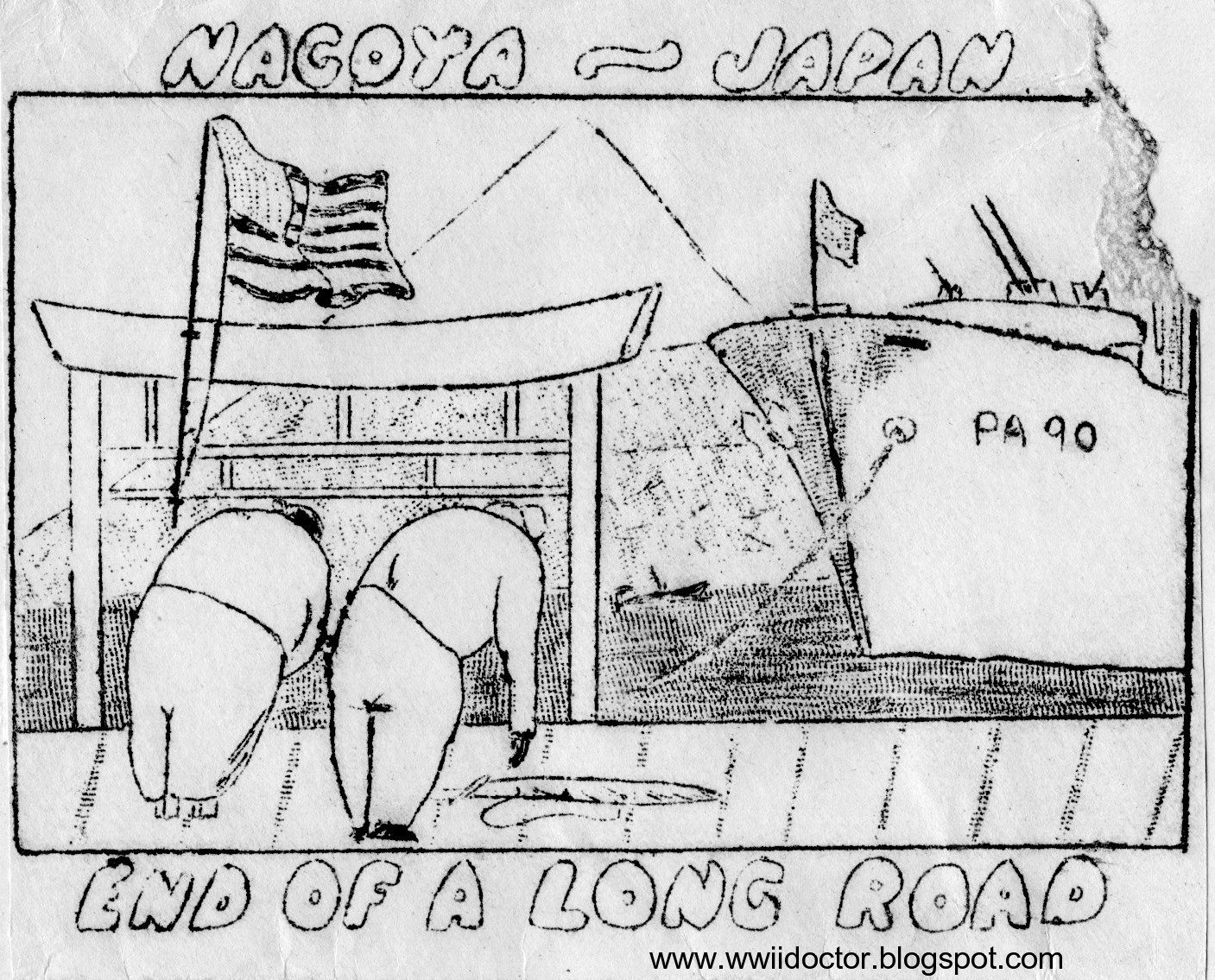
     The men chosen to set foot on Japanese soil as victors of the war were anxious to get home, but were also aware that history was being made around them.  The following article was printed on board the USS James O'Hara, the ship carrying the 92nd Evacuation Hospital to their final destination before returning home.


Editorial cartoon accompanying the following article
(PA 90 is the USS James O'Hara)
Nagoya Base News Combined with 'The Invader'
Special Edition Aboard the USS O'Hara
Oct. 6, 1945
HISTORY IS MADE: Souvenir of Epic Trip

     This special souvenir edition of the Nagoya Base news has been made possible for the troops and crew of the USS O'Hara through the cooperation of the Ship's Office and the Information and Education Section, Nagoya Base.  It may be mailed home.
TYPHOONS DELAY SAILING
     (I-ER [The Invader?]) Time and tide may not wait for any man but the USS O'Hara waited for a typhoon to run itself out.  Figuring the troops aboard would rather spend a few extra days in a safe harbor than at sea in a raging typhoon, Captain Miller of the USS O'Hara delayed sailing on the 27th of September and raised anchor on Oct. 2.
     The seas during the months of July to Sept. are always dangerous, with high winds between the coast off Japan and the mainland of the Philippines.  The heavy winds and torrential downpours have reached velocities high enough to capsize destroyers and damage light cruisers.
     Although the "Fighting O'Hara" has been pounded by heavy seas in the N. Atlantic, a typhoon would probably do considerable damage to the ship and personnel.
CHILDREN OF CREW AND TROOPS WILL STUDY TRIP OF USS O'HARA IN THEIR HISTORY CLASSES
     (I-ER)  This may be just another "boat-ride" to the weary GI's aboard the USS James O'Hara but to the children who will read about this trip in their history books it will be a momentous event.
     For the first time in the history of modern Japan a foreign army will be on her soil and making it even more significant, is the fact that this is one of the few times in the history of warfare when a conquering Army invaded another nation completely unopposed.
     Back home today mothers, fathers, brothers, sisters, sweethearts and wives are reading the story.  On the North Pacific Ocean off the coast of Japan today the men on the USS O'Hara are making that story.
     All that happened since Pearl Harbor on the Pacific fighting fronts, and all the work before and since Pearl Harbor on the home front has been for one purpose: this trip of the USS O'Hara and her sisters-in-arms.
     The squadron is scheduled to arrive at the entrance to the Inland Sea of Japan at about 0600, Saturday, October 6th.  The actual time and place of that landing had not been decided a this special edition went to press.  There seemed to be two landing possibilities: Wakayama or Yokkaichi.
     On that not too distant date when the bright eyes look up and ask "And what did you do in the war daddy?"  Those who rode the USS O'Hara can look down and say, "Son, I was one of 200,000 American soldiers out of 8 million who went ashore on the home islands of Japan."
SAGA OF A SHIP
     (SO) The James O'Hara was commissioned on Apr. 26, 1943.  First European operation was Sicily, July 9, 1943 when it landed the 45th div.  Next came Italy on Sept. 9th.  In these operations she was under air attack seventeen times.
     Then to the Pacific on Saipan when the 4th Marines were landed June 15, 1944, followed by the Anguar invasion when the 81st div. troops were put ashore Sept. 17th.  On the heels of this operation came the Leyte campaign with the 1st Cav. Div. landings on Oct. 20.  While laying in the Leyte Gulf she was hit by a Jap suicide plane.
     The year of 1945 saw her strike at Luzon with the 6th Inf. Div.  Then the final combat target was bloody Iwo Jima where the 3rd marines hit the beach on Feb. 24.
     In all previous operations the USS O'Hara traveled 78,000 miles, crossed the equator 20 times and the International Dateline 4 times.
I AM THE O'HARA
     (SO) I am the James O'Hara, serving under articles of commission in the Navy of the United States of America, as a transport for attack.
     In the Spring of 1943 my crew flung the long, thin, pennant to the breeze; tested my engines; fired my guns, tested my rigging; and found me worthy.
     After that time I came to know the emerald waters of the Caribbean; the gray spume of the Atlantic; the sky-blue of the Mediterranean.  I felt the pounding of the feet of thousands of fighting men; the scraping of their battle gear on my decks; the shuddering jar of depth charges searching out unseen enemies below the surface of the ocean.  I absorbed within me the panting breaths of fearful men.  I jerked with the clapping thunder of my heavy batteries; the staccato rattle of my twenty millimeters.  I felt the burdened clanking of the debarkation ladders as men went down my sides to the boats which took them to hostile shores.  I listened to the harsh breathing and wild babble of men carried aboard, wounded, bleeding, dying.  I have drunk their blood into my steel veins and so gained rage and courage, to carry me on.  I have known heroism and cowardice.  I knew in turn the mixed scenery and smells of Africa; the fresh green of Ireland and Scotland; the raging crash of the North Atlantic; the nostalgic waters of America.
     And so passed the year 1943.  I left some of my crew there, on foreign shores and in the deeps of foreign waters, forever.  Others went to new ships to pass on the knowledge and experience they had gained while with me.
     Then with the new year came a new world for me and my crew.  We steamed slowly through the wild, untamed beauty of the Panama Canal; the blue-green of the Pacific.  We came to know the unparalleled, changing spectrum of Hawaiian waters; the miracles of Diamond Head and Waikiki; the shattered palms and burning sands of Eniwetok; the stink of Guadalcanal; the watery grave of the five Sullivan boys [five brothers who served together on the USS Juneau and went down with their ship when it sank off the coast of the Solomon Islands]; the mountains of New Guinea; the death-trap of Saipan; the swoolen [sic] floating bodies at Angaur; the false security of Leyte Gulf; the loss and gain of days over the Date Line; the breathless heat of the Equator; the hellish humidity and deadly monotony of all Pacific islands; the glassy seas and sickening vacuum of the doldrums [low pressure areas on the sea with little air movement]; the stink of rotting jungle; the endless distances, and the time and memory-destroying stretches of tropical seas; the hush of the passage through Jap infested waters of the Surigao Straits in the dead of night; the awful, slow spiral of burning planes falling into the sea; the horrible futility of a Jap suicide plane crashing my steel skin; the return of MacArthur to Luzon.  To Bataan, to Corregidor; the sickening screech and bust of flame and oily smoke as more suicide planes crushed men and ships; the disgust, rage, and tragedy of half-masted colors when dead men slipped off the stern of ships in canvas shrouds; the sickening sweet smell of human blood as it dripped and gushed; the nauseous stink of putrefaction; the slight splash as limbs of the maimed were dropped over the side; the faltering step of men blinded; the palsied, convulsive shiver of nerve-shattered bodies; the click of typewriters listing the dead and wounded, and writing the poor message of condolence.
     I know the exhausted looks of the crew after grueling months at sea in combat and monotony of routine.  I have watched smiles change to carved lines around eyes and mouths; laughs drop to muttered curses; friendly horseplay to listless steps and dull dejection.  I got to know the letters that men write home - letters of hope, pride, fun, love.  I saw them change.  [The rest of the article is missing.  We will return to Gene's diaries and letters with the next post.]
The arrival of the USS James O'Hara into Nagoya harbor
     

Monday, June 18, 2012

To Japan: Up and Down and Up and Down (75)

     Gene (and Capt. Yount and Capt. Vinicor) were going to be stuck in Japan for a while.  In addition to that bad news, Barnes, and enlisted man, forgot to turn the ice cream machine off when he went on a date, and the entire machine was ruined.  No trip home, and no ice cream!  Then a little good news: the whole outfit was going to Japan before anyone could go home.  The rumor was that 19,000, or 42% of the medical corps would be going home by January 1.

September 19, 1945  Rain every evening for past 3.  High winds this afternoon.  Typhoon somewhere? [This typhoon was to become a major player in the ensuing drama!]

September 21, 1945  We started loading today, including footlockers and bed rolls.  We'll live in the officers' club!

September 25, 1945  Left camp at 0900.  On board APA 90 [an 8600 ton, 2200 troop capacity, army transport ship named the USS James O'Hara] by 11 AM at San Fabian off white beach 1 [the northernmost landing beach in Lingayen Gulf] .  Quartered nicely.  Hot.

September 26, 1945  I'm police officer for the whole boat!  9 officers and 118 EM [enlisted men] under me.  What a headache!  1200 men on board.  Getting organized.
In convoy heading to Japan on board the USS James O'Hara in rough weather

September 27, 1945  Delayed sailing 2 days because of typhoon north of here.

September 28, 1945  Slept on deck last night.  Much more comfortable.  Lots of trouble with the police job.

September 29, 1945  Didn't sail today.  More typhoon or something.  Pulled across gulf to safer anchorage this evening.

October 1, 1945  Same weather.  Gen. [Walter Leo] Weible [commander of the logistical and administrative group for occupied Japan] inspected the ship.  He said it was O.K.!  Sailed at 4:45 P.M. Mabuhay [in the Tagalog language which is spoken in much of the Philippines, it means "live long"]!

1 Oct. '45
Dearest,
     Now I start my log.  We hauled anchor about 4:45 P.M.  They have 2 [anchors] (used only 1) which weigh 6 and 6 1/2 tons respectively.  Some weight!  They wash the mud and salt off the chain as it comes in.  We turned around and headed north about 4:45 P.M.  Right now we are about opposite Caba, I believe, though it is quite cloudy.  Max [Vinicor] and I lined up at the rail and said "Mabuhay ang Filipinos!"  [sic "Mabuhay ang Pilipinas!" or "Long live the Philippines!"] There are 3 columns of 6 ships each.  We will pick up an escort later.  There are long windrows of ground swells that must be a hundred yards apart.  They seem low but the bow of the ship opposite us is going up 10 or 12 feel almost each time it pitches.  We're up to full speed, I think - maybe 15 knots [17.3 miles per hour].
     This is the 6th time I've put out to sea but I still get a big kick out of it.  But what a joy I'll get out of the next time I put to sea - to come home!
     This morning Maj. Gen. Weible and the ship's Exec. made the rounds on our usual inspection.  The general said it was better than he thought it would be!  The ship's Exec. seems to be a cultured sort of gentleman and wears a partial beard and looks distinguished.  I've heard nothing about the typhoon, except that it was passing N and NW of Luzon.  Probably these rollers are from it, for we've read that they may extend several hundred miles from the center.  Apparently they expect some rough seas.
2 Oct. '45
     8 P.M.  Hi Sugar!  Last evening, all night and this morning we had lots of ups and downs.  I wasn't certain when I went to bed about 9:30 whether I was going to be sick or not!  Some of the men and officers were, but none within my sight, thank goodness!  By this morning it was rougher but fortunately we were running almost straight before the wind, with the waves gradually catching up with us.  We were making about 14 knots [16.1 mph] and still the wind was pushing us ahead.  Some of the other ships were really rolling and twisting, much worse than ours.  The clouds began to thin and the wind to go down around noon, so it has been smoother.
Signal flags and radar on the USS James O'Hara
     We've passed Luzon and are going almost due east.  We see occasional islands and some fantastically shaped peaks of rock.  We are to land about 40 or 50 miles west of Osaka, I hear, because the Nagoya harbor is bad.  It will be the same place the 33rd landed.  Then we will have about a 200 mile ride to reach Nagoya.  Yep, see the country!
3 Oct. '34
     It was quite calm all of today till this evening about mess time when we began doing a slow rise and fall on heavy ground swells that parallel the course of the ship.  The whole ship rises and falls without much pitch - something like a roller coaster effect.  The breeze is nicely cool.  We've been heading NE steadily, with no sigh of land.  We should be somewhere SE of Okinawa by now.
     This morning we began to drop back in the convoy.  The main fuel pump went on the fritz.  With the auxiliaries we could make only 14 knots - one less than the convoy, but now at dusk we are catching up again.  You know in a combat force, if a boat has to drop out, it is on its own with no one allowed to delay for it!
     Already we can note the difference in the daylight.  It was light at 6:30 this morning and dark at 7 this evening.  I did some laundry today and read.  The Police job is doing better and doesn't take much time.  I read several lives out of Plutarch's Lives [a series of biographies by Plutarch of famous men; he paired a Greek with a Roman and explored the influence of character for each man].  I can't say I'm very crazy about his style.  Now I'm reading "Followers of the Sun" by Harvey Ferguson.  It is a series of 3 stories about the west, particularly New Mexico.
4 Oct. '45
     More typhoon dodging!  This morning it was quite rough for several hours.  The General went along on inspection and we were all staggering around in great style.  Thank goodness I wasn't sick.  A fair number were.  The General was quite pleased with the policing of the ship.
     Then around noon we slowed down and almost stopped.  Finally we turned around and headed for Okinawa and are still pointing that way.  It hasn't been rough but a high wind is blowing so it may kick up.  The latest dope has us landing at Wakayama, about 40 miles south of Osaka.  Time will tell!  Today I started reading [Hendrik Willem] Van Loon's "The Arts".  So far he hasn't said much about Art.  Apparently the Japs don't use perspective in their pictures! 
     It is a bit cooler but still hot enough in the stateroom.

5 Oct. '45
     We're really bouncing this evening.  In fact this is about the roughest I've ever experienced.  It's been rough all day, though there has been almost no wind or whitecaps.  It must be the aftermath of the typhoon we dodged.  Several times this evening the waves have come over our anchors and into the hawser pipes at the bow, a total rise and fall of about 20 feet.
     We've been watching some poor KA (cargo assaults) that are heavily loaded.  They have taken solid water several times.  They look as though they were trying, alternately, to stand first on their front legs and then on their hind legs.
     Today has been quite dull.  After inspection this morning I read and gazed at the sea.  We must be about opposite the south end of Kyushu.  I've wished many a time that this boat was headed for the USA!

Next, a special souvenir edition of the Nagoya Base News for the troops and crew of the USS O'Hara! "This may be just another 'boat-ride' to the weary GI's aboard the USS James O'Hara but to the children who will read about this trip in their history books it will be a momentous event."

Friday, June 15, 2012

Excitement and Disappointment (74)

     Japan has unofficially surrendered, so the men of the 92nd wait to find out what happens next.
Entrance to Camp John Hay in Baguio, where the Japanese envoys signed the documents of surrender

August 25, 1945  It is said we'll go to the Kobe area in about a month with the 25th Division.  Nothing to do, except read.  Now I'm at "Henry Esmond" [a novel about the English Restoration by William Makepeace Thackeray].  Men going home on points.

August 26, 1945  A quiet Sunday.  No mail for several days, the planes supposedly being used to take stuff to Japan [medicine and food?].

August 27, 1945  [Capt.?] Max [Vinicor] and I went to I Corps to see if we could do anything about the dirty deal we got on the TD [temporary duty] situation.  Nope, we are simply Dittled [diddled?] on the Digit of Destiny.

August 28, 1945  Occupation of Japan began today.  I turned in my carbine and shovel.

August 28, 1945  I heard today that we were slated to land on H+5 [five hours after the first landing] with the 33rd Div. on the east coast of Kyushu, and the 25th with the 98th in reserve.  G-2 [army intelligence] now says that their estimate of 5 Jap divisions opposing the landing was correct.  Oh, man!  What a hot spot that would have been.

Modified CIA publications map
August 30, 1945  We probably won't leave for another 6 weeks.

September 1, 1945  "First to the May Co. [a Denver department store], then back to school"! [Gene must have been musing on the advertisements he remembered receiving around the time that school started in Colorado].  This is the nicest part of the year at home.  Working on my lecture [he explains more about this later].

September 2, 1945  Heavy rain last night.  I received 30 letters, 13 from Beth!  Also the formal Jap surrender was signed.

September 3, 1945  Rainy day.  I gave a lecture on Japan and her Empire, to the outfit.  Some of the gang went to Baguio to see Yamashita surrender.

September 5, 1945  Painting footlockers.  Received Jap language book.

September 6, 1945  No more censorship!  I sent home a bunch of papers, pictures from Maptalk [a weekly magazine with restricted distribution to the American armed forces in the Pacific theater] and my diaries.  No more blackout on board ship!

September 7, 1945  Put 2nd coat of green paint on my footlocker.  New point system score for officers.  My 75 is a long way from the 100 required for field grades.

September 8, 1945  18 or 20 LST's are pulled in down by Lingayen to load.  They passed out some overseas stripes.  I'm going to sew on 5 right away - may as well!

September 9, 1945  Heavy rain last night.  Japs say they expected us to land at Kyushu late in October and were saving all their planes to repel it!

September 11, 1945  All night rain.  Rumor says all troops here now will be home by Jan. 1st.  That is 4 months!

September 12, 1944  Larry Williamson left on points - 97.  He had 25 months in Alaska [which was counted as overseas] and 16 over here [Gene had 11 months in the California desert and almost 27 months overseas].  I bought window-pane clamshell boxes P3.50 [$1.75].

September 14, 1945  Point system [can go home with one of the following] 1) 80 points 2) age 48 or 3) pre-Pearl Harbor.  Only [Capt. (?) Max] Vinicor, [Capt. (?) John] Yount and I fail to qualify of the whole gang!


Counting points, all of the doctors who started when he did should have had the same number of points for time in service (38 months), time overseas (26 months) and campaigns (New Guinea and the Philippines), or 74 points, so the other doctors must have been older, had children, or received awards (Gene didn't get his Bronze Star until later).  Vinicor and Yount were younger than Gene, and hadn't been with the 92nd quite as long.  


Wednesday, June 13, 2012

Morale Modifiers: Japan Surrenders! (73)

     The scenario: Maj. Gene Pfile was expecting to further his surgical skills at a refresher course at the 120th General Hospital which was located at the St. Thomas (Santo Tomas) University in Manila.  The U.S. Army Medical Department, Office of Medical History, in the book, Surgery in World War II: Activities of Surgical Consultants, Vol. II (p. 633) stated: "Suitable assignment was perhaps the most important single factor in maintaining good morale. A medical officer would tolerate hardships if occupied by work in which he was interested and for which he had aptitude and training. Medical conferences, journal clubs, and attendance at medical meetings all bolstered morale, as did the establishment of library facilities and the circulation of medical journals. ...The programs usually were well thought out and excellent."  But they later noted: "In personal notes taken by the surgical consultant, he recorded that long periods overseas without any definite knowledge as to their prospects of being replaced was influencing the morale of medical officers."
     Gene then expected to return to the 92nd Evacuation Hospital, and prepare for following the front lines in an invasion of Japan some time in the fall.
Cartellas on the road to Manila

August 5, 1945  To the 120th Gen. Hosp. at Santo Thomas [sic] in Manila.  A long hot dusty rough ride in a 2 1/2 ton - 150 miles.  Capt. Bottsford of the 3rd Field [Hospital] is here for a course [and assigned as Gene's tent mate].
University of Santo Tomas in Manila

August 6, 1945  Made rounds and saw the hosp. with Lt. Col. Hartwell, Chief of Surg.  In the P.M. with Maj. Monroe.  Apparently I'll be doing some ward work. [Historical note: the atomic bomb was dropped on Hiroshima.]

August 7, 1945  There will be no formal instruction to this so-called course!  Hard downpour of rain this P.M.

August 8, 1945  The atomic bomb has us all amazed.  Will it end soon? [Historical note: Russia declared war on Japan.]

August 9, 1945  Rumors that Russia declared war on Japan!  Later: Is so!  Lovely!  I'm on the O.D. [officer of the day] list, and on Surg. Group A.

August 10, 1945  To the regular meeting at the 60th Gen.  They have a fine place.  Heard rumor that we were to start glider training and support the 11th Amphibious Div.!

But something even better for morale happened!

August 11, 1945  ...  Last night at 10:45 I was awakened by shouting and shooting and the unofficial report that the Japs give in [official surrender was September 2, 1945].  I heard that 9 people were shot to death!

August 12, 1945  Awakened at 0130 by my "happy" tent mate Bottsford to hear more whistles (ship), church bells and shooting.  A fiendishly hot day.  Still no wind.

August 13, 1945  A bitter pill to swallow - the August quota for leave is going - Adams [not called the usual "Sparky"], Chaplain [not noted as "Padre"], Burroughs; Mihalick goes by some trick of [the commanding officer of the 92nd Evac] Huey.  Why do I always have such luck?

August 14, 1945  S.O.D. [surgical officer of the day] today.  A rather busy evening - opened 2 hand abscesses, sewed up 2 cases, calls, etc.

August 15, 1945  It is officially released that hostilities have ceased.  Oh happy day!  I was up until about 2, slept till 6:30.

August 18, 1945  Ward and clinic.  Jap doesn't seem to be for giving up!

August 19, 1945  Now I have 3 wards - about 75 patients.  ...

August 20, 1945  Called the outfit [92nd Evac.] last night.  Asked for a vehicle.  Rainy weather part of the time.  Haven't been down town.

August 21, 1945  Still expecting transportation. ...

August 22, 1945  Still waiting.  Something is very screwy, somewhere.  [Col.] Huey must have it in for us.

August 23, 1945  About 12:45 the men came for me so I packed and left in a hurry.  The truck had been picked up by the MP's [military police].  It took us 7 hours in a weapon carrier [to go about 150 miles].  Had some mail.

August 24, 1945  Glad to be back at the outfit.  Termites were in the bamboo bed frame.  Everyone is sore at Huey, and with reason.  I still think he snafued my leave.

But Gene was able to put aside those bad feelings at the reunions.  Former Col. Huey sat next to Gene in 1974.
The uncropped photo from the 1974 reunion:
former Col. Huey next to Gene and Ed Gray

Monday, June 11, 2012

What Can't Be Changed ... (72)

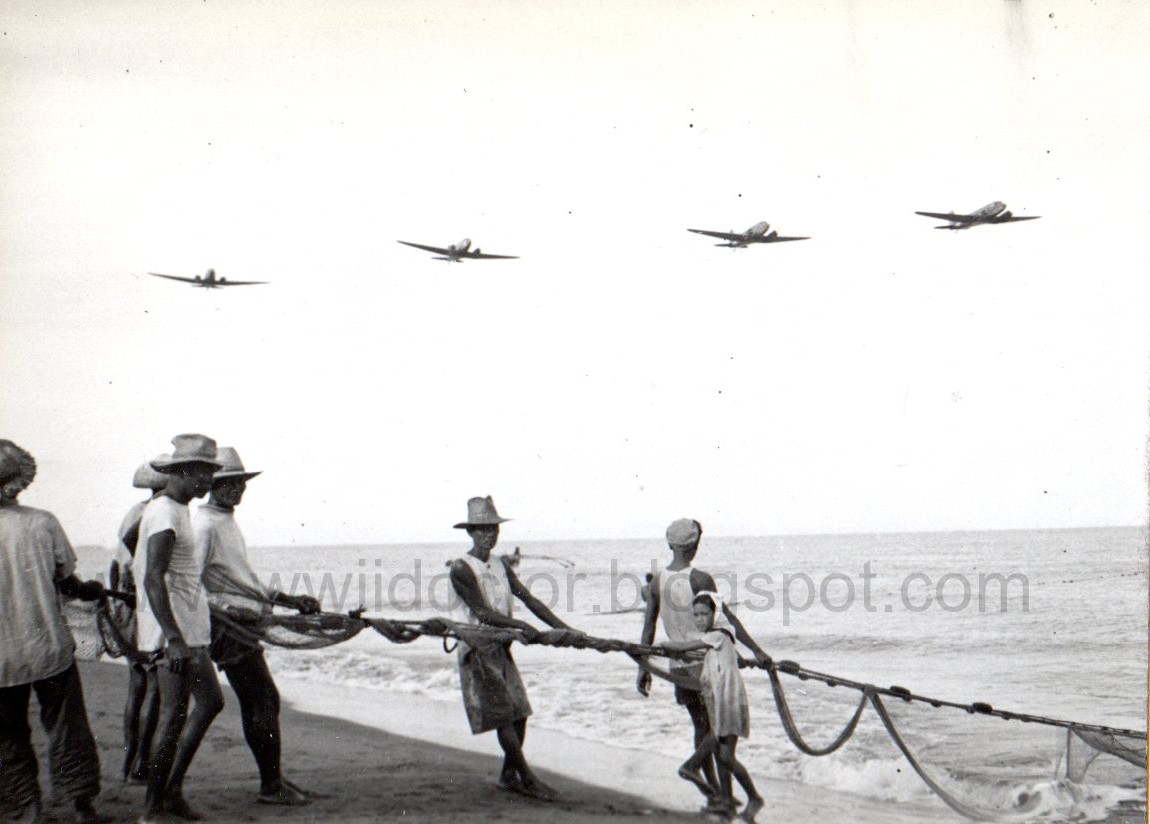
     Life settles into a routine in Caba.  Incoming patients are sporadic.  The census is 150.  Gene has time to play volleyball and develop black and white photographs.  Perhaps the following, one of my favorites, was one he developed.
Filipinos drawing in their fishing nets on the beach at Caba with U.S. transports overhead (I originally wrote "bombers", but my sister, a pilot, corrected me!)

July 19, 1945  There is a possibility I may get to take a 6 weeks refresher course in gen. surgery starting Aug. 1 at some Gen. Hosp.  ...

July 21, 1945  I tried trolling [for fish] from the homemade sail boat.  No luck.  Rice planting is in full swing.  When a carabao gets too hot, he just lies down in the mud and water!
The chapel at Caba was located in a temporary building instead of a tent

July 22, 1945  Sunday services.  Played volleyball and wrote some letters.  Things are quiet.  [Maj.] Sparky [Adams] has amoebiosis.  ...  We have 300 patients.  Weather hot and sultry, with occasional storms.

July 27, 1945  The more we hear of the point system [one point was awarded for each month in the service away from the 48 states, five points for each combat award, and 12 points for each dependent child under the age of 18 (for a maximum of three children)] and T.D. [temporary duty] the madder we get!  Snafu [situation normal, all fouled (or f***ed) up], completely.  Japan says they refuse our Potsdam ultimatum for unconditional surrender [the ultimatum on July 26, 1945, stated that if Japan didn't surrender immediately, it would face prompt and utter destruction].

July 28, 1945 ... They say the Jap landing is moved up but no rumors when.
 Sailboat probably made by army personnel from which Gene trolled for fish several times without catching any

July 29, 1945  Continued hot and dry.  I tried trolling from the sail boat for an hour - no luck.  I signed up ($2.00) for a Self-Study course in "Outline of Hist. Geology".

July 31, 1945  High surf along the beach, without much wind.  Full scale amphibious training starting for the 33rd Div.  Lots of LST's [landing ship, transport], APA's [assault personnel attack ship?], LCVP [landing craft, vehicle personnel], LCM [landing craft, mechanized], etc. etc.
Amphibious tanks (alligators) at Caba

August 1, 1945  Donovan finally left today on T.D.  ...  Beth finally heard my sad story and she is so grand about it.  She is the most wonderful there is!

August 2, 1945 Still another time away from Beth on her birthday [her third birthday for which Gene has been overseas].  How long does it have to last, this separation?

August 4, 1945  Orders came in last night for me to go on TD to the 120th Gen. Hosp. APO #1011.  I hear that it is in Santo Thomas, Manila.