Wednesday, August 8, 2012

Home, Boys, Home, with a Sigh from Gene! (92)

     Gene and Maj. (?) Nigg went from Kyoto to Osaka before returning to Nagoya.

October 29, 1945  Went to I Corp Surg. at Osaka.  Left for home at 1, arrived at 7 P.M. in dark.
Osaka
Map modified from zonu.com showing Nagoya, Gifu, Kyoto and Osaka

29 Oct. '45
Beloved,
     Well, we got back and that's about all.  Oh what a tiresome ride!  But to go in order.  We had breakfast at 7:30 and went down to the offices at 8 and talked for about an hour.  There at 6th Army they say everyone eligible is to be sent home.  It is pitiful how messed up and ignorant of conditions Headquarters is at present.  They had been told this building [in Nagoya] was not suitable for a general hospital!  We put them straight in that and a few other things.  But they said we were under I Corps at Osaka, so we went down there (about 20 miles - mostly cement roads) and arrived at 10:30.  There we got the old run around and double talk.  The Surgeon there says we are attached to the 25th Division so we'd have to see them!  But it looks like Nigg can send the eligible ones out.  To do the work here [Nagoya] they will send in officers from a general hospital on account of the old 92nd is going on and on!  They may close others, but ours - never! [The higher-ups changed their minds -again- and the 92nd Evacuation Hospital was inactivated February 28, 1946.] Isn't that a crack [up]?  What do they need with an evacuation hospital?  Oh well, it will work out and I'm not bothering my head about it.  When my time comes, I'll get out, or else!
One of the many bridges in Osaka
     Well, we went over to the officers' hotel to eat and they wouldn't let us in because we weren't in khaki uniforms with ties!  So we went over to the casual officers' place.  It was the best deal for casual officers I've seen - Jap waitresses, white table cloths, silver, etc.  Good food, too!
     Then I went out and took a roll of Kodachrome.  It was chilly on the way back but we had blankets.  We went for 50 miles again without seeing a GI vehicle, though we passed some Jap trucks and hordes of people.  It was not quite dark when we finished the poor road and the gas was getting low.  After another 15 miles we turned into the road where we could expect to meet some GI cars.  We went a mile and ran out of gas.  We opened up some rations, I put on my wool undershirt and while I was doing that a jeep came by, stopped and we got gas!  We gave them some C rations and came on home.  We drove around Nagoya a while [getting lost, not sight seeing!], coming back to the edge of town once, and finally found our way to the hospital.  Nothing had happened here.  Everyone dropped around to the room to see what we had found out.

     Their trip and Maj. (?) Nigg got things moving.  The next entry in Gene's letter home shows the result.

30 Oct. '45
     Yea verily, this is a glum evening.  Practically all the gang left this evening.  [Maj. Arnold]Neimeyer and [?] Jensen volunteered to stay a few days.  Otherwise, [Capt.? John] Yount and [Capt.? Max] Vinicor and I are alone.  But I'm mighty glad the others got away and as it now appears, safely.  You see, the 25th Div.  and the Nagoya base are trying to set up their organization and there are so few medical officers immediately available - i.e. on the face of it.  Actually, there are 2 general hospitals sitting in the bay with a low priority for unloading.  All that is necessary is for the Div. Surgeon to whistle for 'em and they could be here.  So the soldiers won't be neglected.  Well, the 25th Div. general says he has permission from the 6th Army to hold all officers and men for a while, but he sent no direct order to us, so Nigg went ahead on 6th Army orders and sent everybody out.  Then Nigg and I went to see the Surgeon and said they were gone.  He fumed a bit but then said that what was done was done, and then started to do the sensible thing - plan to get the general hospital in soon.  Apparently this outfit will move in and take over and we will store out stuff and be attached to them.  That will suit me fine.  If Nigg gets away as he should I'll be CO of a paper work hospital - do the administrative work with the help of the non-coms (who know the ropes) and that is all!  So it should work out O.K.  But it makes me sad to see the old gang go.
     All my love, Eugene

Monday, August 6, 2012

Letter from Kyoto (cont.) (91)

     Gene continues his letter to Beth about the conditions in Kyoto.
Scene from downtown Kyoto

Kyoto
     After we came to Otsu, we came out on a good wide cement road that turned west up some nice hills, with an electric car line along it.  We made good time along it to Kyoto.  Kyoto wasn't touched (Phil Moore of the B-29's said MacArthur gave orders to leave it for his headquarters!)  About the only sizable town that wasn't.  It is quite a large town - nice buildings, department stores, office buildings, etc.  There certainly are a lot of people here and some army.
    We got to the Surgeon's office in time to talk to one man and to learn a few things.  We know the Col. at this building so it was suggested we throw ourselves on his hospitality.  They were eating when we came - a dandy dining room.  This outfit is the HQ for what was a medical regiment.  They have separate ambulance companies, clearing companies, etc.  There are only a dozen officers here.  The Col. (Draper) is the CO and the only medical officer - he has to hold sick call for his men!  We had a fair supper in a nice warm room.  It was chilly in the jeep!  Williamson [a doctor who joined the 92nd Evac. fairly late in the war] gave me a new pair of woolen gloves at Baguio that he'd brought from Alaska.  They were a comfort.
     At dinner I met a Rev. Burns, a priest who has been in Japan 16 years.  He was isolated but not interned.  He was going this evening to pay his respects to Miss ?, an 82 (?) year old lady whose birthday it was.  I read about her in the paper on the ship.  She came to Japan 50 or more years ago.  She is the only American the Japs didn't have under some kind of control during the war.  This priest is elderly, nice looking and very pleasant.  He told me about how apprehensive the Japs were before the occupation.  He said a policeman told his (the priest's) cook that we'd take a bunch of women, put needles thru their palms and sew them together in a long line, then take them to the ocean and tow them out with a boat until they drowned!  But since she [the cook] had been with him for 10 years, she didn't believe it.  She went to market the other day and on the streetcar overheard 2 Jap soldiers talking.  One said he had been gone for 4 years and the other, 5 years.  They told each other it had been mighty bad.  The one said "And for what?  Look how it is since the Americans came.  It would have been better to have given up long ago!"  Another conversation she overheard was between some women.  One said that the Americans put them to shame.  That the Jap people were once polite, but now the GI soldiers were teaching them politeness.  She said that on streetcars or trains a Yank (standing himself) would take a young Jap man by the shoulder and make him get up and give his seat to an old Jap man or woman.  Such reports are most gratifying, aren't they?  This priest, when war broke out, had just finished building a TB sanitarium for poor Jap people with money collected in the States.  An order of Jap Sisters were then permitted to take over and run it.
     Tomorrow we will see some men and then try to find a better road home!  Apparently our officers will be able to go.  The EM's [enlisted men] haven't been held up.  The 25th Div. seems to be holding its officers but we aren't under them now.  This Lt. Col. Bumgarten says the 92nd will not be de-activated - that it will be given men from general hospitals.  But the field hospitals well be merged and some de-activated.  So I don't know - maybe I'll be
CO and maybe not.  I hope not!

[Gene now adds some more information about Nagoya]
     Back to Nagoya - all our stuff was unloaded and brought up last night [the night before the trip to Kyoto].  I found my footlocker about 8:30, uncrated and opened it.  Everything was fine.  Gosh but I have a lot of stuff in it!  I declare I'm going to throw plenty away before I come home!  In our room we have a large cabinet with shelves and some drawers and sliding panel doors.  But hanging up things will be a problem.  We don't like to drive nails in the good plaster walls.
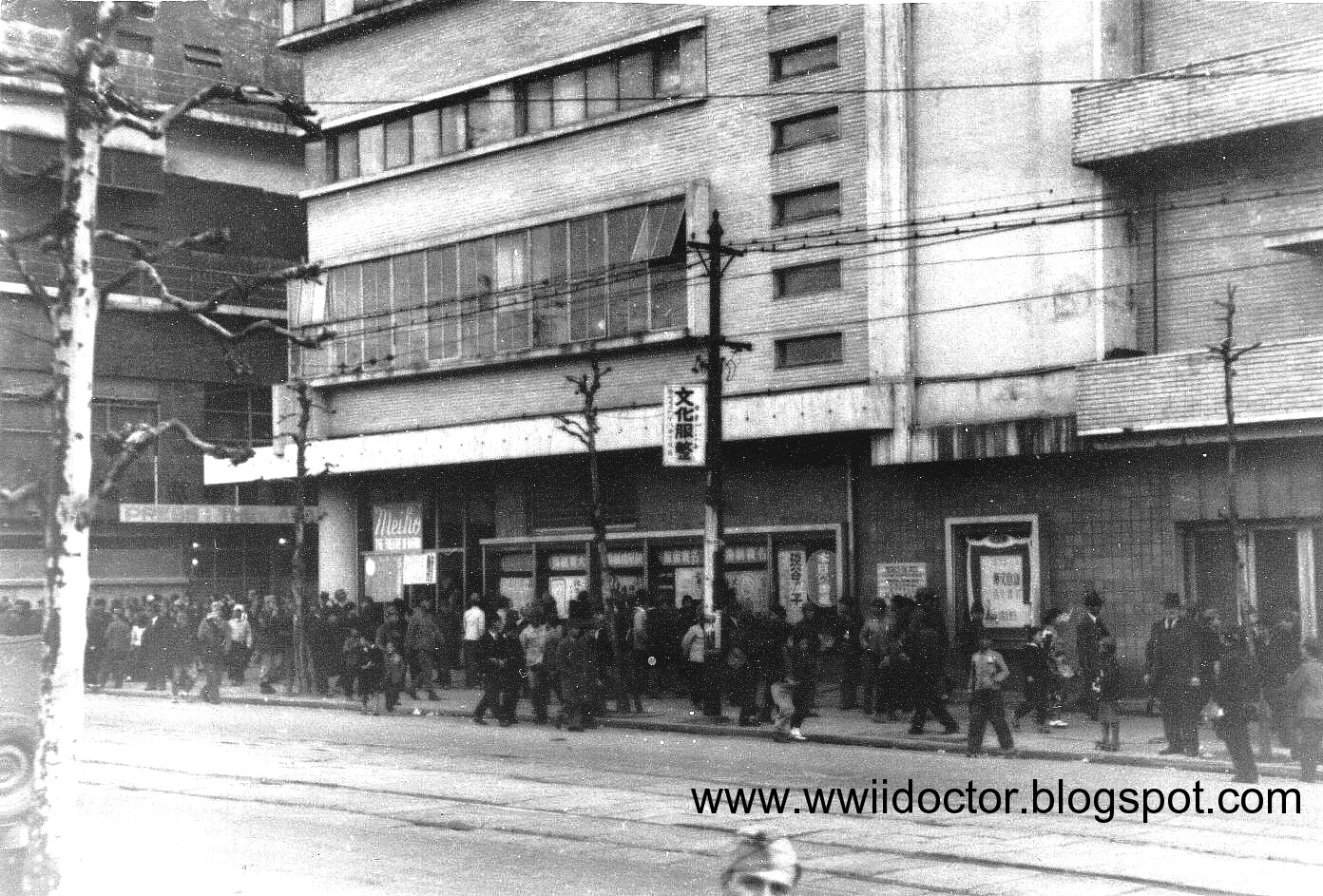
Building where the 92nd Evacuation Hospital was set up
in Nagoya
     I took more careful; note of the building.  It is a T shape, 5 stories in front and 6 along the [back] part, with a large auditorium on the 6th floor and a solarium on the roof.  The outside is of smooth white brick facing, but above the ground floor it has been painted over with black and dark red, which is wearing off and streaking.
     Last night I had a poncho and a double blanket under me and 2 over me (one doubled).  I had a pair of heavy socks and a cotton T shirt but about 4 A.M. I got chilly and stayed that way.  This morning I found my duffle bag and got out my air mattress and pajamas.  The room we have here for tonight [in Kyoto] has steam heat.  In our room this morning it was down to 60°.  In about 2 weeks we should have steam heat in our rooms so it will be comfortable.  They don't have hot water in this place so we are ahead of them on that score.
     One remarkable thing about the countryside here is that most of the houses out in the country have electric lights but they certainly don't seem to have any appliances!
    

Friday, August 3, 2012

On the Road to Kyoto (90)

     Gene is always ready to take advantage of spur-of-the-moment rides, as we see in this post.

October 28, 1945  [Herb] Nigg [an administrative officer ? who had joined the 92nd Evac in Owi] and I (and Lt. Griffith of the 32nd Field Hosp.) went to Kyoto by way of Gifu [about 125 miles].  Left 11 A.M. arrived 4:30 P.M.  What a road!  Stayed with 135 Med. Grp.
Modified map from hhh.gavilan.edu

28 Oct. '45
Beloved,
     I was in the billiard room but it was a bit chilly there so I'm now in the lounge and it is nice and cozy.  The radio is playing.  I'm in a nice easy chair with my feet on a carpet.  No, this isn't Nagoya, it's Kyoto!  This is a former University Club and is it a dilly!  The 135th Med. Group is stationed here and we are staying the night with them.  There are large ornamental light globes and wood paneled walls - a really snazzy place, steam heat and all!  It is a long story - also a long trip!  Nigg wanted to come over to see 6th Army to see what the score is and also to find out about himself and the other officers going home.  So, since I'm apt to be the next CO [he was the highest-ranking doctor of the three in the 92nd Evac. that would be left in Japan], I wanted to come too.  We heard it was a 3 1/2 hour trip over good roads.
     We left about 11 in a jeep with a driver.  Well, we arrived about 4:30 and what a road!  Sugar, you know our difficulties in touring the USA, getting on all the wrong roads [Gene and Beth enjoyed driving around the country seeing the sights].  Well, with signs in Japanese, a map with all the towns in Jap spelling, and their highway system here.  Oy, gevalt!  We took the wrong road out of town several miles and then got to the main road.  I guess it really wasn't so difficult.  We had the large scale Army maps and would point to it and show someone and by saying the name of the town we wanted and by sign language we'd get the general direction.  The highway was cement for a ways and in fair shape.  I can see what the air force meant when they said they were running out of targets.  Golly sakes but a lot of the industrial towns and villages are burned out!
     But to continue.  We headed for Gifu, NW of Nagoya.  We took a turn off the highway because the sign said to.  About 4 miles along on a narrow, twisting road thru an almost continuous village, I knew we were going the wrong direction and finally saw a sign for Gifu pointing the way we had come.  So we went back.  But we saw the sights - bamboo groves, rice fields and raw silk places with spindles of silk that had been dyed out in the sun. 
     At Gifu we drove into town before we knew that was it.  Then we asked for Ogosi and turned back SW.  We had good roads, more or less.  Then we continued on W toward the lake.  We saw quite a range of small mountains with what appeared to be a gap.  In that town we made a false turn and looped back.  There were signs in English spelling of the towns at important turns but their directions were not always clear.  In one town we went all around Robin Hood's barn, on the proper road, however.  It was a main road, but became dirt or gravel, about wide enough for 2 jeeps to pass.  We met a fair number of Jap trucks but no army vehicles of any kind!  But the road wasn't empty!  Oh no, it was simply a stream of people for quite some distance, even in the hills!  People walking, carrying huge loads on their backs, on bicycles with huge loads or pulling great long 2-wheeled carts piled high with boxes, or bundles of brush and branches of wood or lumber - just all sorts of things!
One cart of the many from the stream of people moving down the road
     But the road - words fail me for describing a main highway!  It was just one track.  Jeeps could pass in a pinch.  It ran thru villages where houses were built close to it, between walls, up hill and down, between rice paddies with densely forested (pine and cedar) steep hills beyond.  The railroad (double track) was always near so you can take pictures, but we were in a hurry.  Quite a few houses had steep thatched roofs - thatch about afoot thick, with green moss on the north side.
     There were dozens and dozens of shrines all along the road everywhere, usually in a nice grove of pine trees, one or more toriis ... 2 or even long rows of stone lanterns, sometimes stone lions or foxes, and then the shrine proper - small wooden ones or large tile-roofed ones.  I just wanted to take pictures of each one!  They are all so interesting and picturesque.
     In the higher valleys there was timbering going on, but not even the small branches are wasted.  What loads the people were pulling - men, women and children.  In several places there were bunches of small red chili peppers drying on straw mats.  There were miles and miles of houses with straw mats right on the road, with rice or beans drying.
     They don't pound the rice in mortars here.  They do thresh it out with flails or a sort of foot peddle machine with a rotating cylinder studded with wire loops.  Then it is winnowed in the wind or in front of a hand-turned fan.  Rice is cut close to the ground and tied in small bundles.  Some is put in very open shocks.  Some is hung over racks.  Vegetables are grown on all available ground.  There were plenty of the usual fecal odors!
Preparing the rice for threshing and winnowing
     The hills aren't terraced very high along there.  There were a number of nice clean mountain streams.  The people were dressed the same as elsewhere.  Many of the women wore small white cloth head shawls [see photo above].  Some of the men had bands of cloth around their heads fastened with an odd twist.  At most places the kids waved and hollered.  At intervals there were air-warning watch towers - usually 2 long poles set in the ground like a ladder with a tubular-looking bell.  We saw no cattle, no pigs, very few dogs and cats and not many chickens.  The road was rough and was full of chuck holes in places.  It continued a rather narrow road even after we came out by the lake.  From there on, though in doubt at times, we had no trouble following it.


     To be continued.

Wednesday, August 1, 2012

Setting up the Hospital in Nagoya (89)

     After all of the idleness on the ship, Maj. Pfile is delighted to take some photos, then get to work setting up the hospital.
A field near Nagoya with the air base in the background

27 Oct. '45
Beloved,
     Oh me!  Oh my!  Have I ever been flying around and getting little done.  This morning at 8 [supply and transportation officer Ed] Gray was on hand with our trucks and most of our EM's [enlisted men] came up to our building.  Then they sent back weapons carriers [jeep-like trucks] for the officers.  We left about 10 but first yours truly (and I do mean yours, Sugar!) took a roll of color pictures.  As it turned out, it was well I did, for I had no time later.  The sky was cloudless but there was quite a haze in the distance.  This is all perfectly flat around here, with mountains far off.  We certainly saw a burned out city!  We passed huge factories that were mere skeletons and miles and miles of some factory areas that were burned to the ground, with machinery all warped and rusted.  It certainly is freakish how here and there a home or building would be entirely unscathed.  They certainly have lots of cops here on the street corners directing traffic.  They wear blue uniforms with black roll leggings, white gloves and SWORDS!  Can you feature that?  Most are short swords, perhaps 18" overall, but some are long.  They appear to be on the cavalry saber style and not Samurai.  Here and there are shrines and small nooks with shrines in them.  Very few of the tall factory chimneys were knocked flat, and there weren't many bomb craters.  Rusted iron is everywhere.  They have plenty of scrap now!
A tower of the castle in Nagoya; the enlisted mens' barracks
were located on the grounds of the castle
     What a building we have!  It is 5 stories, completely modern and quite new.  One set of elevators is running, complete with floor indicator showing the floor it is at, in lights.  The outside looks rather crummy - dark and in places the smooth brick facing is knocked off.  But the inside!  The front has a marquis [marquee?] in fancy bricks, with part of the roof in glass bricks.  The floors in all halls are of this smooth stone and there are slabs of it in the walls.  There are mail chutes, light colored metal trims.  Most of the metal banisters have been replaced by wood.  The floors in the rooms are of wood (in squares) laid in cement.  The windows are large and the frames are metal.  The toilets are large - urinals and the porcelain "hole in the floor" stools, but with movable wooden seats over them.  I'm certain they were made at the [U.S.] army's orders.  The wash rooms are separate with lots of basins and large mirrors, both are rather low and you have to stoop to use them.  Showers have been added, again at army orders.  This is the pay-off - hot and cold water! and it is steaming hot.  The place must have been built with the idea of a hospital or barracks in mind, for on each floor is a large pantry with gas stoves, sinks, dining room and dumb waiters to a large kitchen in the basement!  The stoves are out, however.  There is a large built-in refrigerator.  We live on the 2nd floor.  The men have to live in some Jap cavalry barracks about a quarter of a mile away, situated in what was once a castle grounds.  There is a moat and walls and the whole area seems quite large.  They won't have such nice quarters.  The 25th Med. Bn. [medical battalion] and the 32nd Field Hosp. (a long time in Italy - a lot of their docs have been overseas 3 years) are all here but not setting up.  We have a few patients already.  The men are all hard at work plumbing and wiring.  We have lights in most of the building.
     Back to my day - we arrived a little after 11 and looked around.  There is one small building next to us and a large [one] set about 1/2 mile away, but otherwise the area is burned out.  We ate our rations about 12 and went to work.  One of the Lt.s [lieutenants] helped me part of the time.  We went to work on the inventory - gave the kitchen a quick once over, and a few other items.  A lot of it we don't need to check such as knives and forks for they are expendable.  Most of the time I spent on surgery, but it was easy.  They [whoever packed] had a complete list of their instruments, and a list of what was in each of their 100 boxes, so we went thru the lists and named off the non-expendables.  So many things are expendable - syringes, needles, supplies.  It would be something terrible to do the millions of individual items.  Sterritt [?] is doing the wards as they set up.  X-ray, dental, lab, ENT will do their own, so while it will tie me up for a few days, it won't e so bad.  Right now I'm waiting to check the receiving office.  A street car and a suburban electric go by here and the suburban's horn sounds natural.  The high point men are all hoping to leave.  I'm sure a General Hospital will take over, for this is an ideal set up for them.  I suppose they will take me over, too!  Oh, well, what's the difference for a couple of months!

Monday, July 30, 2012

Finally, Nagoya! (88)

     The 92nd Evacuation Hospital is Nagoya-bound, finally.  The sooner they get there and set up, the sooner someone else will be able to take over and they can go home.  Maj. Pfile is one of the unfortunate three who will have to stay longer than most (something to do with points?), but he is just as anxious as the rest of the men (the nurses haven't been with them since Owi in New Guinea).   U.S. government publications tell them what to expect.

This Is Nagoya
Oct. 6, 1945 NAGOYA NEWS-INVADER
Page 3
     The Japanese who live in Nagoya are derived from a mixed stock of Monogoloid [sic] and Malayan origins which at about the time of Christ gradually spread over Honshu.
     Owing to the relatively recent growth in the population and industrial development in Japan, the cities are of very recent expansion.  The rural population lives in closely-built settlements and isolated farmhouses are seldom seen.  Originally all cities, towns and villages had a cluster of flimsy single story wooden buildings with slate, shingle, or thatch roofs.  These were usually built around large factories and other installations.
     Except for the modernized downtown business and industrial districts of Nagoya, cities and towns have the traditional Japanese aspect, unpainted frame buildings, with slate covered tiled roofs of nearly uniform height, facing directly on narrow streets surfaced with stone.  Open gutters carry drainage and refuse water from the houses on each side.
     In many of the smaller towns there are no well-marked residential and community centers, most streets are lined with shops, operated by a family living in the rear or in the second story.  The street pattern is commonly rectangular and in the center of each town often becomes irregular.  Rivers and canals are common features.
     Before the war, modern ferro-concrete buildings and factories, wide main streets of concrete were fast making their appearance but "Old Japan", was usually a few yards away.  Recent developments took the form of fire breaks and strategic highways cut through many cities and towns, new airfields, large uniform barracks at military training centers all indicate the migration of population to the war industries.
     All large cities in the Nagoya area, including Nagoya itself, are served by roads and railroads.  Water transportation is generally available, either via coastal shipping at short river sections or canals.  Bicycles and rickshas [sic] are a major means of transportation.  Telegraph and telephone are available and most urban homes are lighted with electricity.  Ample water is available but purification treatment is necessary.
     Nagoya is a city of great importance.  It is a key center.  In addition to its port facilities, pre-war industries of cotton spinning, weaving, watchmaking, it has aircraft factories, machine shops and chemical works.  Railroads were developed and an important flow of trade took place through this rich agricultural area between Tokyo and Osaka.  Roads were usually one lane, all-weather with main military highways widened and straightened in most places to take two lane traffic.
     The monetary system in Japan is based on the Yen.  The present rate of exchange is 15 Yen for on American dollar.  It you do your part in preventing inflation you should be able to purchase many fine articles at reasonable prices.
     The climate of Nagoya and area is mild and the rainfall is moderate.  The winter coldness is not harsh, while the summer heat is not oppressive.  On a whole the weather is very similar to that of Virginia.
     If we follow the rules and the suggestions given to us there is no reason why our stay in Nagoya should not be a pleasant and interesting experience.  There will be a very broad program of athletics and recreation as well as a news and information program.  You will be able to go to technical schools, University Centers and high schools.  You will be able to utilize some of your time in Japan for your own personal benefit, preparing yourself for civilian life.
     Help in planning to get the most out of the G.I. Bill of rights will be given to you.  So remember, we will probably work very hard at first, getting set up but later it will not all be work.

Approaching Nagoya harbor on board the USS James O'Hara (APA-90)

26 Oct. '45
Beloved,
     By gar, we made it to Nagoya, anyway!  Of course we aren't off the ship yet, but we are tied up to the good solid earth and concrete wharf!  It was smooth sailing.  This morning when I went on deck at 6:30 we could see land to the side of us.  We came to anchor at 11 about 10 to 15 miles south of the inner harbor, and ships started up the channel at long intervals.  We started in about 2 and tied up at 5.  It is a large harbor but shallow with a narrow channel that turns and winds quite a bit.  Near the port we came inside the breakwaters.  Most of the ships went to regular docks further up the river or inlet.  We tied up to land directly - concrete walls, etc.  We came broadsides and the ship's boats - 8 of them, about 2500 H.P. [horsepower] represented - pushed us in.  They pushed and pushed but we stuck!  So the ship backed up, went forward repeatedly, the boats pushing all the time and after about an hour they got us up to the quay.  You could see the mud they stirred up when the bottom was stuck.  A ship's officer told me we were drawing 26 1/2 feet.  Because it is so late and most areas for troops are 7 - 10 miles away, we are staying aboard tonight.  They are unloading vehicles which will take till 2 or 3 A.M.  They leave about 6, guided by our billeting officers - if they can be found - to the respective areas, unload and come back for troops.  So we won't have to walk!  There are huge factories, miles in extent, all around.  Most appear to be burned out.  They say that in most of the buildings where troops are to be stationed, there is no heat and not much in the line of facilities.  Nagoya base has 4th, 5th and 6th floors in a building where the elevators had been taken out and used for scrap!  I hope we are on the ground floor!  Well, I'm going to go stretch my legs on shore.  We are 28 months closer to being together than we were when we parted!
     All my love, Eugene

Friday, July 27, 2012

Waiting in Wakayama (87)

Gene was learning all he could about Japan, including taking advantage of any shore leave he could, but Wakayama was not Nagoya, and Nagoya was where the 92nd Evac. was supposed to set up their hospital.  Waiting was not something that appealed to Gene, but it's about to end, at least this time. 


20 Oct. '45
Beloved,
     Happy is the day when the army gets its mail!  We received 3 sacks of it and my share included 18 from you, 3 and a birthday card from Mom, 1 from your Mother, and Mr. John Fisher, the Colo. Masonic [officer?] and Mead Johnson.  We have gone 24 days without mail.  What an item to go on the blink [the furnace?], at least you could keep warm, which reminds me - yesterday [Maj.] Hi [Armstrong] went ashore.  He came back perfectly sober.  It had rained a bit so he hung my jacket (which he had borrowed) out to dry.  He had not brought his along as this was to be a 5 day trip and he wanted to carry his air mattress.  Well, later in the evening he said he hoped the jacket would air out O.K. and could I smell the whiskey on him?  On account of he had had a pint bottle in his pocket - they'd bought drinks at the Navy Club and just poured them in this bottle.  Well, it was a bit rough on the way out to the boat and he felt his leg getting wet, then smelled whiskey!  The bottle had broken!  It made me howl the way he led up to it!
     Today I read "Tortilla Flats".  Oh me!  How I laugh and laugh!  It is short and quick reading and how Steinbeck knows his Mejicanos!  It is definitely on the "earthy" side and the scene is in Monterrey.  It is the only one of Steinbeck's books I've liked. - - - - It is about like some of Pablo's reasoning in "Tortilla Flats" when he sees a neighbor's young rooster - "Poor naked little rooster.  He must get so cold these damp nights.  It will be much better for him if I just catch him and eat him!"
Maj. Pfile on shore leave in Wakayama
(no one looks very happy!)

21 Oct. '45
     This P.M. I went in on the shore party, went with Gentry and [Capt.?] Joe D. [Davis].  We went first to the Post Office in Wakagura [see map in Post #85], which is the small town at the landing.  The gal wouldn't sell stamps because it was Sunday but she did stamp this page for me with the cancellation stamp.  Then we just walked and walked, stopping to see a half a dozen or more shrines.  Shrines and memorial tablets and stones are just everywhere.  One shrine was on a big rock on a little island connected with the street by a short causeway.  We saw a stone cutter busy chiseling away on granite.  There were 2 lions and a fox he had made.  It must have been slow work.
     I almost purchased an obi for you.  It is the sash they wind around their kimonos.  They vary in width from 3" to over a foot.  This was a sort of brocaded affair and was embroidered with gold and silver threads.  They wanted only ¥50 (about $3.35) for it but it had been used and was soiled and I couldn't figure what you could use it for as it was only 8" wide and 10 feet long!
     I got some post cards which I'm going to send the Bersano [Hildegard Bersano was his office nurse in Trinidad] and Armentrout [another Trinidad family that had moved to Seattle] children and Karla Moritz.  And I bought 2 small ashtray affairs - only they can't be used for that or they would scorch!  They come in neat wooden boxes for ¥5 each (about 33 cents).  I'll send one to each of our Mothers.  The wooden box makes them convenient to mail.
     We poked all around the darnedest alleys.  For 2 pieces of PX gum I received 5 of the 10 sen notes and 2 of the 50 sen notes.  I wanted the money, not what they represented.  Any of them I send in duplicate, give Moppy one, please.  [Maj] Ray [Nethery] is excited about the prospects of getting home by the end of November.  The others are really sweating out the time wondering if they'll be home by Christmas!  Not me - I don't have to worry about that (hollow laugh!)
     I had to laugh at [Capt.?] Joe [Davis] today.  He said he thought the town was pretty clean and the sanitation fair!  I told him he just hadn't been down as many side streets as I had.  So we walked down a few and he found out about the odors.  Outside one Shinto shrine I saw the first rickshaw I'd seen.  One of those rides I must have sometime!  In the larger cities there should be some.  No doubt the goods in Nagoya will be all picked over by the time we get there.  One sees few dogs or cats but the hawks - I'll bet there were over 100 circling around.  No pay day till we get ashore.  I have loads of money anyway.  If I draw about $100 in yen it will be about ¥1500.
Bil Keane, creator of the cartoon "The Family Circus", created "At Ease with the Japanese" for The Stars and Stripes newspaper


[From Gene's diary:] October 22, 1945  Baldy [Maj. Ray Nethery] and [Col.?] Huey left the boat on points.  Huey is a no-good skunk.

[His letter continues:] 22 Oct. '45
     I just read the 6th Army will land in Seattle.  Now ain't that something!  I'll write the Armentrouts not to expect me so very soon however!  Ray and Huey left today to go to 6th Army headquarters at Kyoto.  They are starting to hint that we may leave Thursday the 25th and get there the 26th.  I doubt it very much.  At least it gives us something to talk about.

23 Oct. '45
     We just had a good show "Rhapsody in Blue"!  It was quite long.  Plans are being made and changed again.  This evening we heard we leave tomorrow afternoon.  Now a little later, it is the next day.  Time will tell.  Anyway, I hope we get going soon.
     This morning [Maj.] Hi [Armstrong] and I took our shore parties ashore.  I was shy one man when we returned.  That sometimes happens to morning parties.  They purposely miss the boat and go back on the evening one.  But it is no problem of mine.  Hi and I made the rounds of more factories.  In one a fellow was trying, apparently, to practice arc welding.  A while before the boat left we heard a loud humming noise and saw a big flash among the wires of an electric line.  Some wires had dropped down and shorted for some reason.  They melted thru and in the middle of the next span the process was repeated, when the wires sagged and so on down the line.  Otherwise the trip was uneventful.  In the morning the advance billeting party is leaving for Nagoya by rail.  I don't know why they have to go but they should have a nice trip - it is about an 8 hour ride.  We were issued some rations - enough KC and D [K rations:  two packages of dried biscuits, cigarettes, gum, sugar (granulated, cubed, or compressed), and a key (dubbed a P-38) to open a small canned portion; items specific to the breakfast meal were canned meat and eggs, a fruit bar, and instant coffee; dinner (lunch) items consisted of canned cheese and a lemon (early), orange, or grape (late) drink packet; the supper package contained toilet paper, a bouillon packet, and a lemon, orange, or grape drink packet; late production meals had a disposable wooden spoon; in total, the three meals provided about 3,000 calories; the K-ration was produced by the Cracker Jack Company with the waxed paper ration box about the same size as the Cracker Jack box; C rations: 3 cans containing a meat and vegetable component, and 3 cans, containing crackers, sugar, and soluble coffee; it furnished 2974 calories, 114 grams of protein, and an adequate supply of vitamins and minerals; D rations:
chocolate bar, stabilized to a high melting point by the inclusion of oat flour, and it provided 600 calories; three 4-ounce chocolate bars provided one ration] for 3 days.  The radio news sheet says tonight that the 2 millionth GI has been discharged.  I'm amazed at that.  Maybe things will move faster.  I saw in Time that half of the Medical Officers in the Army had never been out of the States!

24 Oct. '45
     It is claimed that we will be under way by 2 P.M. tomorrow!  I won't believe it until we actually move. ... Apparently we will go down a gang plank, our outfit first.  That will be the first time I've ever gone down a gang plank!  We are to wear green fatigues.  I hope it isn't raining.
     This morning we had beans and corn bread for breakfast - something different!  Hallowe'en will be coming soon.  One thing that certainly can't be done in Japan is pushing over the outhouses [a common Halloween prank at the time]!  When I was ashore yesterday I saw a Jap going down his garden rows ladling out "liquid fertilizer".  The odor was something fierce. ...

25 Oct. '45
     We are underway at last!  This afternoon they hauled in (should I say "weighed", ahem!) anchor about 2.  We should enter the gulf about 6:30 and come to anchor about 11.  Then we may dock about 1 P.M. or later.  In fact, it may be so late that we won't get off till the next morning.  Apparently the channel is quite shallow - 28' and we draw 27'!  Now wouldn't it be something to go aground!  They say we will have a Jap harbor pilot to take us in.  Otherwise the day has been uneventful except for cleaning trouble.


Wednesday, July 25, 2012

Education Article in Japanese newspaper(86)

     The Mainichi was an English edition newspaper printed by Mainichi Shinbun.  Maj. Pfile kept a copy of the Oct. 12, 1945 edition, from which the following article has been copied.

Free Discussions About Emperor Permissible, Says Education Chief
 Japanese Democracy to be Established
 Ousted Libralistic-Minded Professors to be Made to Return to Their Former Professions, statement is Made to Press
Education Minister Tamon Maeda, receiving the press for an interview on Wednesday, October 10, elucidated his new educational policy following the formation of the Shidehara Cabinet, mainly dwelling on the following points:
New Education Policy Elucidated
1.   Educational policy should be based on a Japanese-style democracy.
2.   Various theories concerning the Imperial Constitution ought to be freely discussed in so far as they are not contradictory to Article I of the Imperial Constitution.
3.   Criticism of the Emperor on the teacher's platform should not be allowed.
4.   As a matter of course, liberalistic-minded university professors should be recommended to return to their original academic profession.
5.   A large-scale personnel reshuffling is under contemplation for the eradication of militaristic education.
6.   Special consideration will be paid to the welfare of students and pupils.
     The Education Minister's statement was in substance as follows:
     It is needless to say that democracy in Japan must be a democracy a la japonnaise.  As regards the enhancement of democratic ideology in education, its fundamental idea is to be loyalty and filial piety.  In this regard I will make clear a new concrete policy before long and want to drive home its meaning in the hearts of the nation.
     While there are various questions arising with respect to the Emperor system, I think that in so far as the educational policy is concerned, the study of truth or the expression of frank views regarding the Imperial Constitution, be it the theory of "the Emperor as an Organ" or what it may, are only natural as long as they are not contradictory with Article I of the Imperial Constitution.  However, I do not want the Emperor to be criticized on the teacher's platform.
     There may be some questionable persons among the liberalistic-minded professors who were ostracized from academic circles, but I believe the majority of them ought to be made to return to their former profession.  Of course, this is only my personal opinion, for the question should be solved by autonomous schools themselves, and the Education Office has nothing to do with them.
     As regards my new education policy, I regret to say that educational circles are now in a chaotic state on account of the lack of a firm policy, but i am sure I can show a concrete policy for a new idea for education in the near future.
     The first requisite of my educational policy is to eliminate all tints and traits of militarism.  In order to go ahead along this line, I am ready to effect a large-scale personnel reshuffle in educated circles.
     Although I am deeply concerned over the welfare of students and pupils, to my great regret I cannot fine a good idea as yet to cope with it.  As students' food, clothing, and housing problems are very important in connection with their education, I intend to study ways and means for them in real earnest.  I also contemplate requesting the help of philanthropic persons from outside.

     Also included on the front page are three photos of American Occupation troops, a report about crop damage due to the heavy rains, details of the dismissal of 3000 police chiefs as demanded by the Allied General Headquarters, two short articles about the Nazi war trials, a report on the harakiri (ritual suicide) of the commander of one of the Japanese naval units, and an article about the first World Labor Union Conference in San Francisco.

     In a box at the bottom of the front page is the following:
Notice
A tabloid edition is being issued
today due to the stoppage of gas