Friday, May 11, 2012

Brave Little Boy (59)

     When things are calm, Gene doesn't write much in his diary, but he keeps up writing to the folks at home.

22 Feb. '45
Beloved,
     What another haul of mail!  23 cards and letters.  Christmas certainly extends itself this year, but the way the letters and tier dates [when they were mailed] jump back and forth sort of make me dizzy.  There is no explaining the mail.
     Today was rather quiet.  I'm getting rid of some of my F.'s [Filipino patients].  One way to get them home is to tell them their family can see them only on visiting hours [American hospitals at the time had specified visiting hours, but evidently the Filipino hospitals did not]!  I have a girl of about 18 on whom I wanted to do a skin graft, and darn it, she wants to go home!  She has an area on the buttock about 4 x 6 inches that is just an ideal shape for a split-thickness graft [taking just the top layer of skin from one part of the body and putting it over a wounded area to help it heal].  I'm disappointed!  But I can understand the rule [about treating civilians and visiting hours] - we'd be snowed under doing elective surgery and have no room for soldiers.  Besides civilian hospitals are being organized.  It is a joy to see how the lady with emphysema of the chest (old shell fragment wound) is getting along.  I aspirate the pus every other day and inject penicillin.  I'll certainly be ahead of the home docs on penicillin!  But my poor little 11 year old girl with the osteo [osteolysis or resorption of the bone], T.B. [tuberculosis, which, although more common in the lungs, can attack the bones] or malignancy of the bone of the right leg, we can't determine which, is in very bad shape.  There are some cute youngsters.  One a boy of about 6 [see photo] who has a chest wound and a 1 1/2 inch long piece of fragment still just under the skin of the chest (which I'll remove later), is such a brave one and his parents were both killed.  It certainly reminds me of private practice. 
Two Filipino ward men and a brave little orphan boy who is
Gene's patient

The young fellow on whom I did an appendectomy asked me today what he could give me.  I laughed and told him it was on Uncle Sam.  My officers [who are patients in Gene's ward] are an interesting lot.  One left this A.M. and left the cleverest cartoon.  It showed my ward man (caricatured) in one corner of the room - book shelves and all in the background - with a bed pan in his hand from which a fish is jumping.  "All right, who's the guy that's passing guppies?"  It's a lulu and the officers are always good for the news from their outfits on what goes on in the war.  I have a Capt. Brown, a Methodist Chaplain.  I'll keep him over Sunday!
     [Beth must have asked a question about the kamikaze pilots that struck the convoy Gene was in when the 92nd Evac. came to the Philippines in her letter to Gene:] What was I doing when the Jap suicide planes were about?  Why trying to watch the show and still be ready to duck!  When one of the ships to our port side began shooting too low over us, I ducked.  Then when I stuck my head back out again they were shooting still lower, so I ducked again!  Oh you can bet your last peso, Sugar, I'm taking good care of this "precious" hide of mine.  Sure there are ladders on Liberty [ships] - they aren't luxury liners!  Of course there are only about two of them [ladders], but they were handiest.  I even got so I could go down facing out!  And come up carrying [a cup of] coffee!  And they are between the deck and the boat deck, forward.
     This fellow who was wounded when we had out little fracas [January 19, 1945 when the hospital was attacked, mentioned in a previous post] had a darn sight worse time after he left us than before.  The place [hospital he was moved to] he was at was shelled by a 16" Jap gun in the hills and the fellow in the third bed from him was hit.  Then some Japs sniped at the place.   And a Jap plane strafed them.  And some MP's and guerrillas had a battle with 8 Negroes in a cemetery next to them!  But he took it all as matter of fact as could be.
23 Feb. '45
     This evening I received a big 5 lb. can of Guthrie's candy [from the Guthrie Candy Shop in Trinidad, Colorado] from Margie [Bersano, the daughter of Gene's office nurse].  It is in perfect condition.  I wanted to attend the market this morning but was too busy.  I took a piece of fragment about 1 1/2 inches by 1/2 inch from that little boy's chest wall.  It was just under the pectoral muscle [chest muscle] and not hard to reach.  When we put him on the table he asked if I was going to  ---- and he drew his finger along his skin.  I said yes, we had to take it out.  He looked scared but didn't cry a bit.  [Capt.?] Donovan gave him an anesthetic.  When I got back to the ward, the nurse told me they'd used [just] a local on him before at another place.  No wonder he was a bit apprehensive.  This P.M. I got rid of the two women with the fractured femurs, and the draining wounds.  [Maj. John] Mihalick and I took them to the local civilian hospital where they had made up bamboo beds with a framework for traction on the legs, as is needed.  The hospital had only about 25 patients.  There are two civilian doctors and some nurses.  The beds are all just bamboo frames with bamboo slats close together, on which a single blanket is placed.  There is an army doc in charge of an area of such hospitals.  I think that many of the doctors in these small towns are not so hot.
     The moon is beautiful tonight.  It's like a balmy June night here.  Did I tell you we had a beer ration yesterday?  Six cans for 1 peso [about $.50].  But we have trouble getting it chilled.  Now we can try beer and cheese [see post 58 to find out about the cheese]!  Later - The colonel just called up the office and said he had some chop suey.  I was to get a few of the officers and come over, so I did.  It was cold and not very good.  In fact, not chop suey that I could see!  Besides, it contained green onions and you know me [this was lucky for Gene, as you will later see]!  Roger [Farquhar, a Medical Army Corps officer attached to the 92nd Evac] brought in a bottle of pre-war wine he got while sight seeing in the city the other day.  It was turning to vinegar!  Well, I guess I'll have to go make my rounds of the wards!
     All my love, Eugene

23 Feb. '45
Dear Folks [Beth's sister and brother-in-law, Mary X and John]
     Tonight I'm O.D. [officer of the day, so he has to stay on the wards] so it is a good night for letters!  A real hero just left the office - a Filipino who won the Congressional Medal of Honor [the highest award that can be given to military personnel].  He is a quiet, short, homely fellow!  What a man! 
     Christmas packages are slowly trickling in.  They'll all get here some day!  Yesterday I received your V mail of Dec. 16, Jan. 26 and letter of the 30th.  The time-range confuses me!
     I'm glad to hear the picture of Beth turned out well.  Most of the pictures I've taken here are of the ordinary things and the way people live, but I think that will make them interesting.  All my shots have to be taken just as spare moments permit.  We've been quite busy though not many battle casualties lately.  I have a ward of women and children - almost like civilian days.  Most of these were wounded quite a while ago, and never had proper care.
     The moon is nearly full.  It always brought Jap bombers before.  Here we don't have them.  But the Japs pester us in other ways!
    I'm doing fine.
     Love, Eugene

23 Feb. '45
Dear Jack [the teenage son of Mary X and John],
     I've just been laughing at one of the men poring over a sheet of comics he received from home.  A lot of these soldiers are still just boys.  At least the war doesn't make them morbid.
     Here's the Australian currency: 12 pence = 1 shilling = 16¢.  12 shillings = £1 (one pound).  In Dutch New Guinea, 100 pfennig = G1.00 (one guilder or gulden) = $0.53.  Here it is easy P1.00 (one peso) = $0.50.  But I've found nothing to buy here except bananas, and a bit of "abaca" cloth [see post #55]!  A haircut is 50 centavos.  They give you a dandy neck trim, but aren't so good on the top.
     Many of the women smoke cigars or cigarettes, and some place the lighted end in their mouth and draw on it that way!  Few men smoke pipes.  The guerrillas guarding us are a picturesque lot - rifle either an old English Enfield, a Jap rifle, or one of our make, lots of cartridges slung around their waist or over their shoulder - sometimes a bunch of grenades hanging to their belts - a straw hat or Jap cap or GI cap, and often barefoot.  Blue jean pants, very ragged, sometimes white shirts and pants.  But they can fight!
     Love, Eugene

Up next: cock fights!

Wednesday, May 9, 2012

Homesick (58)

Mail is the lifeline for many soldiers, a reminder that home is only an envelope away.


21 Feb. '45
Beloved,
     Today was the day - three packages!  One in a coffee can and one in a square tin from you and [one] the cheese!  But what cheese!  It smelled distinctly loud and moldy.  The four round balls of it were almost examples of Einsteins relativity theory in arrested form!  I read one time of that theory that if a cannon ball would travel with the speed of light, it would be a disk instead of a sphere.  Well, these cheeses were almost flat.  I pulled away the damp moldy package and peeled away the paper and put them in cellophane.  One I cut in half and tried.  It was a bit on the sharp side but O.K. though I suspect the flavor was not originally that intended by the manufacturer.  [Maj.?] Hi [Armstrong] and [Maj.? Ed] Niemeyer tried some too but not [Maj. Francis] Sparky [Adams]!  He shied away and practically brayed at it.  Tonight Hi plans to hide the parings under someones bed.  No doubt I'll be credited with the prank.  Your tin boxes were rusted and the paper moldy in spots but things inside were in good shape.  Golly, I almost cried when I opened the small box of pine needles, the tiny cones and kinnikinnik [a ground cover plant that grows wild in the mountains of Colorado; it has shiny green leaves with red berries during the winter and was always used by Gene and Beth for Christmas decorations].  They are still so fragrant.  It reminded me about the poem about a bit of ground where a soldier was buried in some forgotten corner of the world that "Is forever England"
["The Soldier" by Rupert Brooke, written in 1914:
                                                       If I should die, think only this of me:
                                                            That there's some corner of a foreign field
                                                       That is forever England.  There shall be
                                                            In that rich earth a richer dust concealed;
                                                       A dust whom England bore, shaped, made aware,
                                                            Gave, once, her flowers to love, her ways to roam,
                                                       A body of England's, breathing English air,
                                                            Washed by the rivers, blest by the suns of home.

                                                       And think, this heart, all evil shed away,
                                                            A pulse in the eternal mind, no less
                                                       Gives somewhere back the thoughts by England given;
                                                            Her sights and sounds; dreams happy as her day;
                                                       And laughter learnt of friends; and gentleness,
                                                            In hearts at peace, under an English heaven.]

Not a bit of the shaving lotion leaked out.  The shrimp and ice cream mix will be swell.  Please thank Mrs. Jamieson for me.  The pipe tobacco is O.K. and now I have enough Kleenex to have another cold!  Which I don't expect to contract for a long time.

Closeup of a carabao
     This evening I took a half hour stroll (carrying my helmet and trusty .45 as per regulations) out across the little creek and up to the rice fields on the other side.  I passed quite a few F.'s [Filipinos] on their way to town.  Some were riding in with a few carabao in tow.  One youngster passed on his horse - an 8 year old pony not quite so thin as most.  All the ponies are a sort of dun color and are branded on the near hip.  I saw one branded with what appeared to be APO!  The sunset was rather pretty.  There appeared to be quite a lot of smoke in the air.  Probably from burning straw stacks.  However we saw two batches of Liberators [heavy bombers] on their way today to make trouble for the Nips.  Maybe they have something to do with it.
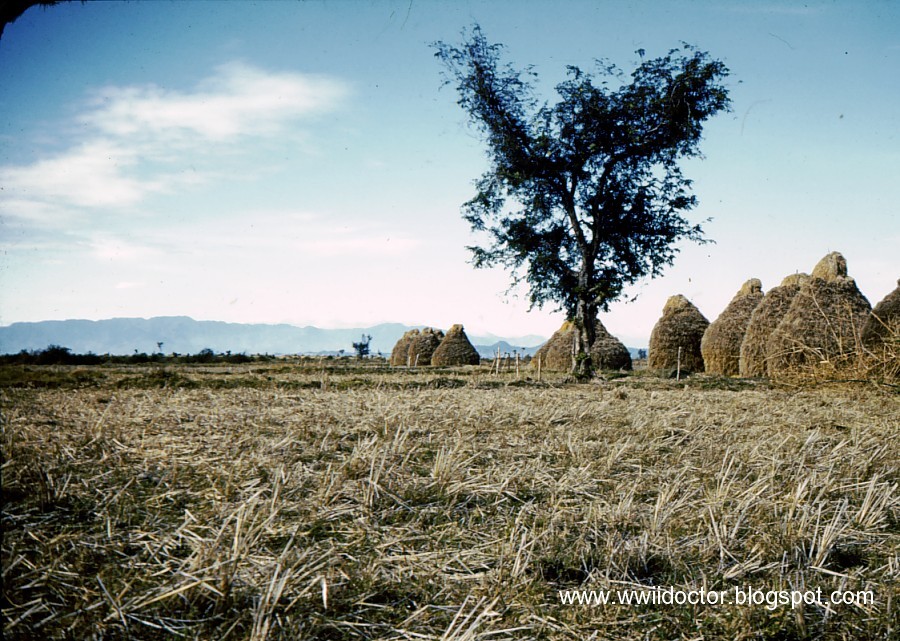
Rice stacks near Guimba

     My day was as usual, except that I performed the first vaginal examination I've done since I've joined the army.  This 47 year old lady is the aunt of a very cute and rather shy nurse on my ward.  I found a fair sized fibroid tumor [a benign tumor of the uterus].  She needs to be operated upon, but I don't know if we can do it here or not.  She and her niece both want it done.  The nurse (whose name I admit I haven't asked) says menopause is usually from 45 to 50 over here.  Nurses before the war received P8 to P10 [$4 to $8] a day for private duty, 12 hours, and P6 for 8 hour general duty.  Hospital rooms run about the same as ours.  She worked at the Lying In [maternity] hospital in a large city.  Under the Japs their pay was P25 but what money [Japanese Invasion Money, sometimes called "Mickey Mouse Money" by the Filipinos].

Monday, May 7, 2012

Old Wounds (57)

18 Feb. '45
Beloved,
     ...My patients kept me busy all day.  They may be transferred to another hospital for civilians and I hope to heck they are.  I opened an abscess of a cheek and took out a chunk of bomb fragment on a young girl.  It had gone in just below into the side of the nose, cut off four upper teeth, went through the pallet [roof of the mouth] and maxillary sinus [just behind the cheek bone] and stopped next to the angle of the jaw.  Some more have osteo [osteolysis, or degeneration of the bone] of the femur and foul discharging wounds.  Poor people!  And tonight I opened a fellow's bladder about the pubis [the forward part of the hip bone] and put in a catheter.  He (a civilian) had been shot by a sniper six weeks ago and urine drained out a hole at the side of his thigh.  I must say I prefer caring for fresh wounds!  All outfits held a Thanksgiving Service for the liberation of the Philippines today, at MacArthur's order.  But I was operating and couldn't attend.  I missed church too, and the cockfights I wanted to see.  Another time!
Capt. Eugene Pfile in the Philippines
     Well, we've been ashore over a month and quite a few events have happened, both to us and elsewhere.  One of our men who was wounded that night [January 19, 1945, the night the 92nd Evac was attacked by Japanese snipers and 5 men were killed] returned.  He had a grenade fragment in his thigh.  I don't believe I wrote that we've had a shower in operation for about a week.  There is lots of water and lots of shower heads.  My but it is wonderful!  The water is from a surface well in the rice paddy and is very soft.  A shower is much more satisfactory than a helmet bath!  I hope I don't get lousy!  It seems that some of our F. [Filipino] patients brought a few colonies of pedicullii [lice] with them!  That is something new for us.
     There is one subject I've neglected in my photography and that is the guerrillas.  They are somewhat colorful!  Several soldiers have told me that they are fine on scattered fighting, but can't be relied upon when there is concentrated shellfire by the Japs.  Then they remember business elsewhere!
Gene's scrapbook label: "Filipino guerrilla detachment eating breakfast
after doing night guard duty on our perimeter"
19 Feb. '45
     ...  I now have on my women's and children's ward a graduate F. nurse and a nurse's aid.  Both seem quite capable so order is coming to chaos.  This morning when I reached the ward (after seeing my other patients) they had already started in to do dressings.  The nurse (what her name is, I haven't the faintest idea) wears a white nurse's uniform and can interpret.  She wears a wedding ring.  I haven't gone into her private life!  Then there is the regular ward man and his F. assistant.  Also a self-appointed F. assistant.  Also the various relatives of the patients.  So it is a tent full!  Some of the people bring food, such as rice in a polished coconut shell, chicken and I don't know what all.  One little girl with the osteo and the pneumonia wants rice to eat.  She doesn't like our food.  I've had others tell me the same.  I inquired at the kitchen and we have practically no rice.  Now to get rice, I'm certain it would have to come from the States, when we are in the rice center of the island!  The rest of the people with the phosphorus burns are doing O.K.  Speaking of coconut shells reminds me that there are no coconut palms around here.  There are some of the "palm leaf fan" palms, if I make myself clear!  Their leaves are about 3 or 4 feet across the fan part.  It is funny how I once thought that was the shape of all palm leaves!  Someone brought bouquets of flowers to the hospital today!  I recognize several of the various kinds.
     I appropriated some [second class] magazines and papers that came in for departed members [92nd Evac doctors that had been sent to other units] today.  [Maj.?] George [Christie, his former tent mate and good friend] "contributed" Colliers, [Capt.?] Ed Powers some Los Angeles Times, [Lt. Col.? Albert] Tipple a November's Readers Digest and one of the nurses a Montgomery Ward Christmas catalogue!
     All my love, Eugene

Friday, May 4, 2012

Civilian Casualties (56)

February 17, 1945
     What a wild night!  I went to bed about 10:15 after working on the youngsters with white phosphorus burns ... At 10:30 the SE corner guards opened up with a few shots and a grenade went off.  We hit the dirt and stayed there for 3 hours while the darnedest small arms barrage went on - all sorts of weapons.  After the first 20 min. we began to figure that most of it was random firing, for no bullets came over us.  I saw some tracers even going up at a 45º angle.  The guerrillas and some of our men just laid down a fire, all night long.  I heard several loud explosions and saw large flashes and thought it might be the Japs using mortar on us.  It tuned out to be some bazooka rockets the men got.  All we heard go over us was one grenade fragment and maybe one bullet.  I'll bet 3000 rounds were fired - M1 [Garand semi-automatic rifle], carbine and tommy gun [Thompson submachine gun].
     Results - 2 dead Japs!  One was lying by the RR tracks.  He had lots of bullet holes in him, but he'd held a grenade against his head, and blown off the hand.  The other was out in the woods.  The guerrillas claimed to have shot another next morning along a little creek about 200 yards off.  They claim they saw 3 more, but I doubt it.  Anyway, the guerrillas combed the area like a pack of dogs.  The Japs may have been escaping from Manila or the Zambales Mtn.
Modified Rand McNally map showing locations mentioned

17 Feb. '45
Beloved,
     This is probably the right date.  I have the darnedest time keeping track of the days!  We take atabrine [a medication used to protect from malaria and some parasites] daily so I can't count for that.  I was rather busy today doing this and that.  We received quite a slug of civilian casualties from another place.  Most have been taken care of but it is something to get a ward full of new patients.  It's a good thing I'm a general practitioner for the bunch I have are all women, girls, and small fry.  Many of them were injured last month and went practically uncared for, for some time.  So you can imagine there are some odoriferous items.  One woman had a large sarcoma of the jaw - very unsightly - and the worst of it is that nothing can be done for her.  It is much too far gone.  Another is a youngster who hammered a 50 caliber cartridge on a rock and all he received from it was a crease across his leg.  Several are in casts.  I've seen several cases of tetanus among the civilians, but they come out of it O.K. with lots of antitoxin.  One poor soul is seven months pregnant and has a compound fracture (shell fragment) of the thigh that was untreated and now she has an osteo [osteolysis or degeneration of the bone] with it.  I just heard that we'll have some casualties.  One of our patrols out in the hills somewhere ran into an ambush.  That patrolling is bad work!  Three of the four youngsters with [the worst] phosphorus burns died.  The two on which I worked seem to be doing O.K.  Later - Well that fellow sure had his Achilles heel [vulnerable spot]!  A Jap machine gun bullet went through his heel bone from side to side and really pulverized the bone.  But he'll get a good result, no doubt.  He was also creased about the left buttock.  I heard that the two Japs that came by the other day were killed by F.'s [Filipinos].  How they go for the Japs!
Some of Gene's civilian patients in Guimba
     The F. people here certainly have Spanish names and use the Spanish pronunciation even though they don't speak it.  The names almost make me think I'm home in Trinidad [Colorado]!  They have black straight hair, black eyes and some have Spanish features.  And the young gals can roll their eyes the same way!  Apparently these "country" ones are not on the loose side in morals.  Some of the men seem to think it "muy malo" to fool around for the family takes them seriously if they do!  There is an F. nurse on one woman's ward looking very crisp in her white unitorm.  We certainly use the nurses now!

Wednesday, May 2, 2012

Escape to the Ordinary (55)

Children are the hope of the future.  Children are also major victims of war.

16 Feb. '45
Beloved,
     I've just spent a bad three hours.  We received nine children and four adults who had white phosphorus burns [White phosphorus is a compound that burns fiercely and can set cloth, fuel, ammunition and other combustibles on fire.  Phosphorus burns carry a greater risk of mortality than other forms of burns because the  phosphorus is absorbed into the body through the burned area, resulting in liver, heart and kidney damage, and in some cases multi-organ failure.  White phosphorus continues to burn on the body until it is deprived of oxygen or until it is consumed, often burning right down to the bone.]  It seems that the kids found a phosphorus grenade and lugged it home and under the house.  Some time later it went off.  They ranged in age from about three and up.  It had happened some hours before they came in and they'd been given initial treatment.  Some of the kids' faces and eyes were really puffed up and blistered also arms and legs.  I had a boy of about eight and a girl of about four.  I've no idea how they will turn out.  On only one place did I find phosphorus active (it gives out white fumes until it has burned out).  This P.M. they brought in a wasted little girl of six with a huge abdomen.  It is probably a tumor of the ovary with fluid formation.  She is too sick to undergo surgery and the fluid is too extensive.
One of Gene's photos depicting ordinary life in Guimba
     [Gene feels such compassion for his patients, particularly the young ones, but dwelling on the tragedies does not help him in the fight to save others, so he continues his letter about happier, more ordinary things in his daily life.]
Photo of the interior of a church in Guimba
     Last evening I forgot to tell you of the color pictures I took that noon.  I fear I ruined several.  The outside of the church is very unprepossessing but the inside rather picturesque.  A bunch of nuns (black hood, white habit) were kneeling in the front.  So from the balcony I tried a seven or eight second exposure.  Probably it won't show a thing!  Then I went up to the belfry to take a picture of the town.  Darn if I didn't leave the [long] exposure time on [the] bulb and so moved the camera before the shutter closed!  Then I got in a hurry to catch some kids in front of some carabao carts and didn't change the focus properly!  I took others about the streets.  I tried to get typical town scenes, usually with people and not pictorial masterpieces.  I think it is well to show the ordinary scenes a "tourist" sees. [Looking for the ordinary is one way Gene copes with the horrors of war.]
     This morning I took a little time off and went to market.  It was held in a vacant lot along the street.  The food was limited to vegetables.  There were some unglazed pots.  I had to laugh at the F. [Filipino].  I asked how much and he had a queer look on his face and said 30 centavos.  I'm certain they were usually about 15!  I could fine no straw matting, wooden shoes or baskets.  A lady told me that in usual times they wore leather shoes, though I suppose the poor always wore wooden clogs or went barefoot.  But I did make a purchase - 6 meters of abaca cloth [the abaca plant fibers were used to make twine and the original Manila envelopes, and now are used to make paper tea bags and other paper products] at 50 centavos a meter [about 25¢].  Of course it's only twenty-two inches wide.  It looks like loosely woven linen.  It is dyed of blue green which no doubt will fade.  It is made from a fiber of a plant resembling a banana.  It is a regular cloth and is treated as such.  Washed in soap and water, cut and sewn and etc.  It is used for shirts, dresses, and such.  I may get some more later on.  A fellow gave [Maj.] Hi [Armstrong] two pairs of wooden shoes and he gave me one.  They are not so fancy.  I saw a shirt of a very fine variety.  It is made from pineapple fiber with very tiny threads.  It is almost transparent but with a glossy finish.  There was a lot of embroidery on it.  I've no idea how much it cost.  That type of cloth is said to be used in the National Costume and is worn by the well-to-do in all big occasions.
     The dogs here are the darnedest looking curs.  They always slink around in a very furtive and sullen manner [dogs were occasionally eaten in the Philippines, so maybe they had reason to slink!].  And how they bark at night.  This morning about 4 our guerrilla guards challenged someone walking along the track.  When they received no answer they shot a few times but hit nothing.  Probably it was a couple of hungry Japs heading for the hills that got away from the fight in the big city.  How I like those guerrillas!  They know how to use [American] Indian tactics too!  We feel perfectly safe with them on our perimeter.

Monday, April 30, 2012

Letters Home (54)

14 Feb. '45
Beloved,
     Oh boy - mail!  At last it seems we've established contact.  ...  Sparky [Maj. Francis Adams] just read this joke and darn if I don't believe it.  Two GI's captured a Jap and spent three hours coaching him in English.  When the intelligence officer came to question him, he asked, "Do you speak English?" to which the Jap in great eagerness said "Where do I stand on the rotation plan?" [In an effort to shore up morale, a system was set up in March1944, so that one percent per month of the troops in hardship areas could be allowed to go home for a visit at the discretion of the theater commanders; the use of a lottery system was suggested, but it didn't work to the satisfaction of most of the troops.]  ...
Japanese dual purpose gun (27 mm anti aircraft gun) in Guimba
     This morning I took a picture of a Jap dual purpose gun that commanded the road near us and of the Jap ammo car on the track that had been blown up.  I looked in at the rice mill where rice is polished and put in bags.  I can see why brown rice isn't popular.  The stuff is just like barley with the hull on!  And I located where they hold cock fights Sunday mornings.  It is a large shed with a galvanized iron roof, with bleacher seats!  Of course it may be used for other things as well.
     The soldier whose arm I amputated is doing much better and is much more cheerful.  [Capt. John] Mihalick just came in with a tale.  He took care of two civilian women who had fractured femurs [upper leg bones] and had just been put in casts today.  They were injured about three weeks ago.  One said she hadn't urinated since morning.  The woman staying with them tried to catheterize her and couldn't so John did.  Then the other one decided she hadn't urinated either!  John told her to try some more!
  Today I had a haircut.  These F.'s [Filipinos] are certainly strong on the neck line!  There is no use arguing in making the man unhappy (or rather, there is just no use arguing!) so I let him go ahead, only making sure he'd take some off the top.  They don't use lather on the neck just wet it and shave!  He used no clips but did a good quick job.
     All my love, Eugene

February 15, 1945  I have a ward of women and children - mostly transferred from the 98th Evac at Tarlac.
Some of the patients on Gene's ward in Guimba who had been wounded by American bombs

15 Feb. '45
Beloved,
     It's good I saved two letters to answer for none came today and other outfits keep getting packages, but small matter.  Say, I just realized that yesterday was Valentine's Day!  Honey, are you still my Valentine?  (Says I out of the corner of my mouth "If you aren't I'll tan you good when I get my hands on you!")  You know (coy look with downcast eyes!) I'm still your Valentine!  I just finished an appendectomy on an F. young man.  It was plenty hot [infected]!  But it was easy to do.  I had some new patients on my officers' ward - FUO [fever of unknown origin] and possible kidney stones.  So it goes.  An F. came in this evening who tried to move a dud artillery shell.  That was one thing the N.G. [New Guinea] natives learned in a hurry - to stay strictly away from anything that looked like a bomb or a shell!  [Gene tells about a tragedy that wouldn't have happened if children had learned that lesson in my next post]  These confounded F.'s are getting worse than the Aussies ever were [about price gouging].  Some of the fellows said one charged him P4 [about a dollar] for 4 eggs and two small pieces of pork!  P6 for cooked chicken.  There is no excuse for it.  An hour and a half later.  [Capt.? Herb] Nigg and I worked on the F.  He had the darnedest set of holes in his hide.  There must have been 50 in all - most of them very tiny.  But I've seen some soldiers who had as many as 200!
     What a snow you're having!  Honey, can't you get someone to shovel it for you?  It's too bad I can't mail you an F. to do the work for you.  One or two pesos a day and some food is all he'd ask. ... But maybe he'd want to plow using carabao and that would scare all the kids and dogs in town!
     All my love, Eugene

Friday, April 27, 2012

Look to the Bridges! (53)

     The war was far from over, but the Americans could take pride in what their engineers could accomplish.  Here is an article from an unidentified newspaper that was in Gene's scrapbook:

WRECKED BRIDGES TELL STORY OF JAP FAILURE IN PHILIPPINES:
American Engineers Did More in 26 Days to Repair War Damage on Luzon
Than Nips Accomplished in Three Years
     Central Plains Command Post, Luzon - (A.P.) - You need do no more than follow the American troops down this rich valley from Lingayen to Manila to see why Japan has muffed her chance at empire.
Modified Rand McNally map showing locations mentioned in the article
     When the Fourteenth corps troops made their blitz to the capital they ran into all sorts of blasted bridges.  But at least half of the big bridges - the ones that gave the greatest trouble - hadn't been blown by the Japanese at all.  They were the unrepaired remnants of bridges the Americans blasted in their withdrawal in 1941.  The Japanese had never repaired them although they were the economic arteries of one of the richest areas captured by Nippon.
     In the main, the Japanese replaced them with flimsy makeshift spans reachable only via tortuous detours scarcely able to support heavy traffic and almost every one a constant bottleneck.  At Bambam, for example, the parallel railroad and highway trestles had been dropped into the river.  I saw them first from the air and remarked to the pilot "the Japs did a good job on those two."
     But when I passed thru Bambam [Bambang?] with the troops later I saw my error.  The steel wire reinforcing that hung from the jagged, broken concrete blocks was black with old rust.  The Japanese didn't perform that artistic job of demolition at all - we did back in 1941.  Two big spans - linking rich Tarlac and Pangasinan and the northern provinces to Manila's ship piers via railroad and road - hadn't been repaired in three years.  Down between them on the river's surface was their solution, a one-way small piling treadway on a pontoon.  They didn't get around to blowing that one up but even so our engineers had to strengthen it before the big stuff could move across.
     When we looked that area over, Maj. Reginald Jackson ... used the words of the major league baseball scout after watching a raw lefthander "Japan as an empire builder is several seasons away."
     My retort was that after she has been pushed all the way thru this current meat grinder she'll be a hundred seasons away.
     I backtracked the troops after reaching Manila and I can tell you this - that after twenty-six days, the supply men and engineers of the Fourteenth corps of the United States army had better bridges between Lingayen and Manila than the Japanese had after three years.
     The bridges were only part of the answer.
     Between Calumpit and Malolos, the national road - the Lincoln highway of Luzon - contains a five-or six-mile segment that was not hard surfaced.  You ought to ride that stretch in a jeep after three years of Japanese maintenance.  We drove over it never more than ten miles an hour.  I was so bounced and bumped that the canteen in my belt was bent.
     These were physical evidences that a would-be empire builder had sliced himself off a chunk that his protuberant incisors couldn't even nibble at.
     The greater answer was in the eyes of the people.
     There was the old shop keeper at Balintawak on the outskirts of Manila who dashed up to the jeep of Maj. Gen. Robert S. Beightler, Thirty-seventh division commander, with an armful of cold beer.
     He saw the two stars on our jeep, jumped up and down, waved his arms and yelled, "Welcome, welcome.  No more Japs.  No more of those _____ Japs."
     Again he waved his arms and hunted for stronger words.
     "Hallelujah," I suggested.
     "Hallelujah, Hallelujah.  No more _____ Japs."
     There - it occurred to me - was an Asiatic small businessman, perhaps representative of the business core of Asia, celebrating with American oaths the end of Japan's program of "Asia for the Asiatics." [The Japanese had declared that they would be the protector of the Orient.]
     The bitterness, the utter hatred they had wrought among these people in three years was, when you thought it over, far more eloquent testimonial to their failure than the bridges they didn't rebuild.