Wednesday, March 14, 2012

Anticlimax - or is it? (29)

Members of the 92nd Evac are facing their first battle.  How will Gene react?

April 23, 1944  Sunday
     Woke up at 0300.  I had to sleep on the hard cushions again.  "And the condemned ate a hearty breakfast" says Hiram.
Humbolt Bay from Pancake Hill - note tanks and LCVP's (Landing Craft:
Vehicle Personnel)
     We landed about 8.  On the way in we watched some of our Navy planes dive bombing some air strips.  One started a big fire.  Some fellows were in swimming so we knew things weren't bad.
     At the beach, not 30 yards from our boat, a battery of 75's were shelling someplace, probably Hollandia [Airdrome]. There were more down the coast and we heard their shells screech a little as they went by overhead.  There were large Jap stores of rice, soy beans, artillery shells, food in boxes and small kegs, bombs, plane motors still in crates, parachutes and medical supplies, all along the beach.  The beach at high tide was very narrow, and terribly congested with vehicles.  Some were stuck in the sand and bulldozers pulling them out.  I'm glad we weren't being bombed or shot at.  There were shell and bomb craters and slit trenches everywhere.  I saw the first body of one of our soldiers, on a litter and wrapped in a blanket.  It took my vehicle (we walked) about 1 hour to get on the beach.  After another hour of barely  moving (it was hot!) we tied our packs to the water trailer back of the weapons carrier and walked ahead to our area.  It was up a new road along the side of Pancake Hill, a bare hillside.  The landing on D day was made without much opposition.  In fact, not a dozen Japs were killed.  One of our Companies was straffed [ sic strafed] by our own planes - 6 killed and 8 wounded.  On a campaign they figure 5% casualties from our own guns and planes!
Pancake Hill from behind the surgery
     We went to the 41st CP [command post] and heard the news.  A soldier was killed by a sniper about 200 yards up the trail about an hour before we were there.  We took over some fox holes - mine didn't even need remodeling.  But if it rains tonight - this red mud!  Not even a pup tent or a tarp.  But I have a Jap silk parachute to sleep on.  We ate K rations [according to Wikipedia they consisted of two packages of dried biscuits, cigarettes, gum, sugar (granulated, cubed or compressed), and a key (dubbed a P-38) to open a small canned portion; items specific to the breakfast meal were canned meat and eggs, a fruit bar, and instant coffee; specific dinner (lunch) items were canned cheese and a lemon (early), orange or grape (late) drink packet; specific supper items were toilet paper, a bouillon packet, and a lemon, orange or grape drink packet (later production rations had a disposable wooden spoon, too); if all three meals were eaten, about 3000 calories were provided; they were produced by the Cracker Jack Company with a waxed paper ration box about the same size as the Cracker Jack box] - not too good.  I perspired something terrific and have a headache in spite of 4 salt tablets.  The sun is fiendishly hot.  All of us have our clothes and persons covered with red clay.  Desultory shelling of Jap positions has gone on all day.  On the beach I took pictures, including a bomb explosion when a bulldozer clearing the dumps pushed it on a burning dump.  One fellow was wounded.  A while later there was a terrific explosion at about the same place.  Several small gasoline dumps had been burned.  The 50 gallon drums were pooched out in peculiar shapes.
     This evening about 40 native men, women and children, in all stages of dress and undress, went past under guard.  I wonder what they are - prisoner or refugees.
     In 2 days the Yanks have made more roads than did the Japs in 2 years.  Pim [on Jautefa Bay about 4 miles south of Hollandia] was taken yesterday and Hollandia by noon today.  Certainly we haven't been in much danger today.  I hope this night is quiet.  They said that in this area Jap snipers bothered some last night.  There is a tremendous concentration of troops and guns and machines, etc., and we haven't seen a Jap plane.  They say several thousand tough Jap marines went to Wewak a few days before, for that is where the Japs expected us to strike.  Mostly service troops are left here.
     At night you crawl in your fox hole with loaded carbine and knife handy, and don't get out for anything, for the rest are apt to shoot at anything that moves.

Little did they know what was in store for the U.S. forces in the area.  The undated article below is from the Yank Magazine.  It is mostly about the portable hospitals which are smaller than the Evac hospitals and are usually closer to the front. 

"MEDICS UNDER FIRE: They're non-combatants according to treaty so they don't get extra pay like the infantry but they do draw plenty of enemy lead" by Sgt. Charles Pearson, YANK staff Correspondent [with comments in parenthesis and underlinings presumably by Gene]
     Dutch New Guinea - A portable surgical hospital is a medical unit of four doctors and generally 32 enlisted men.  They're supposed to work directly behind the line of battle and patch up casualties so they can be removed to an evacuation hospital.  Sometimes part of the portable hospital's personnel have to be removed, too.
     During one of the Dutch New Guinea campaigns a portable unit was brought up by buffaloes [a type of landing vehicle] to a position behind the advancing infantry of the 41st Division.  They were moving up a coastal road from the landing beach toward Jap-held airstrips.  The road was on a narrow strip of land with the sea on one side and a strip heavily wooded coral terrace on the other.
     The portable hospital medics arrived in late morning and set up their tents in a coconut grove.  The infantry up ahead was moving along without much resistance.  The hospital personnel were getting the idea they might have an easy show ahead.  The coconut grove was picturesque.  Just off the shore was a reef.  A lot of the men were out on it looking for cat eye shells.  It was all quite peaceful.
     In the distance could be heard the occasional chatter of machine guns and the popping of small arms.  It was a comforting sound.  They were our guns.
     Suddenly they noticed the fire was rapidly intensifying.  The thump of heavy mortars was almost blotting out the sound of the machine guns.  The operator at the field phone called out that they had run into a strong force and were being heavily pounded with 90-mm mortars.  The first casualties were already on their way back.
     Shortly a captured Japanese truck sputtered into the hospital area with six wounded on it.  All of them were badly torn up.  Capts. Edward L. Waisbrot of Canton, Ohio, and Theodore Moss of Kew Gardens, L.I., were quickly working on a man whose arms had been smashed to jelly.  It was an amputation.
     At the other table set up in the pyramidal tent which was serving as an operating theater, Capts. Bernard Sollod of Baltimore, Md., and Sydney Kahn of Chicago were amputating the leg of a soldier.  It had been badly fractured and the main blood vessel hopelessly torn.
     The six casualties had now multiplied to 20 and they were still streaming in.  T-4 Cecil Wells of Hockersville, Okla., a former boxer and carnival pitchman now wardmaster, was going from one soldier to another trying to ease his pain while patients were coming in faster than they could be treated.
     A call was sent back for more doctors.  Three came up later in a jeep.  Lt. Burroughs from Oakland, Calif., (Oscar!) came from the evacuation hospital.  Capt. Krupke of Chicago was from another portable unit and Capt. Ludden came from a clearing company.  Another table was set up in the already crowded tent.  Three teams of doctors continued work steadily.
     Up ahead the infantry was stopped.  Jap artillery and a naval gun were ranging in on them.  Down between the hospital and the beachhead a second Jap force was driving a wedge between the fighting battalion and the rest of the force.  It was now dark.  The doctors were working by the illumination from one hospital light hitched up to a generator, one Japanese headlight powered by a storage battery, several Coleman lamps and all available flashlights in camp.  It was hot in the tent and the surgeons were stripped to their underpants.
     The casualties continued to come in, now from both directions.  The patched up ones were being evacuated by landing craft and buffaloes.  The force ahead was slowly giving ground.  The battle was coming closer.  An occasional mortar shell landed in the area.  The supply tent and extra equipment had already been blasted into ribbons.  One hospital attendant had been hit by a shell fragment.
     Down in the kitchen tent Sgt. John Millner of Washington, D.C., T-5 Arlen Bradstreet of Stockton Springs,.Maine, and T-5 Lucien Nadeau of Matawaska, Maine, were brewing hot coffee and bringing it to the operating theater.  Operating room assistants Pfc. William Abbott of Sommerville, Mass., Sgt. Emerson Hein of Tonawanda, N.Y., T-5 Richard Lucier of North Adams, Mass., and T-5 Sydney Shub of Ithica, N.Y., were giving plasma and morphine and setting the wounded onto litters in slit trenches.  Knee mortar shells were coming down from the ridge and exploding around the ward tent.
     In the pitch black of the night it had not been possible to bring some of the wounded from the lines of fire.  They had to wait until daybreak.
     At 0500 the next morning all the wounded had been cared for.  The doctors knocked off for a bit of sleep.  An hour later in the early light of dawn the stream of casualties began again.
     At 1030 a message came up from the beachhead to be ready to move out at a moment's notice but to continue working as well as possible.  Dr. Moss was working on a man whose head had been split open and whose brain was injured.  He was hemorrhaging badly.  A patient on another table had had his arm blown off at the shoulder.  The fighting was getting closer.  Wounded men were walking back from the lines and collapsing at the hospital.
     The battalion was withdrawing trying to consolidate its position.  The Japs had cut the supply line and were moving up the beach from both directions.  Cpl. Ted Hunter of Macwahoc, Maine, and T-5 Leroy Faulkerson of Columbus, Ohio, climbed up a bamboo ladder against the coral terrace and brought down a soldier with a hip wound.  Infiltrating Japs were working down through the wooded terrace behind the hospital, setting up knee mortars and trying to hit wounded going out in the buffaloes.  Pfc. Leonard Solow of New York City had the job of getting them away from the jetty.
     One Jap reached the ledge directly above the ward tent.  An infantryman shot him.  He fell into a slit trench behind the kitchen tent.
     At noon the last American vehicle came through.  The fighting was now right in the area.
     At 1300 hours the hospital started to evacuate, but at 1400 those men whose lives depended on immediate attention were still being worked over.  An hour later the last of the doctors climbed into the buffaloes and traveled back to the evacuation hospital with the wounded.  Half an hour later the Japs were swarming over the area.
     Back at the (92nd) evac hospital the portable surgical unit doctors continued working. (and how!)  Two days later they were again sent up to the area of their hectic 24 hours.  This time the Japs were in headlong flight, being pursued by the reorganized battalion supported by tanks.  This time the portable surgical unit could patch up the wounded without ducking for cover every few minutes.  As one tired medic put it, "If I was in the Infantry I might be getting that extra 10 bucks fighting pay they talk about.  But then, they say the medics never see combat."

Tuesday, March 13, 2012

D-Day + 1, But Where? (28)

The 92nd Evac only stayed in Finschhafen a couple of weeks, then they were sent to the battleground.

April 5, 1944
     Well, it looks like we aren't going to play for peanuts.  Today we were all issued carbines and clips for 60 rounds of ammunition.  They say our forward echelon will land right with the infantry.  We won't wear red cross arm bands.  I'm glad of that for the Japs try to get any men so marked.  I just found out that I'm in the first echelon!  It probably won't be long - 2 or 3 weeks.  Well, I don't want to be a hero, but there's no telling!  If we go in on the first day it certainly won't be a picnic.  We'll be operating in bomb and shell craters.  I'm surely glad Beth doesn't know this and I hope she doesn't suspect it.
Easter services at Finschhafen were well attended
 April 9, 1944 Sunday, Easter
     Rain again this morning.  Everything is muddy and encrusted with it - shoes, pants, floors!  This scarcely seems like an Easter Sunday.  I fear the boil I have starting on my leg won't let me go to church.
     It turned fairly clear and the mud is drying up a bit.  I don't believe they ever have a completely clear day in this country.  Everyone is familiar with his carbine.  All we are waiting for is D day.  Apparently the first echelon (me included) will land D + 1, the second day.  It promises to be exciting, to say the least.  They claim they expect it to be a short action - 2 weeks.  We may stay on as a hospital.  Bets seem to favor Wewak or Rabaul.

April 12, 1944
     Finally boil is clearing up!  We turned in our waterproof bags and clothes in it.  It will land some time after we do.  I bought a heavy duffel bag for £1-0-10.

April 13, 1944
     Sitting and waiting.

April 14, 1944
     Still sitting and waiting.  Me leg is doing fine.
     No doubt it's silly, but I wrote a possible "last note" to Beth and to Mom.  But I always believe in being prepared.  I don't know why, but this comes to mind this morning - Beth introduced me to it - "My heart's in the Highland, chasing the deer.  My heart's in the Highland, my heart is not here." [Robert Burns: "My heart's in the Highlands, my heart is not here, My heart's in the Highlands, a-chasing the deer; Chasing the wild-deer, and following the roe, My heart's in the Highlands, wherever I go."]  Rather, my heart is with Beth.

April 15, 1944
     ...  Things seem to be shaping up.  I heard on the Zero Hour the Japs said the 41st Division which had carried on a previous campaign, were now preparing for another north of Wewak, but would fine them (the Japs) well prepared!  In light of that, our mail censoring seems silly.

April 18, 1944
     The first echelon is to go aboard LST [Landing Ship, Tank] #10 tonight.  Rumor indicates Hollandia - also some island N of Truk [Micronesia].  Time will tell.  Too bad we won't be able to see newspapers and tell what is going on where we will be!  ...
Finschhafen is on the right, Hollandia above, and X marks where Japan was expecting the attack (map from http://olive-drab.com/od_history_ww2_ops_battles_1943newguinea.php)

April 19, 1944
     Didn't go aboard until this morning.  Slept quite uncomfortably on a bare cot, with 1 blanket, last night.  We were called at 0330, breakfast soon after 0400, and then sat around until 0630!  Mud was fairly deep.  We were dressed in field equipment.  They came for us in about 25 jeeps and a few trucks - it looked like a scene in "A Connecticut Yankee in King Arthur's Court" where a flock of knights in baby Austins [automobiles] come driving over a hill [a revival of the musical by Rogers and Hart, A Connecticut Yankee came out in 1943].  We went to the beach just beyond where we had landed, and LST's were drawn up on the beach side by side.  We got aboard without too much delay.  I'm quartered in the ward room, which is a combination officers' dining room, lounge, and surgery if necessary.  There is a small OR [operating room] light over one table.  The first thing I did was to shave and wash - nice hot water!  Then I stripped and washed my muddy leggings and shoes and took a shower.  The best I've had in a long time.  We eat like officers - tables, silverware, and dishes - even soup for dinner.  Of course the piece-de-resistance was hash!  The coffee tasted superb!
     This morning I wrote a letter to Beth - my last for ? long?  No mail yesterday and no chance of any for a long time.
     We are going to convoy, 3rd in a line of LST's - 17 in all, and 5 troop ships and 7 destroyers.  It's nice to see the destroyers riding herd over us!  There is a tremendous amount of shipping all around Finsch.
     This afternoon I tried to wash the mosquito repellent (bottle spilled in my pack!) off some rubber bags.  No luck.  We had our first briefing.  We will land about Sunday (D+1) and have a mile over new road to go - walking for us and unknown amounts of small arms fire, mortars, planes and snipers all possible.  Then we dig in.  Fox holes supposed to be about 2 1/2' x 4' x 5', and with a small shovel that will be no cinch!  I brought along leather gloves.

April 20, 1944 Thursday
     Slept on a couple of flat "cushions" from the back of a couch, placed on a table.  No good!  Besides, it was hot.  Phosphorescence last night was beautiful.  I could see the wakes of the ship ahead and behind, though it was an absolutely black night.  This evening we began passing thru the Admiralty Islands, to go around N of them.  The shore was lit up like a Christmas tree.
     General quarters [call to battle stations, in this case for a briefing] sounds at 5 A.M. for the entire crew.  The darn ward room is never empty or quiet until 11 or 12 P.M., so I am disgruntled not having my usual 9 hours of sleep.
     Briefed again.  I have 5 men - Boltarez, Barnes, Boitnut, McCavie and Griffith.  We go ashore after our first vehicle and keep together as a unit for work.  Went over the maps again.  We land in Humbolt Bay, a few miles SE of Hollandia.  I read the special book on data about Hollandia.

From Reports of General MacArthur: the Campaigns of MacArthur in the Pacific: Volume 1
Humbolt Bay is circled in pink
The Cyclops Mountains, a 25-mile long chain of 7000-foot-high mountains, follow the coastline and end at Humbolt Bay.  On the south side of the mountains is the Lake Sentani Plain.  The Japanese had built three airfields in 1942 between the Cyclops Mountains and Lake Sentani: Hollandia, Sentani, and Cyclops.  The purpose of the Hollandia attack was to secure the airfields, which were referred to in the British parlance by the Allies as airdromes.  A fascinating account of the dangerous and tragic reconnaissance work carried out before the landing can be found in the chapter "Ferdinand on Hollandia" by Commander E. A. Feldt of the Australian navy in Combat: the War with Japan ed. by Don Congdon (1962).  "Ferdinand" was the code name chosen by the Coastwatchers or intelligence operatives in the south Pacific for their organization because in the children's book,  The Story of Ferdinand by Munro Leaf, Ferdinand did not fight but sat under a tree and smelled the flowers.  The name served to remind the intelligence officers they were just supposed to observe.  General MacArthur planned three simultaneous landings on April 22nd: Tanahmere, Humbolt, and Aitape.  The Allies fooled the Japanese into expecting the attack to be in the Madang-Hansa area (marked with an "X" on the black and white map above.

April 21. 1944 Friday
     Slept on the couch - better!  The sky was brilliant with stars last night.  The Big dipper looked swell.  Clear and beautiful this morning.
     I wonder what Beth is doing.  I know she'll be watching the papers for news of any push over here and figure I'm in it.  How I miss her!

April 22, 1944 Saturday
     "D" Day.  I wonder how the show is going?  We're still too far out to hear the shooting.  Hard rain.  More briefing today.  No one, even myself, is much stimulated by the thought of landing.  Certainly no one has any premonition or worries about it.

Monday, March 12, 2012

Coconuts, Rain, More Rain, and Critters (27)

Starting with Gene's letters from New Guinea, Beth copied the non-personal part to share with her family and other wives of 92nd Evac doctors.  I never found the originals, so I don't know what salutation or closing Gene used in writing Beth, so to distinguish them from his journal entries, I'm using "Beloved" and "All my love, Eugene".

2 Apr. '44
Beloved [Gene is not allowed to mention his location, but in copying the letter, Beth wrote across the top: "I'm sure this was at Finschhafen"; army wives were pretty canny!],
Gene with his jungle pack in
front of his hammock
     You should see me.  I'm sitting on my helmet - a few red ants keep me off the ground.  I'm in the midst of a grove of coconuts.  All around the ground is covered with coconuts.  Some of the fellows are trying to knock off the green ones.  They may taste better.  I tried a few.  The milk is very watery and not so sweet as I remembered.  The meat tastes the same.  First I tried my machete to take the husk off, but I found my hunting knife does better.  Then I split them with my machete.
     Can you imagine me sleeping in a hammock?  Well, I do.  The jungle hammock has a canvas-rubberized bottom, wider rubberized roof, with mosquito netting sides and zippers to close where you crawl in.  Mine right now is slung between two coconut trees.  If you get unbalanced, it is hard on the net sides.  I find that with due caution I can turn on my side, but none of this flopping around stuff.  Each time you set it up you have to cut sticks for spreaders for top and bottom.  The blanket and hammock fit right into the jungle pack sack.  In fact it is surprising how much it holds - so much better than the musette bags.     The humidity is terrific, but it isn't really hot even with the sun as bright as it is.  But you just drip whenever you move around.  A blanket is necessary by morning.
92nd Evac men bathing in the little river
     I can hear some one whooping at the little river.  This temporary spot offers no other means of washing or bathing or shaving.  The water is surprisingly cool but not like a Colorado stream.  It is astonishing the lack of mosquitoes or flies.
     I wish we had some of this soil for the ranch and garden.  It is so very black with so much humus.  It has been cleared with a bulldozer so makes a good surface - unless it rains a downpour.  Ferns and heavy undergrowth are all around.  There is a great deal of coral around and the roads are made of it in places.  There is quite a dank smell in the evenings.  I haven't seen a snake, not that I have been searching for any.  The hills are certainly steep.
     Too bad I can't dry a bunch of coconut meat to send you for coconut cream pie, frosting and such.  There are hundreds of nuts on the ground, and they float out in the ocean in places.  They seem to sprout quite readily and make the nicest little trees.  They would go well as potted affairs.  No, they can't be sent in the mail, but I'll eat enough.  It will be surprising if there aren't a few gashed fingers.  The machete reminds me of the corn knife I used to like to swing around when I was a kid.  It is very handy. [In later years he used it extensively in chopping up corn stalks and such for compost in his garden which, alas, had none of the nice black soil!]
     All my love, Eugene

April 2, 1944
     Atabrine [against malaria] will by [be] 2 daily, 5x a week!  [Some of the doctors suffered from malaria anyway; Dr. John Mihalick's obituary from 1961 mentions that he quit his orthopedics practice after he suffered another bout with malaria after the war, and then took up psychiatry.]
     All the washing facilities are, is along the creek bank.  ...  I just washed my face - I couldn't bring myself to it just yet!
     There is a small cemetery near here - U.S. and Aussies.  [The soldiers' who died in battle or shortly afterwards were usually buried locally and later exhumed and flown home].
     Perfectly open-air latrines.  We go thru the mess line, too!
     The heat gives me a little headache in spite of salt tablets.  This certainly reminds me of our first days at Freda [California].  We just sort of wander around aimlessly and don't know what to do.

April 3, 1944
     Light showers last night.  Our own mess starts today.
     What a time this noon!  Around 11 A.M. it began to rain and just poured down.  I had put up a pup tent to keep my stuff dry and ditched around it.  I sat under it until 12, then had to improve the drainage ditches.  ...  I stepped in an old shit trench and went almost up to my hips.  Then I took my clothes off and took a shower in the rain - lathered nicely.  I caught rain water off my hammock top in 2 helmets and did some laundry.  This evening we were supposed to move to a better area, not so down in a hole.  The men finally had to move in the dark.  Sterling [the C.O.] was unpopular!

3 Apr. '44
Beloved,
     Here I sit in our pup tent, snug as - well, pretty snug.  The rain drops slowly.  George and I each played safe and brought a shelter half and I'm certainly glad we did.  Now we can keep our stuff dry.  But the humidity is terrific.  One stands around in the rain without a raincoat for you are already wet and surprisingly enough it isn't uncomfortable.  I wear my helmet for coconut protection and to keep my glasses from spotting so fast.  Am I ever thankful for all the Kleenex I have.  A raincoat makes you hotter and wetter than going without.  I have my hammock roof higher at one end and my helmet catching the rain water so I can wash some socks.  The creek water is tidal and so is extremely hard.
     There is quite a collection of insects.  Big red ants that bite and lots of small spiders.  In fact, when I opened up this writing case, one was inside.  There are a few small land crabs around,  There are not so many birds and they don't make such a racket as in Australia.
     I have my camera wrapped in plioform as well as the film and the whole thing in the large waterproof bag that fits in the jungle pack.  Really they have thought of everything.  There are six small rubber bags in addition to the large one.  I am very glad I packed Vernon's lighter, for it works beautifully.  Matches are almost too damp to strike.  The pack also includes a waterproof match-safe with a compass top and a flint strip on the bottom.  Really we aren't uncomfortable and I am getting adjusted.
     The fuzz wuzzies are peculiar looking chaps.  Black as the ace of spades.  They wear a piece of cloth wrapped around their hips like a skirt.  They can go right up these 60 foot palm trees.  They tie a rope around the trunk and each foot and just sort of hop up.  At the censors' office I saw some dillies of pictures that had been confiscated.
A look at the jungle in Finschhafen
     You should have seen me about two hours ago.  About noon I came out of the pup tent and went to eat.  I stood ankle deep in water in the mess line.  By the time I was thru eating my mess kit had about 1/4 inch of water in it.  It is a nice way to cool the coffee, though.  When I got thru I decided to wash.  I'd been wanting soft water.  A helmet on each side of the hammock collected it nicely.  I washed 4 pairs of socks, 2 handkerchiefs, a shirt, pants, 2 pairs of shorts and coveralls.  During that time I took off all but my shoes, and took a bath.  Rain water lathers wonderfully.  I put shorts, pants and shirt back on for they will dry better on than any other way.  Oh I have dry ones but these aren't uncomfortable.  But the darn rain let up before I got the coveralls rinsed.  I took off my shoes and dried and powdered my feet and put on dry socks and my jungle boots.  They are slick items, heavy rubber soles with broad rubber cleats, and canvas foot and tops over half way to the knees with a tongue joined all the way up.  The good thing is that when your feet get wet they dry much faster than leather and won't be stiff.  Rubber overshoes would make your feet too hot and nothing else would keep them dry.  There is just one drawback.  The canvas snags too easily.
     I didn't get this mailed so will add to it.  Here I sit puffing a Roi-Tan [cigar].  For free.  It seems that there were extra as PXs are few so everyone is issued chewing tobacco, pipe tobacco, cigarettes and cigars - 20 of the latter.  Not bad.  But I imagine it won't happen again.  I took cigars.
 

Friday, March 9, 2012

Forward to Finschhafen! (26)

Members of the 92nd Evac board the ship, not knowing where they are going (after all, "Loose lips sink ships"!)

March 24, 1944 - Friday
     Here I sit in the wheel house, and the darn boat is pitching before we're out of the harbor!  Oh me!  We are to eat about 0830 and 1630.  Mess is set up on the forward deck.  This is a Liberty ship [a cargo ship that was cheap and easy to build, and became a symbol of pride in the wartime industrial ability of the U.S.] and never intended for a cargo and troop ship.  The 218 F.A. Bn is with us, with 155 mm howitzers [a cannon-like piece of artillery], weighing 7 tons each!  All the junior officers have to sleep out on the deck.  It will be cold and maybe wet.  This is certainly a nice spot.  I can watch the compasses, steering (last night I had my clothes hung on the wheel!) and engine speed.  All we have to do is keep things cleared away.  I didn't get to mail my last letter to Beth - a V-mail.  Our last mail was the 22nd.  I have to set up a dispensary on board for our men.  ...
Wake of the Francisco M. Quinones

March 25, 1944 - Saturday
     Awakened at 0530 to attend one of our men who fell down the after hold - fortunately nothing broken.  Groping along a wet deck, in complete blackout, and a strange deck at that!  A blacked out ship is an eerie thing.  Reminds me of the movie or play "Outward Bound" [a supernatural drama that concerns a disparate group of people who find themselves sailing to an unknown destination on a ship constantly shrouded in fog].
     We're on the "Francisco M. Quinones [launched Nov. 1943, scrapped Sept. 1968].  We should reach Townsville  [on the Australian coast north of Rockhampton] by 5 or 6 P.M.

March 26, 1944 - Sunday
     We've been at anchor in the harbor of Townsville over 24 hours and no sign of leaving.  ...

March 27, 1944
     Finally left Townsville at 0300.  Cloudy.  Turned NE off Cairns and went thru the Barrier Reef into the Coral Sea.  Not at all spectacular.  Just a line of surf breaking along the horizon.
Sunset on the Coral Sea

New Guinea is, after Greenland, the second largest island in the world.  The interior is blanketed with dense, unexplored rain forests.  The highest mountains are over 14,000 feet.  Rainfall in some areas is 300 inches a year.  Parts of the interior are still in 2012 largely unexplored.

Tropical diseases in the 1940's were rampant in the area due to the hot, harsh climate and coastal swamps.  Malaria, respiratory diseases, dysentery, frambesia (yaws), tropical ulcers, hookworms, and filariasis were common.  The people of the area were not homogenous.  The ethnicity of the natives varied according to the tribal area, but cannibalism, headhunting, and tribal warfare occurred regularly.  Hundreds of languages and dialects were spoken.  The Japanese were mainly interested in using New Guinea as a protective barrier for their southern flank and as a base from which they could threaten Australia.  The Allies, Gen. Douglas MacArthur in particular, were interested in using New Guinea as a jumping-off point for recapturing the Philippines.

Before the Japanese invasion, the island of New Guinea was separated into three political divisions: Papua (formerly British New Guinea), which was the southeast quarter and administered by Australia; North-East New Guinea (formerly German New Guinea), which was the northeast quarter of the island, part of the Australian-run Mandated Territory of New Guinea; and Dutch New Guinea, which was the western half, and part of the Netherland East Indies.  Finschhafen was located in North-East New Guinea, and Hollandia further northwest along the coast just barely into Dutch New Guinea.

In January 1942, Japan invaded New Guinea.  Their control was never complete due to the dense jungles, but key ports and airfields were seized, and more airfields were built.

Finschhafen was re-taken by American and Australian forces from the Japanese on October 1, 1943.  The 92nd Evac headed for Finschhafen on March 28, 1944.

Gene continues in his diary:

March 28, 1944
     Beautifully nice morning but 84º at 7 A.M. and sticky.  We have the coolest spot on the ship in the wheel house.
     I slept fitfully, with the hydrophones [for detecting submarines] buzzing over my head at night.  We are well out on the Coral Sea.  Last night there was gunnery practice and are these young Navy squirts are good!  They launched large red balloons (about 2' or 3' in diameter) and let them get 3 or 400 yards away and up.  Then they cut loose with 20 mm tracers, about 4 guns at different places along the port side.  They hit 4 out of 6.  Then the 3" on the bow fired a few explosive shells but didn't connect.
     A plane circled us several times today.  On patrol, I suppose.  Also we saw a sub-chaser.  These darn latrine seats!  They are the Johnny Jump up kind which follow you up with a surprising sort of feelling.  This is the first day I've kept my flotation bladders in my pocket.

March 29, 1944
     ...  At anchor in Milne Bay by 1030.  This place is certainly lousy with every kind of vessel up to and including cruisers.  The passage thru the China Strait began about 0700.  I saw the first coconut plantation.  There were a few nice-appearing red tile-roofed houses.  The Owen-Stanley Range was visible.  High hills begin at the water's edge and go right up - extremely rough-looking country.

March 31, 1944
     Arrived Buna about 1:30 A.M.  Certainly lots of shipping coming and going.  All had their riding lights on.  ...  Almost hit a ship when we turned east at Lae during night.

April 1, 1944 April Fool's Day
     What a day to arrive [land] in New Guinea.  Arrived at Finschhafen and finally unloaded troops about 15 miles S. of Finsch.  I came ashore in a Duck [actually a DUKW (D=designed in 1942, U=utility, K=front-wheeled drive, W=two powered rear axles)- a six-wheeled amphibious truck].  They are the darnedest things - waddle up and out of the water just like a duck.  We drove to Finsch. in trucks - terrible dust though fairly smooth dirt road.  We put up in a temporary area in a coconut grove - a mess.  If anyone had told me a few yeas ago that I'd sleep in a jungle hammock, slung between coconut trees, I'd not believed it.  There are coconuts galore.  Right off I cut the husk off the end and tried the milk - clear but not as sweet as I expected.  Then I cut it open with my machete.  The meat tasted fair.
Hammocks slung in coconut grove in Finschhafen

Thursday, March 8, 2012

A Short Break (25)

     Before travelling With Capt. Pfile to his next destination, I'd like to share a chapter from a gem of  a book I discovered in the flea market yesterday.  It's entitled C/O Postmaster by Corporal Thomas R. St. George, and was published by Thomas Y. Crowell Co., New York, in 1943.  Cpl. St. George was shipped to Australia in 1942 and sent a number of articles and drawings about his experiences from the time he left San Francisco until he left Australia in 1943 to the San Francisco Chronicle, which were later published as a book.  This is from a chapter entitled, "The Everlasting R--n":


"Probably the only thing that we really disliked about our first few weeks in Australia was the weather.  That we didn't like the weather, that we thought the weather was miserable, that the weather was interfering with our plans and training, that the weather spoiled many a precious pass were all bad enough; but what was worse, we couldn't write home and complain about the weather.  You see, they told us, there are only about three places in Australia where it ever r---s, and if you write home that it is r-----g the Japs will know where you are.  That, of course, was taboo.  But, we wondered, if there are so goddamn many places in Australia where it doesn't r--n, why don't we move?  They told us we mustn't worry about that.  Where we moved, or didn't move, was something G.H.Q. would decide.  We had visions of G.H.Q., diabolical monsters, all colonels no doubt, hunched over a report of mean annual rainfall of Australia, gloating at the spot they'd found for us.
     To add to our disgust, what mail we received, though welcome of course, added little to our appreciation of the climate.  Most of our letters had been written while we were still playing Hearts on the broad expanse of the Pacific, at which time our friends knew nothing except that we had left Frisco.  But did any of them imagine that we might possibly have 'arrived safely' in Alaska and console us accordingly with promises of hand-knitted sweaters or useful brown mufflers?  No!  To a man, and to a woman, they were convinced that we had or would shortly arrive, not where it was cold and damp, but where soft tropic breezes would play softly through our hair.  Some of them became positively lewd concerning our supposed existence on a secret base in the South Pacific Seas.  Where clothes were sheer absurdity, dusky native lasses a necessity or a luxury depending on the point of view, and gracefully waving palm trees laced a tapestry across the sky and protected us from the glare of the tropic sun.  (The above was lifted, practically intact, from The National Geographic and forwarded to me by a young lady with whom I immediately severed all diplomatic relations.)
     The gracefully-waving-palm-tree myth had already exploded right in our faces.  There were some palm trees near camp, but they didn't lace any tapestries to speak of.  They stood around in the rain with the rest of us and looked cold and miserable and out of place, like nudists in a gooseberry patch.  Obviously, we decided, the mere presence of palm trees does not necessarily insure a sub-tropical climate.  And how I wished, those first few weeks, that Josie knew as much.  Nor did these palm trees at any time protect us from the glare of the tropic sun.  If one of us so much as saw a small patch of pale wintry sun, he staked a claim on it.
     The natives insisted that the weather was all 'very unusual,' but we'd heard that before (in California, for one place) and expected to hear it again, wherever we might go.  We ignored them unless they became too insistent or too loud or harked back too far ('the winter of 1810,' for instance) in their efforts to remember a similar season and convince us that the weather we were experiencing was truly an experience for all but the very oldest of settlers.  In fact, a phenomenon.  Then we asked them, 'If this is so goddamn phenomenal, why do you build your houses eight feet off the ground?'
     We suffered and cursed the exigencies of the service that demanded we live through 'Two winters in a row!'  Our camp being more or less paved, we had no mud to contend with, only
r--n and the everlasting chill.  The former (the r--n) had an ugly habit of coming at night when we were inside anyway and therefore had nothing to gain.  During the day it usually held off until some optimistic lieutenant got a hike well under way, caught us with our pants down two miles from camp and drenched us till we treaded water.  The everlasting chill worked a twenty-four hour shift, seven days a week, being heart and soul in somebody's War Effort, just whose we could only suspect.  Particularly this chill cut us down at Reveille, and on one occasion provided the background as a macabre bit of humor as ever appealed to Nero.
     Louis, a thin shanky sort of youth, one of Spotlight's luckless platoon and the unwilling recipient of a good share of Spotlight's decidedly heavy-handed wit, was standing more or less at ease preparatory to 'falling in.'  I say more or less.  His bony shoulders were hooped against the wind, his whole attitude indicating that here was a man on the verge of collapse.  Worse than that, he had his hands in his pockets, a place where 'good soldiers' wouldn't be caught dead with their hands.
     Spotlight, always disgustingly full of vim, verve, animal spirits, and according to most, bologna, even at 6 A.M., saw Louis, surged up to within four inches of that hapless young man's pinched face, roared, 'Are you cold?'
     Louis stammered y-y-yess, he was cold.
     'Well,' roared Louis' leader, 'GET WARM!' "
     
Gene in that "unusual weather"

Wednesday, March 7, 2012

Shipping Out - or Are We? (24)


Camp in Rockhamton
January 15, 1944
     Today I was relieved from the admitting office and put on surgery.  I will have the Dispensary and a clean surgery ward [a ward with patients not suffering from "dirty" (infected, such as gut wounds) wounds so infections wouldn't be spread unnecessarily].  Hope I'll get to do some surgery.

January 27, 1944
     I heard that [Maj. Omer C.]Rathman and [Capt. Irwin I.] Schatz are on their way back to the States because of disabilities (?).  Lucky dogs, no matter what.

January 31, 1944
     Maybe this is the beginning of the rainy season.  Temp. this morning is 71° and humidity 50.  Census runs about 300.
     We received 2 new nurses and physiotherapist.
     24th Division is leaving for somewhere up north.  24th Portable left us and are now on hosp. train duty.  16th is going with 24th Division.

February 25, 1944
     The passing parade goes on and we stay here.  The 24th Division is just about all gone, and part of the 41st is getting ready.  We hear an occasional rumor that we may be assigned to the 6th Army and move up north.  But nothing really exciting.  My work on surgery continues to be very light.  No really rainy season.  Now it is getting hot again.

February 29, 1944
     2 days ago, Sunday, I took a prisoner patient with Cpl. Barnes as attendant, to the 105th Gen'l at Brisbane (the 2nd Howard Unit).  I borrowed [2nd Lt. Medical Administrative Corps] Klockner's gun, for I had to be armed!  The prisoner was a psychotic with suicidal tendencies.  We went down in a C-47.  I had to wait at the Archer Field  Airport [Archerfield Airfield] for 3 hours to take us the 50 miles out to Gatton [Gatton Agricultural College campus was the location of the 105th General Hospital where many of the psychological cases were taken].
     I saw [Lt. Roy A. L.] Swanson and Miss Risby.  He still doesn't know what will be done with him.  He's working there at present.  Miss Risby thinks she may go north to a small psychiatric hosp., of which there are to be 3.  I stayed there overnight.  Next morning we rode the pay car into Ipswich and took a train from there to Brisbane.  I was assigned a billet at Albert Hotel, across from the City Hall.  I bought 3 kangaroo skins for about 13/ each, but they were very thin.
     At the American Center I saw a familiar face - it turned out to be Major Walter Neely, who was in my freshman class at Elmhurst [College] and whom I haven't seen for 15 years.  I recognized his drawl, too, since he's from Asrkansas.  He's in the Inspector General's Dept.  We had quite a talk.
     I called Bob Young (of the 24th Portable) to deliver a message, and he invited me to dinner at the Gregory Terrace Officers' Club.
     I had to get up at 3:15 [A.M.], and a car was waiting to take me to the field where we left at 5.  It took just 2 hours - a nice trip.  I slept a good part of the way.  (Back by Aussie plane.)

March 1, 1944
     At 3 P.M. we had word to stop receiving patients and to get ready to unload what we have.  Will this be another dry run?

March 3, 1944
     !  End of month we'll leave?

March 4, 1944
     Packing and lots of rushing.

March 5, 1944  
     Everything being "combat packed".  Beachhead?  Admiralties?

March 6, 1944
     We seem to be picking up speed.  First we had until the end of the month to get ready.  Now we're supposed to do it by the end of this week!  The last of our patients go out by noon tomorrow.  I worked the hardest today that I have for a long time.  From 8 until 5, with about 20 minuets for lunch getting the dispensary fixed.  We have 4 MD [medical dispensary] chests.
     All this and I can't breath a word to Beth.  In a way, I'm glad she doesn't know what outfit we are to support or where we're going, because news of a "bad go" would only worry.  Now at least she doesn't know what to be afraid of!  I only wish I could let her know not to expect much mail.  I supposed that after none of the wives hear for about a week they'll compare notes and know what it means.
     We are doing everything "combat pack".  We may be getting ready for a beachhead landing.  The 29th Evac. Hosp., an outfit just like ours, had a tough time in New Britain.  They landed in the 12th wave (we heard!).  After they were set up a bomb or mortar shell landed on a surgical tent and killed a number of officers and men.  Their perimeter was 300 yds!
     Maybe we'll follow in on the Admiralty Islands!  That would be a fairly hot spot!  The way things are going, we may be on the ocean a week from tonight!  And we may still be sitting here next month.
     We've handled almost 8000 patients since we set up here [in seven months 7,466]!  A lot of stuff.
     If we make a beachhead landing, my dispensary is to be minor surgery - maybe under some tree!  Sounds interesting!  I'll be interested to see my own reactions under shell fire!
     I'm thinking of Beth more than ever, these days.  She'll soom be going back to Trinidad [Colorado].  I wonder if I'll be there with her next spring?  Hope so.

March 7, 1944
     More packing of the dispensary.  Hiram and I gave everyone cholera shots yesterday.  But seems now that the nurses aren't going with us - at present at least.
     The general packing goes on for about 18 hours a day.
     Last night George and I walked straight down the road to the river - about 2 miles.  We met an interesting old fellow, who lived there for 65 years!  His dog he called Woombly, Black fellow [Aborigine] for dog.  This old gent was a commercial hunter and fisherman.  He made some comment about youngsters going barefoot "as soon as they're out of the pouch!"

March 8, 1944
     George and I went hiking.

March 10, 1944
     Last evening the nurses left, bag and baggage, for Brisbane.  When we'll see them again (or rather when they'll see us!) nobody knows.  It seems that we are to take their furniture, so maybe we won't be going to such a bad place.  Also, we have our full number of 20  2 1/2 ton trucks and apparently we are to take them with us.  So it doesn't look as though we'll do any beachhead stuff.  Just about everything is packed.  I can't decide what to do with my blouse and pinks [Class A or service dress uniform]  - store here or send back to Beth to store!  Whatever I do will probably be the wrong thing later.  ...

March 11, 1944
Looking toward Rockhampton from the Mt. Archer
Pathway
     So now we start a physical hardening program, for want of something better to do.  I did about 6 miles (2 hours) this afternoon.  Sparky was our squad leader.  We went past the schoolhouse on the way to Mt. Archer Pathway.  No movement orders. 

March 13, 1944
     Is this good!  This morning I was going thru some things and discarding.  I looked at the horoscope Beth sent me for my birthday as a joke.  It says for March that I should avoid travel and danger!  And me bound for up north!
     Another 6 mile hike today, in the hot sun!  I have a pesky little head cold.

Gene now writes one of those difficult, don't-divulge-anything letters

13 March '44
Dear Folks [Mary X and John],
     Thanks so much for the [photographic] exposure guide and letter.  It came today.  I haven't had a chance to study the guide as yet, but it appears to be quite ingenious and comprehensive.  And the calendar is just right.
     The News Capsules came a few days ago and I enjoyed them very much.  Thanks!  Jack's V-mail came the same day.
     And National Geographic - Jan. and Feb. came about 10 days ago.  I don't believe that any one in the outfit has them, so they will pass through a great many hands and be enjoyed by all!
     I'm getting along very well, except for a nasty little head cold that seems to have caught me a few days ago.  But I don't believe it will amount to much.
     By the time this reaches you Beth and Mother Ferguson will probably be in Trinidad.  I hope they have a good trip.
     Things are all quiet and uneventful here [!] and I haven't been doing anything exciting.  I'm so glad that the war seems to be moving faster on all fronts.
     Again, thanks a lot for everything!  I hope you have a nice Spring!
     Love, Eugene

March 14, 1944
     Another 6 miles this morning.  Last cholera shot.

March 15, 1944
     Organized athletics this evening instead of hike.  First volleyball I've played for 15 years at least!  If my Honey could see me now!  It doesn't look like we're getting ready for a tea dance!  This evening we turned in our helmet liners and suspenders and shelter halves.  We were issued: 1) jungle pack 2) machete 3) hammock with roof and mosquito bar [it's a net and bars mosquitoes from entering!]  4) camouflaged helmet liner 5) waterproof clothing sack 6) 6 small waterproof sacks for food, etc. 7) jungle shoes 8) mosquito repellant 9) match safe and compass 10) jungle flashlight 11) fish line and hooks 12) mosquito gloves [army green woolen gloves with knit tops]  13) wool socks, jungle 14) Red Cross Brassard [armband] 15) canned heat.
     I promptly named my machete "Excaliber" [sic] although it says nothing on one side and "US Sidney 1943" on the other instead of "Take me" and "Throw me away" [like King Arthur's sword Excalibur, according to legend].
     I still feel that if we go into a hot spot, I'll try to accept it philosophically - if my number is up - O.K.  If not - that will be fine!  Above all, I have an abiding faith in God, and an abiding love for Beth!  Please God, I'd rather die than crack up mentally.
    Actually, I rather doubt that we will ever use all this stuff.  We'll probably go up north somewhere and be a plain old station hospital as we always have.

March 16, 1944
     Only 5 miles today.  Not bad.  My blister still bothers me a bit.

March 17, 1944
     More organized athletics tonight - I played volleyball.  Lots of fun.  Today we saw how the hammock is swung and the jungle pack fixed.  It holds: 1 undershirt, 1 underpants, 1 handkerchief, 1 pr. socks, waterproofed bags and bladders, jungle boots, match box, canned heat, flashlight, sheet, mosquito gloves, machete and sheath, raincoat, mosquito headnet, blanket, hammock, mess kit, huck towel [16x32" cotten towel with a honeycomb weave] and toilet articles, and rations!  Weighs about 30 to 35 #!  I hope we never have to live out of it for long!

March 20, 1944 Rockhampton
     Typical!  They got us up at 0445, breakfast at 0500, and supposed to start on a loading detail at 0530.  But nothing stirring until about 0615.  Anyway, I sit around with the hot water bottle on my axillary abcess which Niemeyer opened last evening.  They loaded our freight and shipped it to Gladstone with a guard detail.

March 21, 1944
     Our trucks went down this morning.  We were to leave today, but won't.  So we'll sit, again.  I washed a sheet, pillowcase, coveralls and socks this morning.  Mended a hole in my mosquito net.

March 22, 1944
     We expected to be here for several days.  George went fishing.  At 1100 they told us to pack hand luggage and bed rolls by 1400.  I had to do up George's stuff and we couldn't locate him.  We'll leave about 0400 - maybe.

March 23, 1944
Rockhampton train
     Typical!  Slept in our hammocks slung in the mess hall. What a sleep!  Up at 0330, breakfast of bologna and cheese sandwiches and coffee at 0400.  Left at 0530 for the RR siding north of town.  Train came at 0655.  Left at 0730.  Out of Rockhampton at 0800.  Gladstone and mess line at depot (Aussie run, and lousy food) at 1100.  I'm certainly glad I'm one of the first 12 officers!  We got to come on the boat about 1300.  Sparky and I took our choice as sleeping wheel house.  Aussie longshoremen are very slow and careless besides.  I was much concerned in getting my hand luggage so it wasn't stowed in the hold, for it had my camera!  Finally about midnight I got it and came up and went to sleep.

They are obviously going to nearer the fighting because the nurses aren't coming with them, but where?  Admiralty Islands?  Aitape?  Wewak?  Hollandia?  Biak?  Tune in tomorrow!

Tuesday, March 6, 2012

Return to Brisbane (23)

Have you ever wondered how psychiatric patients were transferred in the WWII?  What happens to their clothing, restraints and bedding?  Capt. Pfile receives orders to escort some patients to the General Hospital in Brisbane. 

A member of the 92nd Evac modelling
a straight jacket: to understand it,
try it on
November 28, 1943 Sunday
      Thursday afternoon I took 4 psychos to the 42nd General Hosp. at Brisbane, by plane. 2 of the patients had to be in restraints. We left at 4 P.M. on a C-47. There were 8 litter cases and 20 other people on the plane besides the crew. The 354 air miles took 2 hours against a slight headwind. We bounced a bit at times, flying just under the broken clouds. The patients raved all the way, but the noise of the plane was greater. We sat on bare aluminum seats (room for 40!) which I noticed as we neared Brisbane, made the trouser seats black! Next evening I washed the seat of my trousers for that and no other reason!             Aussie ambulances and women drivers met us and we took the patients right out to the hospital from Archer Field (5 miles?). There was a lot of delay at the hospital. The 40 odd patients who arrived on planes (from Townsville too) just seemed to daze them. They had no system! As a result it was 7:30 before we got rid of the patients and went to the dining hall to eat. Then it rained a terrific downpour, and hailed a lot, for a short time.  We (Capt. Casey and Capt. Koenig from the 1st Evac Hosp at Orro Bay, on the way for leave had to accompany patients from Townsville and Capt. Lacey from the 12th Station Hosp.) went to check our equipment - it hadn't been brought back! 
     I called the billeting office - no room, so we all stayed at the hospital overnight. Had a nice inner springs mattress, on the officers' ward! After breakfast, I hunted down where my 4 patients had gone and got 4 suits of pajamas and 4 pillow cases in exchange, and got credit for them. Then we (Casey and Koenig and I) went down to the 3rd Med. Supply Depot (we had to catch a ride in an ambulance) to try to straighten out the property, for it had all been turned in there and a tally out given in the name of the [Brisbane 42nd Gerneral] hospital! But a driver had the tally, so the hospital knew nothing of it! 
     After planning to meet there at 1:30, we went to the billeting office and I was assigned to the CTA - Commercial Tourist Assn on Elizabeth Street.  It was on the club style, but quite ancient [it was built in 1907].  I was assigned a room on the 4th floor - a [w]hole bedroom affair. No key for the lock, hard mattress, ancient plumbing. But at 3/6 a night I couldn't say much! Then I went by street car out to the Hq at Sommerville House and got my orders and signed the book. 
     Going back to town I met Jackson, a fellow who had worked in x-ray and transferred 2 months ago.  So I took him to lunch and we talked.  Then back to the Supply depot, who gave us a car and we went back to the hospital and finally got our receipts.  Back to town [the top of the diary (a "Queensland Exercise Book") was cut off, probably to make it fit the space available for packing, and a comment added there later can't be read].  I looked thru the stores a bit, ate at the Officers' Club, met up with a 1st Lt who was going to a show so I went along.  Then back to bed at 9:30, quite tired.
Brisbane Botanical Gardens
     Saturday morning I was up early (well 7 A.M.) and could find no place open for breakfast so back to the Officers' Club where for 9d I had 2 pancakes, honey, coffee and toast!  Food there is good and cheap.  Then I shopped around and got nothing for myself except some leather.  Then took pictures in botanical Park [see also post #17], walked on the hill above town, and finally took the train out to Ascot.  I went in to the Px and had a coke, took a picture of the green back of the grandstand [see post #13], walked around the residential [area] and took 2 more pictures.  Then back to town and had 2 malted milks (at 5d and 6d each) for lunch and went to a show.  Out in time to go to the air transport window and was very much surprised to get a ticket!  Back to the Officers' Club to eat and sat around.  I was astonished at how well my feet held out.  I used calamine lotion and it seems to dry up the areas.  Back to the room and sat around talking.
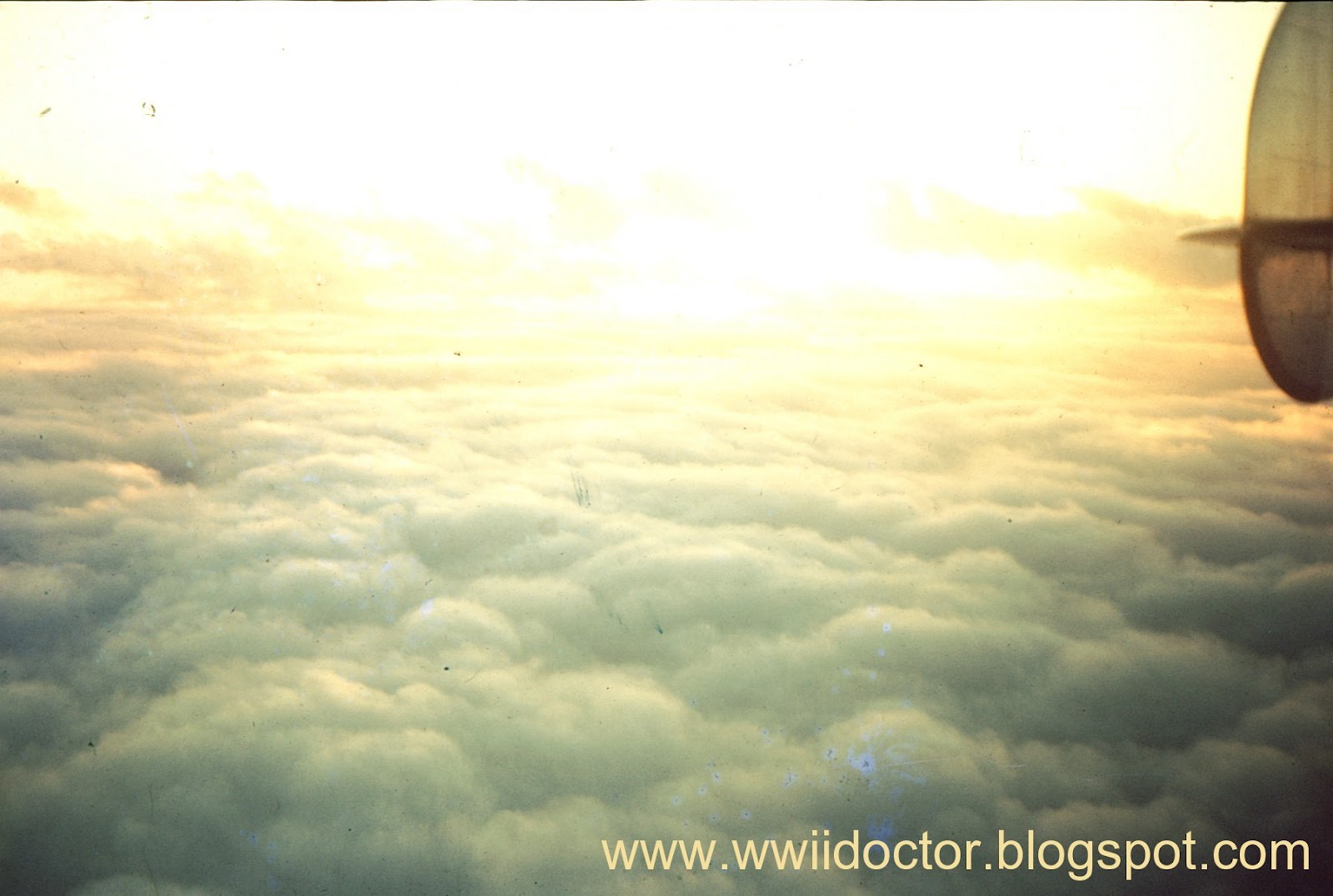
Sunrise above the clouds, winging their way
 back to Rockhampton
      I had the porter call me at 3:15 [A.M.]. I was to be picked up at 3:45 but the Aussie woman driver picked up 3 others first, and got me at 4:10. Out to the field. Weighed in on the U.S. scales at 147 and on the Aussie ones at 150, 11 pounds luggage. Coffee and donuts at the Red Cross! The Ansett (commercial line) plane was a dandy - 10 place Lockheed, 2 pilots. We had only 5 and the pilots. It was 5:10 when we took off, still quite dark. We climbed gradually thru 2 layers of clouds to (I guess) about 7500 feet. It was beautiful to watch the sun come up, just like fairlyland. The clouds were scattered and not solid so we had glimses of the ground. 
     2 Col.'s of the Dental Corps were on the plane - Shuttleworth (who knew 92nd from the desert) and Snyder! The Fitzroy River certainly breaks up into a maze of passages on reaching the river [ocean?], and the tide water has innumerable criss crossing channels for miles along there. We landed at 7:40 - 2 hours 25 minutes. Nice soft seats, less engine noise - lots of fun! An Aussie female driver met us and took the Col.'s to the Criterion and dumped me out since her duty period was over! I could have called for a ride, but I thumbed one. When I returned Iwa [?] had a fit because I didn't bring back the restraining sheets. I was lucky to get even a receipt! So ended my air trip - lots of fun. If Beth could have been in Brisbane with me, I'd have been happy!